Showing posts with label mathematics. Show all posts

Tuesday, June 19, 2018

High-School Algebra: Our Executive-Type Middle-Schoolers

I have been teaching college mathematics for many years, and quit recently.  (Well, I called it retirement, but actually it was quitting.)  But I was getting a little bored, and decided to put up a video on YouTube to show an alternative method for doing something students learn in Calculus 2.

Well, I just finished it, and it involved quite a bit of algebra.  And I was wondering just how much detailed explanation would need to accompany the slides, to make the calculations comprehensible to a typical viewer.  For instance, I had to compare the results we would have gotten, with an authoritative result from WolframAlpha, a program we used at our school, until it became a little too demanding for our majors, and some of our faculty!  (Our school is still ahead of the curve, but depending on how much incoming faculty at schools like ours like to trade interesting content for easier, more entertaining content, we might end up behind the curve.  Read on.)  The two answers are the same, except for a little algebra.  Here is a screen capture of the last slide:
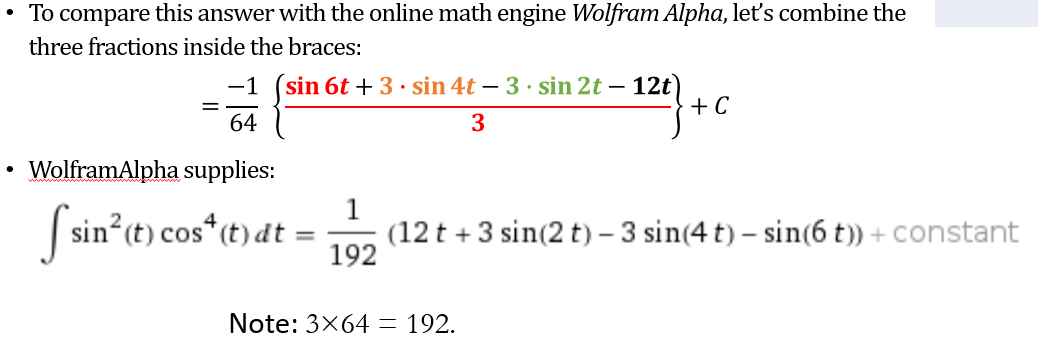
Anticipating the question:  "What has 192 got to do with anything?", I added the little note at the bottom.

Now, I expect my readers to be divided pretty much in half between (a) those who think "It is perfectly clear that the answers were the same," and (b) those who think, "Well, that may be the case, but an explanation is in order, after all, these are just kids; heck I could not have figured that out, and I'm pretty good at math!"

Part of the problem is that many sorts of employers, both businesses and the government (or as we say in economics circles: the Private Sector and the Public Sector) want their prospective hires to know calculus.  Among other things, this means that Calculus teachers have to deal with students now who suspect that they will never actually use Calculus in their chosen fields, and their suspicions are probably right.  Over the last several years, things have let up a little, but there was a time when even Pre-Med students needed to get a good grade in Calculus to get into Medical School.  Why is this?  I don't know, but I can guess.  And my guess would give you pause as to the motives of the Medical Education Industry.

Coming back to those algebraic formulas above, it boils down to whether or not two formulas which look roughly like
are equal.  This material is actually learned (in most schools, at least a decade ago) in Grade 8, in better school districts.  Obviously, there's nothing to be done if you happened to live in a school district in which most parents prefer that their kids get better grades than a rigorous mathematics training.  This is one of the major pairs of opposing forces that keep battling inside most parent's heads.  The kid is hamstrung unless its grades are good, but the kid will struggle to even understand its math classes unless it knows its algebra really well.  Looking up these algebra facts just can't be done in real time; they have to be at the tips of the child's fingers.

In addition to school training, there is the problem of discipline.  Fractions are an obnoxious kind of mathematical thing; most kids prefer to use decimals.  Fractions are exact, while decimals are usually approximations, and for most purposes, including Chemistry, Biology, Physics, Economics, Political Science, Business, Engineering and Statistics, approximations are good enough.  (They have to be good approximations.)  So why do math teachers keep plugging these fractions?

The fractions are more logically useful.  Before the decimal approximation can be applied, the formula is developed using fractions; the relationships between various quantities are given using fractions.  Once the number you're interested in is narrowed down in terms of fractions, it can be approximated using decimals.  If anyone takes a nap while the fractions are being thrown around, and wakes up just when the calculator is needed, he or she will know a number, which may not be any use for the next problem, and will not know how it is arrived at.

This little post about fractions and elementary algebra describes only the tip of the iceberg.  Better minds than mine must address the problem that Indian and Chinese and Russian and Brazilian kids learn algebra a lot faster than American kids.  Their lives are tough enough that algebra is hardly something to complain about.  In contrast, for American kids, algebra is the worst kind of torture they have to face, so that for many men and women, algebra is the poster-boy for the unpleasant subjects they had to deal with in grade school, and which thankfully they did not need to suffer with in Adult Life.  If we keep up this level of intolerance to mathematics, kids might end up refusing to subtract, even if they reluctantly agree to occasionally add.  Think that's funny?  If Medical Schools keep up the mathematics requirements for admission, their numbers will fall, and we will find most of our medical professionals coming from overseas.  Which is not entirely a bad thing, I have to add.  On the other hand, if med schools relax the math requirements for admission, many citizens will harbor the (entirely unfounded) suspicion that medical professionals of the years after 2018 are not quite up to the standards we're accustomed to.

What the Monkey should have said is that There is no progress without some drudgery.

Arch

Saturday, December 6, 2008

Leonhard Euler: Mathematical Genius

It is strange, but true, that not a lot of people enjoy reading about mathematics, or doing pretty much anything with it. This post is aimed at the exceptions, and especially those who are on the edges, just becoming interested in the subject.

In the early 1700s, mathematics had just taken off like a jet plane, shortly to be more like a rocket. Newton and Leibniz had just invented Calculus, and Johann Bernoulli, a brilliant Swiss mathematician, had turned his mind to inspect everything that the theory could do, and had asked the big theoretical questions that would drive the engine of mathematical discovery in the next hundred years or so. It was an exciting time in which to be a mathematician.

William Dunham, of Muhlenberg University has made a particular study of Leonhard Euler, one of the greatest mathematicians of all time, born in Basel, and a protegee of the famous Bernoulli. In his book "The Master of Us All", Dunham describes some of the most accessible and interesting of the discoveries of Euler, making a point to underscore the intuitive methods Euler used, which though not acceptable as formal proof today, reveal the amazing mind of Euler.

To the layman, the idea of an infinite series might be a little strange. An infinite series is simply an addition of an infinite number of terms. Generally, a sum of infinitely many terms will produce an infinite number. However, if the numbers are very small, the sum could be finite. Such finite-valued "infinite sums" can be highly useful; many useful numbers can be approximated as "truncated"infinite series (infinite sums of which only a finite number of terms have been added; what is omitted is carefully calculated to be less than an acceptable error tolerance).

Consider the infinite sum 1/2 + 1/4 + 1/8 + 1/16 + .... With a little thought, it can be seen that this sum can never be greater than 1. As Zeno observed, if you walk half a mile, then walk half of the remaining half mile, and then half of that, and keep doing this, you'll never walk more than a mile. In the chart below, the blue bars represent the terms that we want to add up, and the pink bars represent the running subtotals. As you can see, the subtotals approach 1, and rise no higher.


In contrast, the series 1 + 1/2 + 1/3 + 1/4 + ... can be seen to be infinite. Observe the sums climbing steadily. (They do slow down, but not enough to make the sums approach a finite value.)


It is harder to show, but the series 1 + 1/4 + 1/9 + 1/16 + ... , (the sum of the reciprocals of the square numbers, 1, 4, 9, 16, 25, ...) is a finite sum. (See below. The sum is about 1.64.) The story of how Euler showed that it adds up to the unlikely value of (Pi)^2/6 (Pi squared divided by 6) is entertainingly recounted by Dunham in his wonderful book. This derivation is characteristically Eulerian!

The discovery above is topped by a result that connects an infinite series consisting of the reciprocals of the squares of the positive integers on the left, with an infinite product of factors of the form (1 - 1/P^2) on the right:


Bill Dunham's book, beautifully written, combines stylish exposition with absolutely fascinating content. Euler, a contemporary of J.S.Bach, showed a similar brilliance and creativity to the musical genius, and both had similarly enormous influence over the development of their respective areas. Both had many children: Bach had 20, and Euler had 13, and in each case, only a handful lived to adulthood. Finally, both were afflicted with diseases of the eye. While Bach died at the age of 65, Euler lived to be nearly 80.

Arch

Final Jeopardy

Final Jeopardy
"Think" by Merv Griffin

The Classical Music Archives

The Classical Music Archives
One of the oldest music file depositories on the Web

Strongbad!

Strongbad!
A weekly cartoon clip, for all superhero wannabes, and the gals who love them.

My Blog List

Followers