Showing posts with label teaching. Show all posts

Thursday, October 10, 2013

Focus on Education: Diane Ravitch

.
I have no right to address this issue, because I’m reacting to a report of a book by Diane Ravitch (see here for a brief bio, and a summary of her latest ideas)  that I have not read. This author seems to be saying most of the things that I have tried to say, and has said them better, and has more information with which to support her points. Rather than state that she has said these things, (which she may have), I’m saying them for myself.
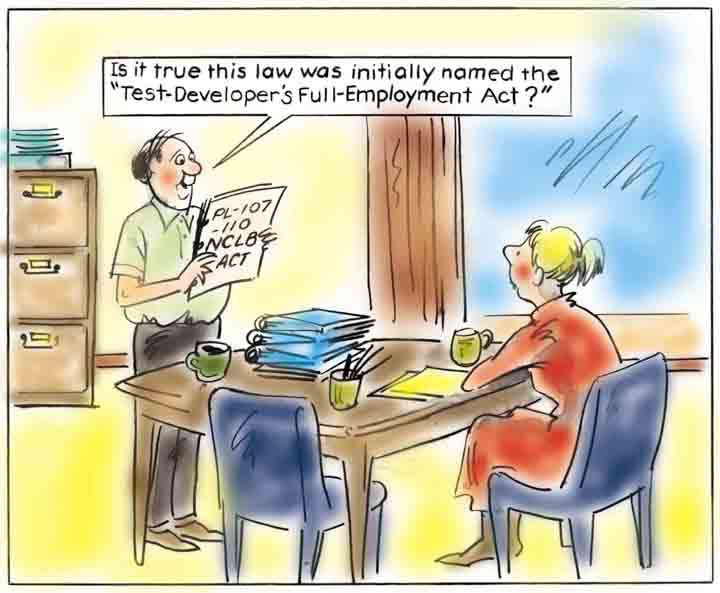
The furious testing that goes on is misguided. I’m not at all against tests; I think they allow students to know how good they are. But that’s all they should do; they should not be used for anything else. They should certainly not be used to assess teaching. It is unfortunate that there are no better ways to tell whether a teacher is doing his or her job than to assess his or her students —and in the fee-for-service atmosphere that we find at the present time, there doesn’t seem to be an alternative—there is nothing that can be done, as far as I can see. If tests are going to be administered, someone is sure to use them in a way that they find convenient. All over the world, it seems that tests are poisoning the water of education, and as tests become increasingly indispensable for establishing the value of people, other abuses inevitably come into play: private tutoring, available only to those that can afford it, and, I’m sure, someday corruption and bribery will not be far behind.
Teaching is a profession that seems to destroy those who take it up. The social climate is such that so much hangs on the outcome of education that everyone looks for a scapegoat, and the teacher is a natural one. Don’t be too surprised if very soon only the scum of the earth will take up teaching. No amount of marketing or PR will serve to persuade any but the most gullible into the trap of taking up teaching. You truly have to be naïve to want to submit to the humiliation of being a teacher in the United States of America, the land of the brave, and the home of the constant testing!

The effectively privatizing of education, towards which the US is being pushed, by commercial interests, obviously, will inevitably create economic stratification of education as much as there is stratification in other aspects of society. While society rebelled against racial segregation in the sixties, today segregation of all sorts is being encouraged by the conservative elements among us, and the very people who are aghast at the increase in the use of Spanish across America, and at the access that the underprivileged have for all sorts of goods and services, will prefer to have their children educated in an environment free of what are probably perceived as the marginal elements of society. The rush to embrace Charter Schools, Diane Ravitch seems to say, is just the desire to have minority-free classrooms in disguise. Even if such a motive is furthest from your mind, be careful: to have poverty and diversity hidden from your child’s eyes is not the best thing for your child.

I had forgotten what a broadening thing it was, to have a college education. Those of us who have had the privilege of schooling beyond the twelfth grade sometimes forget how different the world is as we see it, from how it must seem to those who only learn about the world outside through the distorting lens of the Evening News, or worse, Fox News. Or through telescopes from their bedrooms.  Some of the inexplicable attitudes of people like the former governor of Alaska become a little more understandable. The attitudes of conservative members of Congress who have actually had an education are truly inexplicable.

The main job of a teacher, as I see it, is to teach the student to understand and love the world, all of it, all that it has been, and all that it is now, and to delight in how things work (when they do work). But that will not happen, because it isn’t profitable.

I was recently made aware of several books that had titles something like: How Science Poisons Everything, in opposition to another book that said something like: God Isn’t So Great. It’s time someone wrote a book titled How Business Poisons Everything, or How the Profit Motive Destroys Everything We Hold Dear, Including Education, Society, Our Homes, Our Children, Our Government, And World Peace. So There.

[Added later]

AND ANOTHER THING.
We’re told that Diane Ravitch has come out against not only No Child Left Behind, but also Obama’s program and slogan: Race to the Top.  If you read Ms Ravitch’s bio, you learn that she was educated at Wellesley, an excellent, very selective East Coast college (no criticism there; I live on the East Coast myself) which was, until a few decades ago, a women-only institution.  If we go on the assumption that her elitist education had an impact on her thinking, we might begin to understand why she first supported clumsy initiatives like No Child Left Behind, and then abandoned them.

Any idealist who has received a good education knows that there is an amazing amount of things out there that would be even more amazing if people weren’t so dumb.  And certainly, ignorance is the greater part of dumbness.  So it isn’t surprising that anyone with any sort of heart who’s been to college wants to set out to change the world; and plans brimming with energy, like No Child Left Behind, promise to be almost the only thing that’s going to make any sort of difference in the monolithic monument to stupidity that US schools appear to be, from the outside.

The inside, too.  Except for a few cracks here and there, and a little intelligent erosion around the edges —and let us be grateful to the intelligent termites who have kept working at the pile of petrified crap for so long— the monument survives.

There is some suspicion that politicians in office are sort of divided on the issue of education.  It seems obvious that cynically, an ignorant electorate is to be desired, because they will believe anything.  But it is not easy to pile lies upon lies, because lies are harder to defend than the truth, and so there is something to be said for an intelligent, educated, well-informed electorate, which is able to knowledgeably judge what the issues are, and judge how well you have addressed them.  When it comes to competing with foreign technology, though, we have two options: import educated labor, or educate our own.  Neither option is easy, with folks being as lazy, and as hostile to all things non-American as they are!

It is not that the rest of us want our youth to remain ignorant.  It is just that the American approach had become: leave it to the professionals.  If they don’t fix it, sue them.  We forget that we can’t do that in every case, but we continue to do that, because it is the lazy thing to do.  I don’t know what Ms Ravitch advocates; there is no simple fix.  The road to good education is long, and it takes first raising a generation of young people who value education for its own sake, who must grow up to become teachers who value teaching because of their love of children and their hate of ignorance, and their faith in a better world, and become parents who are actually interested in what their kids are learning each day, and know the constraints under which their friends, the teachers, work.

I know.  I know.  It’ll never work.  Perhaps something like No Child Left Behind might be easier. . . every decade or so . . .

Arch
’

Sunday, March 22, 2009

What's Wrong with American Education?

. I was recently talking to some of my friends, and we were deploring the fact that our education system seemed so ineffective. Rather than simply plug my own views here, I thought I'd ask as many of my friends as would spare the time, to tell me what they thought the problems were. Unfortunately, only two of them responded. (Nobody likes writing assignments, right?) One of them wrote right back. "What education? I don't see any going on, to be honest," she said. She is not directly involved in education, and only sees its effect in the younger people with whom she works: "And where does some of the information and opinions given come from – does learning stop when you walk out of the classroom door in the summer? Were you given the freedom – or, did you demand the freedom – to question what you were taught? Did you challenge ideas, or did you blindly accept, because it was easier and took less energy?" Here is a summary of her assessment of the education that she's seeing:
  1. Poor language skills, writing skills, mechanics (spelling, punctuation)
  2. Eager acceptance of wild ideas; uncritical attitude towards information and opinions
  3. Religious interference with teaching science
  4. That external tests (Federal and State administered) steer the curriculum
  5. Too many students per teacher
  6. Poor preparation of teachers; teachers are poorly educated themselves, and propagate their ignorance.
  7. Guns and violence in the classrooms create an atmosphere unfriendly to learning
The second response was from a friend who was a teacher, who is battling their school principal, who is determined not to allow any sorts of enrichment activities. She writes: "The only way we can take out kids on any field trips is if we raise the money ourselves, so there has to be a fund raising component of the job as well as the teaching component. That's another thing wrong with American education, and maybe the most important one. I'm sure even from the beginning it was obvious that funding schools with local property taxes would only perpetuate the inequities of the society."
  1. Teachers (and Principals) are trained with a lot of education theory rather than actual education content. The theories are a matter of fashion, in this year, out the next. Substantive education on subject matter is considered unimportant.
  2. There are too many public-school principals who were athletic coaches, and not really academics in any way. (My own principal thinks that homework should not be given at all.)
  3. The only way I can teach the material is to make the kids stay after school and work with me, because they do not get that kind of reinforcement at home.
  4. The only way kids will get better at math is to do math. The principal does not get this.
  5. Teachers are responsible for fund-raising, for extra programs. This is not the case in richer school districts; money for extra programs is readily available there, obviously.
My own opinions:
  1. Education appears not to be a value in society; a diploma is.
  2. There is no national curriculum; state curricula vary widely, and often reflect extreme agendas.
  3. Teaching is not taken up by the best, since the profession is not respected. So the teaching profession is populated by an odd mixture of idealists and bumblers.
  4. Political pressure is applied not to embarrass poorly performing students, who are often minorities.
  5. Mathematics education is particularly weak, because many teachers have been badly taught as children themselves.
  6. Finally, there appears to be a common view that education is something that benefits me and my family. It is a community effort only for the sake of convenience, because I just don't have the money to start my own school.
Disparities in resources: As you can see, the causes of difficulties with education emerged to transcend cultural and social effects, and are actually political in nature. The education system is set up so that richer people live together, poorer people live together, and schools in the richer districts have better resources than schools in the poorer districts. Education as a value: Unlike in the Third World, where education is considered something useful in its own right, here it is seen as a minor stumbling-block. In big Corporations, for instance, it is the lower echelons that must be educated and trained to actually do the work. The higher-paying upper-echelon occupations require less education. The more a youngster realizes this, the less incentive he or she has to get an education, which dooms him or her to a middle-level occupation. Furthermore, students are often cheered up by the family if they come home with bad grades, by telling them that good grades are not important after all. In the pursuit of self-esteem, (academic) success in school takes a back seat. In addition, teachers are vilified for giving the bad grades in the first place. Support at home: In the poorest inner-city homes, students understandably find little support for doing homework, etc. Some of the most wonderful inner-city youth projects include spaces for students to simply sit and do homework quietly. But even in middle-class homes in the suburbs, there is often little support for students with their homework. Some parents are so exhausted when they return from work that they simply cannot help. Some parents do not know the material. Some students are overwhelmed with extra-curricular activities that trump the homework. Most of all, doing homework seriously is simply not a priority in many homes. Education as a social activity: There are two radically opposed points of view concerning education. View 1: I educate my child as well as I can, because I want him or her to have the edge when competing with others for employment. View 2: I educate the entire younger generation, because among these kids might be someone who finds a cure for cancer (or finds a way that I can own and operate a dozen cars without harming the environment.) It's not that those of us who hold View 2 have less faith in our offspring. I firmly believe that those individuals who are more evolved can see that community-orientedness is a winning evolutionary strategy, whereas individualism is not. Education does enable solving the problems of society, but it also makes life richer, makes work more meaningful, and makes leisure more interesting. Being interested in a better life for the children of one's neighbors to the degree of being willing to fund it is an enlightened condition to be in. In these days of economic hardship, only this attitude will help us survive with sanity and optimism intact. Archimedes

Final Jeopardy

Final Jeopardy
"Think" by Merv Griffin

The Classical Music Archives

The Classical Music Archives
One of the oldest music file depositories on the Web

Strongbad!

Strongbad!
A weekly cartoon clip, for all superhero wannabes, and the gals who love them.

My Blog List

Followers