Wednesday, July 31, 2019

Debate 2019 Part 2, Day 1

Well, fellow citizens, we watched last night's debate, and we were probably just as underwhelmed as anyone else.  But for the most part, the candidates were consistent.  There was one new candidate, Steve Bullock, who revealed the fact that he had not been on stage for the previous debate, because what the candidates say is strongly affected by how they remember their previous performance!

I don't want to appear snide, or patronizing, or cynical, but most voters will agree that what the candidates say during debates may not, and probably will not, relate closely to what they will do if they're elected.  (Of course, in the case of candidates known to be deceitful--and we won't mention names--you just know that  they don't have a clue as to how to go about doing anything, and they never had any intention of doing it anyway! Well, no reason to get discouraged . . .)

There are good reasons for this.
1. Collaboration.  Most of the difficult things they want to do needs support from Congress; and what Congress wants to do and what the president promises have to be merged and forged into what actually gets done.  Of course, a president with a melodramatic style will demand that his or her vision be put into action first, and then pretend to reluctantly compromise, claiming that it is a sign of their willingness to be flexible.
2. Flexibility.  We want to hope that the president is intelligent, and can learn from the best ideas of others.  This presentation of themselves as coming to the debates with all their program fully formed, like Venus rising from the waves, is a concession to the worst aspects of media coverage.  The media is usually harsh with any candidate who appears to show that they don't know the details of their plans.  Some of the most weak-minded candidates did take the time to learn the details of their own plans, but then clung to those details so tenaciously that we must suspect that they did not realize that they were details.  And of course you can't change your mind about any detail, because that would be Flip-Flopping, another modern evil invented and enjoyed by the most mediocre of news personalities.
3. The next point is rather a sad one.  Marketing.  None of the candidates can do anything unless they're elected, and manage to defeat the incumbent (whose name eludes me for the moment).  Therefore, they must declare policies that are a hybrid between what they want personally (which is ultimately only of secondary importance), what their constituents want (which is important), and what undecided voters want, which is actually pretty important as well.  So there are all sorts of calculations going on.  These are the calculations that they teach you in Politics School; it is called political science, and since its birth, the political calculations that the average citizen can make have become a lot more complicated.  We spend a lot of time second-guessing every candidate, and reading between the lines of what they say; was that a marketing statement?

Something that pleased me was that at least a couple of the candidates recognized that the entire row of debaters last night were actually on the same page on most of the issues.  There are transcripts that you can read to get the details; I'm only trying to present general observations, because in my view general observations are important.

4.  There was fair agreement that border security was necessary.  Even if a candidate was of the opinion that an open border would be nice, it is not practical.  In the best of all worlds, there would be no borders; we know that.  But since we cannot share all government services with our pals in the southern countries, we have to have a border.  This is reality; it is also marketing, because the Democrats have been rapped on the knuckles for giving the impression that they really wanted an open border.  There was some disagreement about other aspects of immigration, and rightly so; Immigration is one of the most difficult problems to get our heads around, given that out of the wealth at the disposal of the government with which to provide services to the people, a large proportion is tied up with entities that are controlled by the most wealthy.  There just isn't enough money to waste on unworthy illegal immigrants.

5.  There was agreement that Universal Health Care was necessary.  The more conservative of the candidates wanted that to be reached within so many years; others wanted it right away.  There was considerably less agreement on whether private insurance would be abolished.  Some candidates, who have studied the problem personally, are more inclined to deal harshly with the Health Insurance Industry, to the point of killing it dead.  This seems unnecessarily extreme, and would probably be regarded as constitutionally impossible.

6.  There was agreement that the most wealthy people and corporations had to pay their fair share of taxes.  Even one of the most wealthy candidates on stage agreed that this was reasonable.  However, he seemed reluctant to support the inheritance tax.

There seemed insufficient talk about the so-called downstream races that are so important this election year.  If the Democrats gain a majority in both houses, then un-veto-able legislation could be contemplated.  There is a lot of--well-earned--hostility towards Mitch McConnell, and great determination to unseat him.  The same goes for Susan Collins of Maine, and Martha McSally of Arizona.  If Democrats win all three seats, the Senate will effectively have a bare Republican majority (since the Vice President is the chair of the Senate, and has a casting vote).

There was also little talk about Climate Change.  Many of the candidates said at the first debate that rejoining the Paris Accords would be their first order of business.  But I get the impression that candidates are fearful about backlash from talking about environmental issues.  Let's face it: with an ignorant population, disaster is almost inevitable.  With half the population distrustful of science, and the other half hunkering down to pray, things are looking bleak.  But Be of Good Cheer, as Charles Schultz famously said.

The bottom line is that, in fact, I would be satisfied for anyone on the stage to be the Democrat nominee.  If the vote were to go on straight party lines, then the Democrats would win if enough of them came out to vote.  Elizabeth Warren kept making that point: enough people would come out to vote only if they were voting on a platform of policies that was exciting and imaginative.  On the other hand, there are more mature voters who would only be comfortable with "more of same", which is something only aging Democrats want.  Aging Republicans, on the other hand, voted for Trump because they did not want more of same; it is difficult to guess what they will do this time.

Arch

Friday, July 26, 2019

The Mueller Hearings

I do not have any special insights into, or additional information about, the Mueller hearings; to paraphrase some baseball hero: All I know is what I see on TV, and read on the Internet.
Mueller looked confused, and stumbled.  Apparently he was a lot sharper when he was younger--which strikes me as amazing--and was a lot quicker to respond.  This investigation alone, and its implications, would have aged anyone.  We're not accustomed to thinking about the White House as a hotbed of anarchy, even if it has been often the source of serious wrongdoing, crime, or even misbehavior.  The way things stand now, Mueller must have felt very exposed for a couple of years.  Compared with the shenanigans of Kenneth Starr, Mueller's behavior was the epitome of rectitude.  (But what do I know?)
Does Mueller's team have the ability to totally exonerate?  This sounds like a good point; in criminal law, one can convict--in which case, there has been no exoneration at all--or one can not convict--in which case there has been neither total conviction, nor total--what's the word?--exculpation.  The word exoneration is being used here in a colloquial sense, and one wonders whether it should have found its way into the report.  In response to the Administration's crowing about 'No Collusion,' etc, perhaps it was put there to make it clear that ongoing investigations could still yield some damning conclusions, for a later, more appropriate time.
Russian Interference in Election 2016.  Mueller was explicit in stating that there had been systematic efforts--largely successful--to sway voters before the election, and direct interference by means of hacking into Ms. Clinton's email account, and the Democratic National Convention computers, etc.  All the hacking is criminal, and all the efforts put into social media subversion probably comes close to being criminal, but to my eyes, it seems just glorified propaganda.  Since we Americans exist in an atmosphere of aggressive marketing (which is close to the President's idea of Fake News), we are both more susceptible to swallowing propaganda than the Russians themselves, but we're also inured to marketing in some ways.
It seems to me that the Republican strategy of restricting polling access was arguably a more direct and significant influence on the election outcome than Russian fiddling with facebook and twitter.  It is pathetic to point the finger at how much of an effect the Russians had on feeble-minded Pennsylvanians and their beliefs; Pennsylvanian conservatives absolutely rejoice in the feeblemindedness of their constituents.
Distraction.  By now, most of us are well aware of the principal Trump (and New Alt-Right) technique of distraction.  The onslaught of polemic from Trump and company is often stepped up when they are about to quietly take some very deliberate action to do something terrible.  At present, what they're trying to do is to win the 2020 election, to get done all sorts of unfinished business having to do with supreme court justices, appointing other federal judges, more legislation to benefit the wealthy, and big business, and giving away access to National Parks, etc.  Health Care and Immigration are only distractions, at this stage.  There are some diehard conservatives who keep those topics in the forefront, but the Republicans just can't bring themselves to put in the work it would take to replace the ACA (a.k.a. 'Obamacare') with anything that the people would like, and the insurance companies would like.  Immigration is even more difficult, and almost anything they try will result in howls of protest, from many among the Republicans as well as outside the GOP.
Another thing Republicans (and their Alt-Right Running Dogs) want, is for the Democrats to fight among themselves and select an nonviable nominee.  But I personally don't think steering the nomination towards someone who is deemed to have winnability is something we could live with (though it certainly looks as if the candidates themselves are making winnability calculations that are alarmingly cynical).  However, choosing the candidate of whom Trump seems most afraid of is surrendering more power to Trump than is comfortable to me.  He isn't intelligent, but he is tricky.
In conclusion, I do think Impeachment might be the right thing to do, as Robert Reich says; but beginning Impeachment proceedings could send a lot of lazy Republicans to the polls, who might otherwise be more interested in swilling beer and hunting deer, and so on (just kidding; they're probably wonderful people working ordinary jobs and drinking diet Coke, like everyone else).  This election, like most others, will be determined by who stays home.  And also by how successful the GOP is in discouraging minority voters.  The GOP never minds what minorities do actually--to paraphrase Professor Higgins in My Fair Lady--as long as they don't vote.
A Few Thoughts that Have Nothing To Do With the Mueller Report
I'm sorry to see the negativity that surrounded Beto O'Rourke's First Debate performance.  He seemed to be very careful in his statements, but that caution came across as hesitation.  If he settled down, and became quicker on his feet, he would have been a great candidate, though the tide of Democrat opinion seems to be to nominate a female / minority / young candidate.  Beto is certainly young, but . . .
Perhaps it's a little too early for this, but the success of any future Democrat presidency will not be dependent on the know-how and agenda of a single man or woman.  I must be a collaboration; something that the GOP cannot do.  There has to be a team, the members of which must work like dogs to repair the economy (though in statistical terms, the economy is performing in such a way that it gives Wall Street daily--thrills--shall we say).  Bear in mind that there are some extremely wealthy people who actually advocate higher taxes for upper-income individuals and corporations.  My belief is that these people know that the US infrastructure is sadly lagging behind, and the government can support repairing infrastructure and extending it and developing it only if the tax dollars are available.
The Green New Deal has a lot of window-dressing, but most definitely environmental action can no longer be kicked down the road.  A president who is good for the US will have to be someone persuasive enough to convince the people to adopt at least a few austerity measures.  I worry about water quality.  I worry about education.  I worry about deforestation.  I worry about the politics of Central America, and the opportunists, hardliners and crooks (not all the same people) who tend to snatch power there, sometimes with US clandestine help.  A huge deal of talent will have to be brought to bear on the problems that have been deferred for the last several years, and more that have been actually caused in the last several years.  I worry about plastic waste, but I fear that contracts might be taken out on anyone who brings that up, from both parties.

Okay; I need to go eat some oatmeal; we all need to keep healthy and sane, and tackle problems a few at a time, and be little Eveready Bunnies for the foreseeable future.

Arch

Tuesday, July 23, 2019

Being a Leader of Society; Being a Public Personality; Being a Citizen

I guess FaceBook has come to stay; despite everything I hate about FaceBook—and I wish someone will invent a substitute for it; I don't mind paying a nominal fee to have something like FaceBook without the oppressive disadvantages—it looks as though I can't stay away from it. 
No, this post is not about FaceBook!
Leonard Bernstein, c. 1950
(On FaceBook,) I 'Liked' the page of Leonard Bernstein, a personality well known to music lovers, and many others of a certain era.  Periodically, the page posts a statement that Bernstein has made on some subject or other; sometimes responding to topical issues, other times simply inspired by whatever moves the person or persons who own that page.  (Obviously not Mr. Bernstein himself; he's dead.)  And it struck me that Bernstein never made any statement with which I disagreed.
No, this post is not about Leonard Bernstein, either, though he was an amazing, admirable person.  As you probably know, music is one of my major interests, and I have lots of opinions about it.  But, once you get to know Bernstein, about Bernstein, you are struck by the breadth of music that Bernstein liked, and appreciated, and was anxious to popularize.  I mean, there were a few sorts of music that he did not particularly like, but they were vastly in the minority.
What Bernstein commented on was essentially about being a human being.  About being someone who lived on this planet.  About knowing all the wonderful things that there are on this planet, (and out of it, if it comes to that,) appreciating them, and loving them, and bringing them to the attention of everyone who had a moment to spare.  (Bernstein was not unique; Carl Sagan is another one, and arguably Neil Degrasse Tyson is yet another, with perhaps a smaller set of interests on which he comments.)
I have often written about my belief that a college education is about knowing what there is in the world that we should care about, and be interested in.  Some people prefer not to know.  If it isn't mine, then what do I care?  This is a defensive posture; it avoids the pain of worrying about things over which you don't have direct control.  But it detracts from that thread of concern that connects you to the world, that you need to make sense of what you see in the news; to talk to people whom you meet, to make sense of the motives of others; to reach out to those with common concerns, in order to make joint efforts to solve problems.  A college education is also about focusing in on matters about which you care greatly, to train to specialize on that area, with a view to working in a field that interests you.  (But we know that many go to college purely to be qualified to get a high-paying job, even if they don't have time to learn very much about the qualifications for that job the energy or the inclination to pursue those subjects to the necessary depth.)
The reason that the emphasis has changed from connection to the world to getting a high-paying job is because employment is steered today by businesses---or employers of which the majority are businesses---and hiring practices are subject to maximizing profits and minimizing costs.  In fact, there is lots of money to go round. But the competition for financial resources is so fierce among the most wealthy that it appears to ordinary folks like us that there is very little money to spare.  Everyone's attention is so completely on money, because for many students, there is great doubt whether they will be able to earn enough money to have a reasonable lifestyle, that nobody talks about falling in love with our planet and its people.  It only comes up occasionally, in a graduation address, and nobody actually listens.  To be honest, a living wage, or a comfortable wage is important before we can stop being drudges, and are able to free our minds to think.  But you see all around you, people who are kept from being free to think, because they were either denied the opportunity to attend college, or attended college as if it were a vocational school.
Because it is no longer feasible to leave it to high-school teachers and college professors to deliver basic lessons on universal values: the conservation of cultural and Art treasures, and knowledge of history; of natural resources; protection of valued ways of life; it is up to parents to take up the slack.  Those of us who were lucky enough to have been told about the treasures of the world, we're going to have an easier time of it.  For the rest of us, there are numerous programs on TV: The National Geographic (which could be weaponized by Murdoch any day now; for the moment it seems politically neutral); the Discovery Channel (I don't really know anything about it), and so on.  We have to be critical, because soon these channels might be dispensing absolute crapola.
Unfortunately for everybody, there are not many public models for young people to emulate.  One has to look very hard to identify a public personage who demonstrates the properties of caring for others, for valuing the cultures of other lands; for appreciating the Arts.  This is very painful.  In the parable of the Talents, Jesus is reported to have said words to the effect that from those to whom much is given, much is expected.  Unfortunately again, the culture of the most affluent in the nation seems to go in the direction of effectively saying that they didn't get where they are by being expected to give much.  Ironically they talk about makers and takers, but it is they who take.  We cannot expect much charity from them, and we cannot expect much leadership from them, and we cannot expect much polite speech, and we cannot expect intelligence.  We can only expect them to take mean advantage of any weak opponent; that's how they make their money—with a few notable exceptions.
Well, I had much more to say, but it has fled my mind.  Perhaps it is just as well; my blog posts often tend to ramble off topic.  This time, it has just stalled!  The skills needed to be a citizen are actually learned in high school: mathematical, statistical, logical, language skills.  High schools may not be as efficient in teaching these skills as they once were, but I get the impression that teachers still convey these ideas fairly well.  It is impossible to possess these skills, and not convey them to students of an appropriate age.
Arch

Friday, July 12, 2019

A Mid-Life Crisis That David Brooks Turned Into Gold

First, watch this, and I'll eventually give my thoughts on it!  David Brooks
By the way, I didn't mean gold in the sense of money; I meant valuable insights for us.

(For those of you still wondering whether it is worth spending your precious time watching this TED talk by David Brooks, here's a little more information!  (I know, I know: people have no clue how busy you are.  Idiots, all of them.)   David is the conservative counterpart to the liberal voice of Mark Shields, in the reflection / opinion portion of PBS News Hour, with Judy Woodruff.  Just the fact that David Brooks has been selected for this job to some degree indicates that he is a moderate, and that he is at least capable of civil and rational speech, and of reasonable reactions to the news of the day.  Among conservative voices, today, there is almost no other voice to which liberals listen to on an ongoing basis.)

Monday, July 1, 2019

A Very Simple Instance of Control Logic

My latest idea for a blog post might get some readers interested, and others annoyed!
I'm going to describe how I think a humble (old-time) clothes-dryer works, and then I'm going to Google that question, and see how far off I am!
The whole idea of control systems---temperature control systems, for example---is very clever, and over several decades, engineers who design these systems have got them refined really nicely, and it's a lot of fun to learn about.  (While we're doing it, I can show you how this sort of thing is represented using very traditional computer code.  Computer code is a lot of fun, and little kids are beginning to learn it, at school, or at home.)

Your Clothes-Dryer
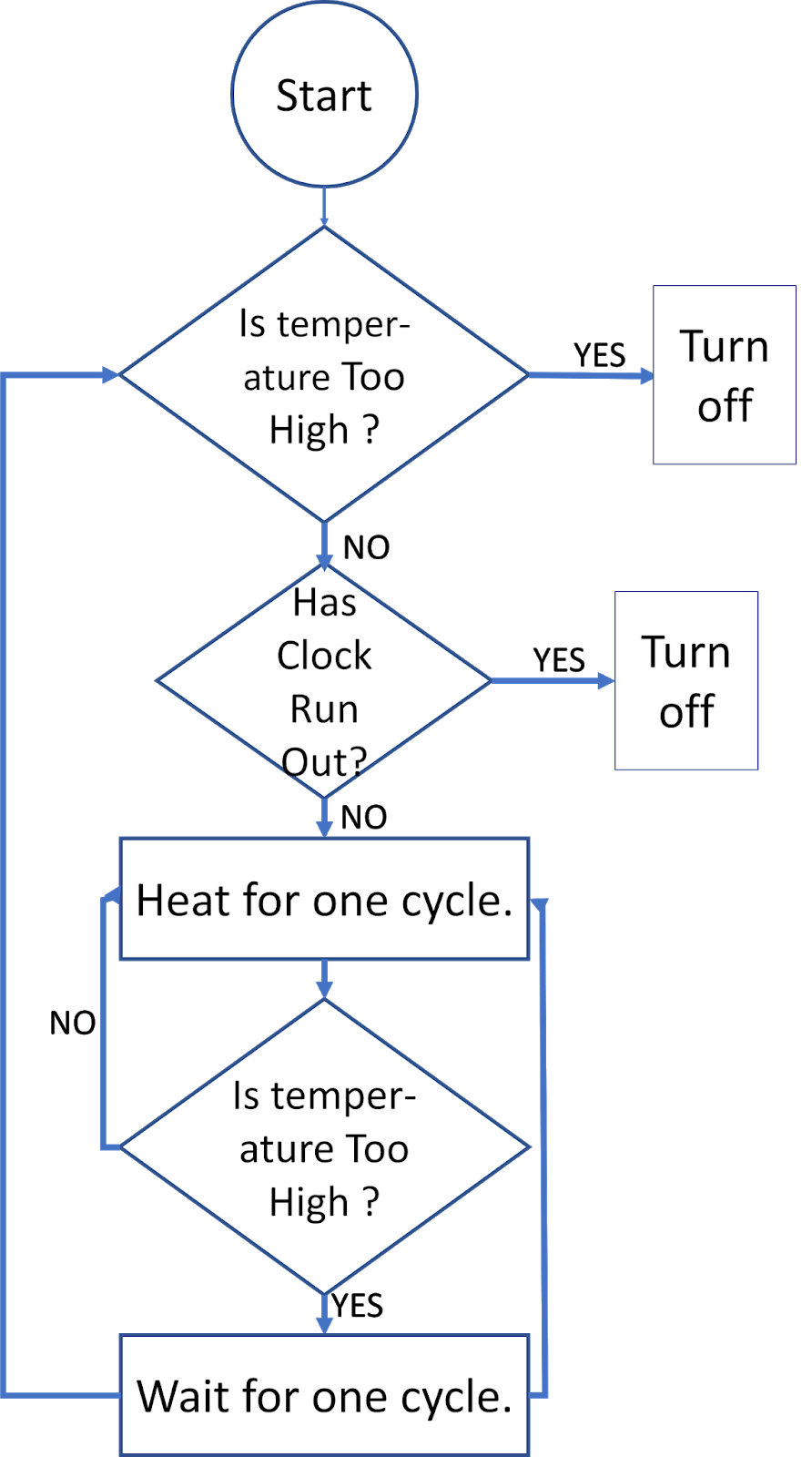
(1) You put your damp clothes in.  Avoid putting actually wet clothes; unless you have items that are very delicate indeed, it is a good idea to run your clothes through the spin-dryer a second time, especially if you have jeans, or towels, or other really heavy items.  There are two clocks.  One is the timer you set, for how long you want your clothes dried.  The other has to do with a little internal timer, just so that each step goes for a minute, or whatever.
You turn the Dryer ON.
(2) The temperature starts to rise.  The Dryer waits a measured amount of time.
(3) Here we have a branching step.  The Dryer checks the temperature.
(4a) IF the temperature is below the cutoff temperature, the Dryer heats again, for a measured amount of time.
(4b) On the other hand, IF the temperature is at or above the cutoff, the Dryer stops heating, and waits a measured amount of time, and runs its little timer thing (clock).  If there's no time left on the clock, the Dryer powers off.
(5) Dryer checks the temperature again.
(6a) IF temperature is below the cutoff, Dryer heats again, for a measured amount of time, but does not run the clock.
(6b) If temperature is at, or above, the cutoff, Dryer stops heating, and runs the clock.  If there's no time left, Dryer powers off.

So that's essentially it!  As you can see, steps 3 and 5 are actually identical, and steps (4a) and (4b) are identical with (6a) and (6b).  Quite honestly, most people who have a dryer have probably guessed that this is the program of the thing.
The important detail to remember is that when the heating cycle is going on, the clock is paused.  The clock only runs when the clothes are not being heated.
Explanation
What we really want to know is how dry the clothes are.  But dryness is difficult to measure directly.  Here, the dryer does something very clever; it depends on the idea of latent heat.  Water needs some energy (heat) to evaporate; while it is being evaporated, its temperature does not rise.
When the clothes are heated, if the clothes do not get hotter, this means that there is water, and more heating will be good, the clothes will not burn.
When the clothes are heated, if the clothes do get hotter, it's time to stop, or the clothes will get scorched.
To summarize, the dryer keeps heating the clothes (for measured periods of time) only as long as the temperature drops at the end of the cycle.  When the temperature rises at the end of a cycle, the heat is switched off, and the timer starts counting down.  If you've set the 'Dryness Level' to be very dry, the Dryer keeps returning to the heating cycle, and sees whether a little heating is received without overheating the clothes.  This can easily happen; the surface moisture of a towel, or a pair of jeans can dry off, but the moisture in the inner layers with diffuse out, and the item will behave again like a damp fabric.  So given that your Dryer is not going to use X-rays of some chemical magic to analyze your clothes, it's up to you to set the Dryer to go for longer if you have heavy, dense fabrics, and to go for less time, and use lower cutoff temperatures, if you have delicate fabrics that should dry quickly.
Now: I have to Google this question: how does the control on my dryer work?

Back From Google
Well, that was disappointing; all the articles were packed with information such as 'How the temperature limiter switch works', and 'What to do if your dryer won't start.'  A lot of the self-help information on the Web has been put there by people who are trouble-shooters, and not those who are merely curious; or people who think that the mechanism is so obvious that it doesn't need further elaboration!

The diagram at right, called a flow-of-control chart, or just a flowchart, shows visually how the control branches when the various sensors (actually, just a temperature sensor, and of course, the clock(s)) make the logical system ask itself questions.  In this version, the control starts off with a couple of checks, one just for safety, and the other to simplify one of the loops.
Arch

Friday, June 28, 2019

The Democrat First Primary Debate, Part 2, Thursday, 2019-06-27

The candidates for this second round (of the first debate) were:
Marianne
Williamson
(Author, and spiritual guru)
John
Hickenlooper
(former Colorado Governor)
Andrew
Yang
(former Corporate executive)
Pete
Buttigieg
(Mayor of South Bend, Indiana)
Joe
Biden
(former Vice President, with Obama)
Bernie
Sanders
(Senator for Vermont)
Kamala
Harris
(Senator for California)
Kirsten
Gillibrand
(Senator for New York)
Michael
Bennett
(Senator for Colorado)
Eric
Swalwell
(California Congressman)
Marianne Williamson:  Almost all of what Ms. Williamson said was sensible and rational, even if out of place in a presidential debate.  Her closing statement was that she would counter Trump's strategy of mobilizing fear for political purposes, with love.  At the risk of discrediting myself, I think this should really be what we try to do, but obviously, with more conventional rhetoric!  To my great satisfaction, I admit that both nights, the Democratic candidates were firm, sometimes fierce, but never harsh.  There is a significant chunk of our population that thinks that US politics and foreign policy should be conducted with testosterone and bullying.  But few of them are in the Democrat Party.
John Hickenlooper:  He came across as a centrist, who disagreed very little with the other candidates, and did not bring a lot that was different to the table.  He is evidently a geologist by training (?), and can be depended upon to support climate change initiatives.
Andrew Yang:  Yang had an interesting idea that every citizen should receive a $1000 / month income.  I'm not sure this is an idea whose time has come, and it is a not a bad one; it would be more palatable if it was linked to some service that was required.  But at this time, other problems need more attention.
Pete Buttigieg:  Made an excellent impression whenever he was called.  Interestingly, he did not support the steps toward universal health care supported by the others.
Joe Biden:  Did not present any distinctive policy ideas; his main feature seemed to be that he had a better chance to replace Trump than any of the others.  This panders to the increasing belief among those who are observing politics as complete outsiders, that style is more important than substance.  This may be true, in the noxious style environment that Trump has wielded, but on principle, it is too much of a concession of decadence to go along with.  We must cling to our belief that we have a rational electorate for at least a little longer.
Bernie Sanders:  Said nothing surprising.  But a new perception emerged last night; it seemed that a lot of his initiatives are fueled by a very personal anger toward the insurance industry, Wall Street, Big Oil, and so on.  It sometimes makes sense to become heated when condemning these entities, but a cool head when dealing with them is needed, in my humble opinion.  As I said in my previous post, we do need specifics when dealing with major initiatives with enormous consequences.
Kamala Harris:  Came across very well indeed.  She raised her hand when the entire row of candidates was asked who would support abolishing private health insurance; she is now evidently on board with Medicare For All, and certainly for Universal Health Care.  As someone said, people do not necessarily like their present insurance company; what they may like is their present health provider.  With Medicare, you can continue to get treatment from your preferred provider, who will find it simpler to bill Medicare.  When asked how she would pay for Medicare For All, she retorted that she appreciated the question.  But where was this question, she demanded, when Trump pushed through that massive tax cut in 2017?  Nobody seemed to worry about how to pay for it then!  This was essentially Jill Stein's position, when asked how she would pay for free college education.  (Stein went further; she said she would print more money.)
Kirsten Gillibrand:  was not very aggressive, and as a result, did not get a lot of talk time (a total of about 7.5 minutes, compared to the longest time of all the candidates of Joe Biden: 13.6 minutes).  But she emphasized that she participated with Bernie Sanders in some Medicare For All bill, which implemented a transition phase in which private health insurance still played a role (which many of the other candidates seemed to want.  Bernie himself chose not to mention this feature, which seems to indicate to me that he is driven by considerable anti-health-insurance-industry animus).  Kirsten G. soft-pedalled her interest in Equality of Women, Female Reproductive Rights, and other social justice issues, which received considerable applause.
Michael Bennett:  Seemed very centrist to me, except when he gave his opinions about Trump.  His views were in line with most of the other candidates (except for supporting private medical insurance, at least as an intermediate step).  His speech is a little difficult to understand.
Eric Swalwell:  Seemed frustrated at not being called upon more frequently.  His words about gun control, and assault weapons ban, were moving and persuasive.  Whatever happens, they will not be forgotten.

To summarize, I feel, with considerable surprise, that---with the exception of Andrew Yang, who has a good idea, but was not a persuasive speaker under debate stage conditions---the younger candidates did better than Bernie and Joe; and Elizabeth Warren did pretty well, and she may well end up the candidate who wins the nomination; but very clearly, the women did better than the men.
The women outshone the men for both parts of this first debate; something that the News companies are not shouting about because (A) they want Trump voted out, as do most of us, and (B) they think a woman is not electable, remembering 2016, perhaps, and being persuaded that misogyny is more deeply rooted in US politics than racism is!  For pure charisma, it would be difficult to beat Kamala Harris.  For sheer determination, and preparedness, and thoughtfulness, it would be hard to beat Kirsten Gillibrand, and Elizabeth Warren.  Amy Klobuchar has a strong list of achievements in the Senate, and seems to be able to support good initiatives from others in a thoughtful way.  Thulsi Gabbard and Marianne Williamson have good ideas, but don't appear to have the charisma that being a presidential candidate in the US seems to require.  This is unfortunate, because some people who do indeed have little or no charisma can fake it, and that's what we have now!  Trump's charisma seems to consist entirely of saying: "I'm very, very rich," which seems to gild him in the eyes of feeble-minded strangers to the world of rational thought.  The very idea that a presidential candidate would even consider pandering to the feeble-minded just makes me want to stay home on election day, which is utter foolishness, of course.

Passing the Torch
I'm trying to think what drives Joe Biden.  It could be sheer ambition; he ran once, for president, and was bullied off the candidacy, for having borrowed rhetoric from John Kennedy, or someone.  It was a more morally upright time in terms of intellectual property, I guess, before China lowered the bar.
It could be fear that no one else can defeat Trump, because the latter appeals to the unfortunates in the Midwest (and certainly in Pennsylvania, a place in which I had been proud to live at one time; I still live here, but I'm less proud of it), and the so-called Rust Belt.  It is not so much a belt as a sort of half-ripped-off patch on a pair of jeans.  Just as it is difficult to got one's head around out-of-work coal miner, it is equally tough to worry about those who helped to put together the metal monsters that cheerfully participate in this climate change we're seeing.  Americans are not about to give up their destructive personal transportation any time soon, which means that (non-unionized) workers in other countries earn money for the cars that we drive, which is what Trump parlays into votes.  It's all parlay and parlay, and no substance.
It could be---and I don't really believe this---that Joe does not think an ideas man can win the election (and this is what Marianne Williamson says too: we need the right tone rather than detailed plans).  Perhaps he thinks that these young firebrands---and the old firebrand---are likely to alienate voters, while Slick Joe can schmooze them, after which, all the good ideas can cut in.
It could be that those in his bubble are all of the previous generation, and they all desperately want to have a few more years of comfort, before they go on practically permanent pro environment austerity.  If nothing else, the Green New Deal raises the specter that, in order to delay and postpone environmental ragnarok, belts will have to be tightened.
I sincerely wish that those participating in these debates take a few hours to watch and listen to them.  Someday, a Democrat president will have to listen to Republican colleagues in Washington.  They should practice by listening to their fellow-candidates for a start.
Wouldn't it have been wonderful if one of the candidates had said the following in their closing statements?:
"Look, friends; for the purpose of this debate, I have made it look as though I have all the answers.  But it is actually a team effort.  I can provide leadership, but once we win this election, we must have a team to do the spadework; the mental and physical spadework.  We have watched, with horror, a president who has no idea how to put together a team, and a party that has no one to offer for that team, anyway.  If I win the nomination, and subsequently, the election, I would like all of you on my team.  If I lose the nomination, I would be delighted to be on your team, any one of you!"

Arch

Thursday, June 27, 2019

The Debates, Part 1 (Miami, Wednesday, 2019-06-26)

Last night, ten of the Democrate candidates for the Presidential election of 2020, had a face-off sponsored by (the DNC, of course, and) the NBC and MSNBC networks.  Some of the candidates were:
Bill DeBlasio (Mayor of NYC),
Tim Ryan (Ohio Congressman),
Julian Castro (Mayor of San Antonio, Texas, and former Congressman),
Cory Booker (Senator for NJ, and former Mayor of Newark),
Elizabeth Warren (Senator for Mass, and former Academic),
Beto O'Rourke (Former congressman from Texas),
Amy Klobuchar (Senator for Massachusetts),
Tulsi Gabbard (Former Representative from Hawaii),
Jay Inslee (Governor of Washington State), and
John Delaney (Former Representative from Maryland).
From the Economic point of view, the candidates were all pretty much on the same page.  The present economy---even before the GOP, and then Trump, tinkered with it to its detriment---was stacked against the typical citizen, and in favor of the most wealthy; the so-called 1%.
From the point of view of Health, there were small differences.  Some were adamant that only the public 'option' should be permitted; that is, Medicare for all; others said private insurance should be permitted.  But all of them supported universal coverage, which is the important thing.
Immigration was another issue where approaches differed; Julian Castro and a few others were adamant that the specific paragraph that permitted undocumented immigrant children to be separated from their parents should be struck down; others wanted a more holistic approach to reforming immigration.  But it was a mistake to try to debate such a technically tricky subject in real time.  Bill De Blasio made the important point that there was wide belief that immigrants were ruining the economic well-being of the US population.  Rather, he said, it was the large corporations that were responsible.
There seemed to be universal agreement on the subject of sensible gun control legislation.  The moderators tried to ask whether the government should try to remove certain sorts of guns from the hands of owners, but that idea did not get far.
Foreign policy was an issue that Tulsi Gabbard stressed, and there was agreement that the current administration had mishandled it, and continued to mishandle it.  Amy Klobuchar said that she had participated in the Obama agreement with Iran, which Trump abandoned.  She said they would negotiate something better if the chance arose once Trump was gone.
The problems with International Trade (read: tariffs), and much frustration on the economic burdens placed (by the Trump Administration) on our closest trade partners, namely Mexico and Canada.
Bill de Blasio, among several others, stressed the importance of paying attention to childhood education, and making Kindergarten free for all children.
Generally speaking, I was pleased that so many Democrats---not all of them experts, by any means; some of them were merely former Congressmen, which does not guarantee expert status in any department, though anyone running for President should have some expertise in most areas---I was pleased that so many of them were so much more knowledgeable about so many things than Trump has been.  Their attitudes were almost invariably appropriate, and their solutions were mostly quite sensible.  Tim Ryan seemed a little confused about Iraq and Afghanistan, and their relationship to 9/11, unforgivable in a Presidential candidate, really.  But the Bush Administration tried to confuse everyone about the facts, just so they could invade Iraq, with a view to stealing some of their oil.  Sad.

Day 2
I just took a break from watching this second part of the debate, and it seems to me as if it is not going as smoothly as did the first part.  The candidates seem a little more desperate, they seem more at odds with each other; the consensus on issues we saw yesterday seem absent.
Vice President Joe Biden, though he is the favorite of a lot of Democrats, seems an undesirable choice.  To me, he appears to have yesterday's answers to tomorrow's problems; he seems to be banking on his record of past achievements, which are certainly numerous, but I believe he does not have the ideas that will work for the present era.
There is a lot of Presidential Rhetoric flying around; a lot of podium thumping that really isn't necessary; the measured speeches of Pete Buttigieg is a pleasant relief from the emotionalism of even my favorite candidates, including Kamala Harris and Kirsten Gillibrand.  Even Bernie Sanders seems to be trying to finesse giving straight answers about ways and means by supplying abstract principles instead.
More to come.

Archie

Final Jeopardy

Final Jeopardy
"Think" by Merv Griffin

The Classical Music Archives

The Classical Music Archives
One of the oldest music file depositories on the Web

Strongbad!

Strongbad!
A weekly cartoon clip, for all superhero wannabes, and the gals who love them.

My Blog List

Followers