Friday, October 27, 2017

A Clear Study of the Split among the Democrats

a writer of whom I have not heard before: Pete Davis, has an interesting article in the Guardian, one for which we should be thankful.  Democrats of all shades of blue should try to read and understand this--luckily, it is not hard to understand.  Still, I'm going to try and paraphrase some of the most interesting points for slow readers out there.  (You know I love you, but face it: you don't read very difficult prose.)

Davis's article is about the fact that the Democrats are divided into two groups: the traditional Democrats, the Party Loyalists, who mostly voted for Clinton in 2016, whom he calls the Liberals; and the rebels, the Bernie followers, who were mostly disgusted with the 'business as usual' attitude of the Party Loyalists, and who kept asking 'But what are you going to do about **?'  He calls this group the Leftists, and so the article is about the Left / Liberal Divide.

The various ways in which the two groups contrast with each other makes fascinating reading.  For instance, the Liberals are concerned with the nuts and bolts of getting the Dems back into power, and resisting the evils of the Republican agenda.  The Leftists are more concerned with the finer issues-- which remain in the periphery, because of Liberal platform control--and moving them into the center of the conversation.  The Liberals are the ones who go door to door before an election, getting out the vote.  The Leftists are often furious with the party leadership by that time, and won't have anything to do with the election.  It goes without saying that unless there is some cooperation between the two groups, elections can't be won.

But, even before reading Pete Davis's prescription for a strategy for both groups to cooperate as needed, it is interesting to read the different characterizations of the two groups, and recognize their behavior.

The Liberals, for instance, he says tend to adopt Republican rhetoric.  Remember, rhetoric is patterns of speech that have a particular intention.  If we adopt the rhetoric of Republicans, we run the risk of supporting conservative intentions, and, as the Left declares, end up being pulled to the right.  Something Davis does not mention is that Bernie Sanders brought up the issue of income inequality, something which the Liberals have abandoned as being too "socialist" for America.

Another interesting point is about the implied strategy of the two groups.  To put it simply, the Liberals are all about winning; once they have won, they feel they would have some flexibility about how to proceed, to focus on various initiatives post-election.  For the Left, he says, the ideology comes first; if they cannot win the immediate election, they're resigned to waiting until the party has come round to their way of thinking.

How the Democrats respond to these conditions, whichever group they may happen to be in, will influence how things turn out.  And the Dem response, I believe, will depend on clearly understanding what this article explains.

Homework for you!

Arch

Wednesday, October 25, 2017

D. Trump and his Sleepover with the Republican Kids

In a recent article on HuffPost, reporter S. V. Date conjectured how members of the Republican core feel about how things are going.  Two members of the party had opposite views.  (If you want more Trump disasters to relish, read the article.)

White house staffers, Ms. Huckabee Sanders, and those close to Trump state that Trump is doing what his voters wanted from him, and they feel that "America is winning."  Obviously, we're all going to disagree about what sorts of things can be considered to be signs that America is winning; to us moderates and liberals, both America and the World seem to be losing fast.

Others, including senators Bob Corker, Jeff Flake and John McCain, are disgusted.  "Win what?" said someone; saying that the party is in such sad shape that they don't know how to proceed.

This brings us to a major issue about party politics.  In times past, each party needed to win in order to put through some legislation that was intended to point the country and the government in some direction.  But now, because of voter polarization, partisanship--the enthusiasm of a person for his or her party--has gone beyond any interest in the political principles or even the programmatic elements of the party's platform.  Many in both parties are more preoccupied with winning, rather than with what to do once they have won.  The only thing that Trump has succeeded, which is a major setback for liberals and for the nation, is appoint a supreme court judge who seems to be blindly loyal to conservative principles, and has little if any empathy for the concerns of common people.

National politics must stop being all about winning; this must be recognized by both parties.  The GOP, sad to say, despite their 8 years in power, has taken on a sort of victim mentality, focused on winning at all costs.  (In contrast, supporters of Bernie Sanders, to Bernie's own disappointment, have taken the view that it should be Bernie or bust, which led to this disaster.  What can we say?  They must have lots of people whom they can blame, and I hope that gives them comfort!  Any Democrat would have done infinitely better as President than Trump, and so would have a number of Republicans, but there's no point in crying over spilled candidates.)

[Added later:]
This post about Jeff Flake has some interesting follow-up questions for Jeff Flake and Bob Corker (the two Republican senators who announced that they will not run again with Trump in the presidency). Again, they articulate rather well many of the things I have been struggling to say.  A thought that stands out strongly about the obsession with winning is: "My reelection before America."

Arch

Tuesday, October 10, 2017

Are Pro-Hillary Speakers at the National Democratic Convention to Blame for Donald Trump?

First of all, for those of you who don't have the patience to read most of this post, the answer is: No.

Anyway, Sarah Silverman recently posted a video in which she sings about all that she's feeling about the current state of affairs: <https://www.facebook.com/ILYAmerica/videos/1870297263299554/>.  I was impressed; she encapsulated most of what was depressing me when I saw it.

This afternoon, I noticed a commenter had dismissed her, claiming that she had stabbed Bernie in the back at the national convention.

Listen bud (though this fellow probably doesn't read, and only watches videos; someone will have to make a video of this blog post for him.  He should love the president, who is supposedly firmly in the non-reading camp): you can only logically blame Sarah Silverman for the election of Trump if she was instrumental in sabotaging both the Democratic Candidates.  Now, let's talk about what you did.
  1. You were persuaded by Sarah Silverman, and reluctantly voted for Hillary Clinton.  In this case, I will humbly accept that you had a point.
  2. You were pissed off at her, and since you hated Ms. Clinton, you voted for Trump.  Well, let this be a lesson to you; voting out of anger puts you in an unpredictably messy position, and you only have yourself to blame.  It's tough to make us believe that Sarah Silverman was at fault, if there were more than a couple of hotheads like you!  Turn from your evil ways, and vote the GOP out at the earliest opportunity.
  3. You went ahead and wrote in Bernie Sanders.  I don't know if this was allowed where you vote, and if it was, what the conventional wisdom concerning such a vote could be.  My suspicion is that it was a wasted vote, and again you have only yourself to blame.  Blame Sarah Silverman if your mental health requires it, but if possible, cast a more useful vote next time.
  4. You stayed home.  I think this is the most likely case.  We can't take you seriously.
If Sarah Silverman had persuaded more Democrats last year, we would not be in this position.  I have my doubts about how effective a president Hillary Clinton would have been, but she would probably have been far more effective than what we have now.  Of course, we would have had the GOP hyperventilating, trying to get her convicted of security breaches, and so on; this is the traditional approach of the GOP.

I have to wonder whether the GOP got a majority in the House because of Bernie Sanders boys sulking.  That would be pathetic.  At any rate, unless there is protracted and relentless sulking among the Alt-Left, there is an excellent chance that the House will go Democrat next year, and the Senate will eke out a narrow Democrat majority, and they will filibuster the daylights out of every reasonable bill that they get sent.

Arch

Friday, October 6, 2017

A Summary of Government Environmental Rules and Procedures Attacked by the Current Administration

Here is an entire article on which rules and regulations that were set up under the Obama Administration have been tossed out by the Trump Administration, which are under threat, and which are being considered to be removed.  The source is the New York Times (a newspaper that Trump deplores).  We don't notice these things until they're gone.  It is good to be aware, so that we can take steps for our protection.  I'm only commenting on those whose effect on our lives might not be obvious.  I apologize if you feel insulted.

01.  Removed stronger flood standards for new Federal funded construction projects.
This is a matter of saving money in the long term by building carefully in the short term.  Building in a flood plane plain is asking for trouble, and not always for the obvious reason.  A major building in a flood plain makes the flooding worse for homes and businesses nearby.  My wife works for the government of a nearby rural county, and businesses absolutely hate flood-related building restrictions.  It costs more money to put together a project that satisfies flood rules, and they feel as if the engineers soak them for all they're worth.  [Nasty remarks about engineers removed.  My sources said that the business, and the government agencies that are anxious for economic development to proceed at the greatest possible speed, just by themselves are enough of a force to handicap cautious best practices proceedings.  "We just don't have the time to slow down to take careful precautions for floods."  We will have even less time to rebuild after floods.]

02.  Tossed out restrictions on an insecticide that the (Obama-era) Environment Protection Agency had classified as dangerous to developing fetuses.
Scott Pruitt has said 'It needs more study.'  Normally, if it is possibly harmful, we would ban the chemical while we study it.  But conservatives, who do not like taking the life of a fetus, do not mind taking the risk that its brain development would be hurt.  Is it that wealthy folks can invest in private water filtration systems, while poor folk who live near farms and field that might use these dangerous chemicals . . . Let's not forget Flint.  Lead and Chlorpyrifos are not the same, but some of the issues are the same.

05.  Revoked a rule that prevented coal companies from dumping mining debris into local streams.
This will raise more red flags to those of you who live in coal-mining country, such as we, than for most people.  The crap that comes out of coal mines are highly toxic.  Please do your own research; I hate the very thought of that stuff being put in streams.  The sight of water stained bright orange coming out of coal mines makes lots of people sick, and the smell makes you even sicker.  Bear in mind that the coal from these places kept people warm for centuries.  However thankful we are, it makes absolutely no sense to turn our back on safe practices that prevent poisoning the water that eventually flows into, for instance, the Chesapeake Bay.  Angry coal companies could take the position: screw the Chesapeake.  But only the Trump Administration would consider going along with them.

10.  Proposed the use of seismic air guns for gas and oil exploration in the Atlantic.  (The Obama Administration had refused permits to do this.)
These are loud sound blasts that map the ocean floor by tracing the sound waves that radiate from essentially a super loud air horn [which has been, I think, clamped to the ocean floor].  The loud noises [high-energy sound waves] can harm whales, fish, and turtles.  A bunch of whales with ruptured eardrums seems a small price to pay for lots of gas that we can keep burning, but each of us has to decided exactly how upset we are at this permission.

12.  Repealed an Obama-era rule regulating royalties for oil, gas and coal on government and tribal lands.
The Trumps have decided that these rules cause confusion and uncertainty. Remember that the poor gas companies have millions of lawyers. This is just another way to make sure that native tribes and the Federal Government do not get a reasonable royalty fee for the oil, gas or coal. Royalties are a percentage of the value of the material, a few cents per pound, just like musicians get a few cents each time their recordings are played (in a for-profit venue).

14, 22.  Relaxed the Environmental Review Process for Federal Infrastructure Projects.
This is worth understanding, though conservatives will probably not sympathize with it.  I only know about it because of my wife's work as a county planner.
When a large project is put forward for approval by the county, the plan must contain a chapter that says how the building project will deal with the environmental impact of the construction.  If there is a huge building with an enormous roof, how will the runoff water be dealt with without destroying the stream into which the gutters disgorge?  How will they prevent erosion with runoff from the driveways and parking lots?  If the project is to be build on top of a stream, or even an underground stream (there are such things) how will the building 'pad' be designed to disrupt the water flow as little as possible?  (I'm not an expert, so I'm winging it here.  It can only be more complicated, not less.  It is on the same lines as dealing with the flood plane.)  If the project is subsidized by the Federal Government, the rules are even stricter.  Well, the review process has been relaxed by the Trump Administration.
Not all conservatives are happy with this.  Some of them, those who have been involved with local, county and state planning in Pennsylvania, know the issues.  It does not need an actual flood for bad project design to pop into public attention.

20.  Stopped discouraging the sales of plastic water bottles in national parks!
Hmm.  Whom does this profit?  Clearly, the water bottle lobby is powerful, and has sent a lot of really, really great water Trump's way.  Or the fact that Obama set this policy in place has really got their knickers in a twist.  Fragments of plastic water bottles, over a decade or two, find their way into the oceans, and into the lungs of whales and other sea mammals.  Conservative congressmen hate aquatic mammals with a passion.  Jesus is not going to be happy with them.

The entire list has 48 items; this is only a few of them.  Not all of these are the children of Trump's own genius; some of them are the pet ideas of various congressmen and senators from the GOP.  Read the article for more, but take some tranquilizer first.  They make me mad.

Arch

Tuesday, October 3, 2017

Dealing with Massacres

“Dealing with massacres” seems too ambitious a title for this post; it seems to imply that I’m going to give you a course of action.  No; it’s only that I have been thinking about them, and I’m reporting the most obvious conclusions I have arrived at.  Actually, there’s only one major conclusion.
A massacre such as happened in Las Vegas on the night of October 1st is ultimately an act of communication.  This man is telling us something.  Unfortunately, what he is trying to say is, at the moment, completely unknown.  Some light may be shed on it if he has left behind something, but until that happens, the whole thing is an act of communication that never succeeded.
The (missing) statement could be something like: “I hate [blank],” where blank could be almost anything: country music, or young people enjoying themselves, or the government, or people who wave the confederate flag, or people who have unprotected sex; who knows?  It is possible that a suicide note has been found, and that the law enforcement people are keeping it a secret until the public is less interested in it, and (hopefully) less likely to act on the information.  The man has been said to be mad, but everybody calls everybody mad, to make it appear that only insanity causes people to resort to violence.
Acts of communication of this magnitude are probably planned and executed by those who feel insignificant.  They probably feel that they’re neglected or disrespected, or dismissed or ignored.  We all feel that way at times, but we don’t take the trouble to acquire a score of deadly weapons, and spend all our savings on shooting a pile of innocent people.  I’m not a psychologist, but it seems to me that an important task we have to address is to teach our citizens how to put feelings of insignificance in perspective.
Increasingly, looking around me, I see that our society is becoming one in which only people of higher than average intelligence can function satisfactorily.  A college education enables even those of modest intellectual gifts to function to a certain degree, for a few years.  They know where to look for answers, and the point of the old adage: “It isn’t what you know, but who you know” becomes clearer: If you’re an idiot, it helps to have smart friends, who can explain things to you.  As time goes on, and most of your smart (and attentive) friends begin to die off, you’re left high and dry, and ignored, confused, and disrespected (and you begin to acquire automatic weapons).  This problem is going to get worse, and nobody is causing it intentionally; the world is getting steadily more complex, and there are all sorts of complexity.  Some of us can handle some sorts, others can’t handle much of any sort of complexity.
Education is the best tool for teaching younger people how to handle complexity.  Of course, it cannot teach them how to handle an emergency situation in progress*, but it will go a long way toward preventing our children from becoming the causes of such a situation.  The NRA, which started out as a group of hunters and gun users who were appalled at the lack of safety training of their fellow-gun-owners, ended up being a collection of frightened men manipulated by gun manufacturers, and the women who love them.  Perhaps they view those of us who do not own guns as idiots living in a fool’s paradise, but I strongly believe that, except for children, the ones most often hurt by gun violence are gun owners.  [I never finished this thought, but here goes: the NRA started out being a force for gun education, but became a club for anxious men.  Perhaps I should never have drawn the NRA into this . . .]
I hesitate to bring up this next thought, because it smacks of religiousness.  Let me cover my bona fides before I lay it on you.  We are all very angry with drug users and drug dealers.  In our minds, the entire business of drugs is accompanied by the image of a suspicious-looking foreigner lurking at a corner, waiting for someone.**  I was never shy of declaring that drugs and those who use them were despicable and senseless things that I would never associate myself with.  And, unfortunately, some individuals close to me were listening carefully.  It happened unexpectedly that I learned that members of my family had become addicts, and had been frightened off from coming to me for help and support, because of my stated anti-drug stance.
The way back from addiction is a long, long road.  I watched with horror, and admiration, as the young people involved tried to fight their way back, and failed many times, suffering horrible physical pain, and mental agony, before there appeared any promise of success.  And the fact that saved us all was that these were my people.  I could not turn my face from them.
If we can choose to understand the perpetrator of a heinous crime, it doesn’t make things better for the victims, but it makes things better for us.  Nursing hatred towards the man gets us absolutely nowhere.  Of course, nobody I know personally has actually been killed in a massacre.  You could hold that up as a fact that invalidates my idea.  But, at least those of my readers who have thus far escaped the experience of having a friend or loved one mowed down, you could start out by adopting this attitude.
When you see members of your community able to empathize with and reach out to those trying to recover from addiction, you have to strongly suspect that they have been touched personally by addiction—themselves, or members of their families, or loved ones.  Taking a long step away from the scene, one begins to understand the message of The Beatles: All you need is love.  It is almost impossible to misunderstand that sentence;  Love enables you to understand, and understanding enables you to forgive, and forgiving enables you to stop feeling the pain.
So, remember, it isn’t just Christians who own the idea of Universal Love.  Perfectly ordinary people, including atheists and agnostics, can choose love, as a principle for living in the world we have, rather than the world we want!
Well, after that, I suppose I should give up blogging; it sort of says it all!
Arch

*Any techniques for dealing with an emergency situation in progress, except for the most minor ones, is likely to be as scary as the situation itself.  Just saying.
**Or this sleazy-looking muppet on Sesame Street who tries to sell Ernie a Letter N.  "A LETTER N?"" he screams, and the panicked muppet tries furiously to shut him up.  (You had to be there.)

Tuesday, September 26, 2017

Dealing with Frustration

Something I learned late in life is how to get angry without losing my temper.  This is something we have to do daily, with the onslaught of foolishness that Donald Trump unleashes on the —now far from unsuspecting— public.  I need not list the matters that are in the news du jour— kneeling for the National Anthem, hurling invective at Korea, responding to foolish behavior from children and in-laws, being befuddled with the continual attempts of the majority in Congress and Senate to repeal the ACA (Obamacare), repatriate children of immigrants, and destroy protections for National Parks and wilderness refuges.  (Well, I listed them anyway.)
Of course, like most Americans, I sneak a peek at faceBook every day, and since most of my friends are either die hard liberals or moderate conservatives, there is a lot of hateful posts ridiculing the president and his gang.  If one of my friends cannot invent a vicious meme him- or herself, he/she finds one on the Internet and links to that.
I don't think our hate really has any good effect.  All it does is incite us to steadily worse behavior, while the president (who does not read the posts on my wall) simply ignores it.  My conservative friends ignore them.  Only my liberal friends read all this poison, and it gives them a bellyache.  We hurt no one but ourselves with all this vitriol.
Of course we can't help being angry.  But how can one actually hate someone with a cognitive disability?  In addition to cognitive disability in the White House, there is poor behavior, loose morals, lack of empathy, ignorance of history, obliviousness to the best examples of Presidents of the past, lack of being able to interpret the words of others, and so on.  We needed a leader with intelligence, tact and subtlety, and a sense of fairness, and we got . . . that.  But hating . . . him . . . is totally useless.  It's like hating a mosquito.  We certainly do, but it doesn't do the mosquito much harm.

Arch

Monday, September 11, 2017

Repost: Education, Values, and Bringing Up Children

I often re-read my own posts.  Actually, I don't, but I saw the file that goes with this post from 2013 that I could not remember having written, and I read it.  Forgive me for being shocked and impressed with my own writing, but I simply must post this again.  [Warning: there is absolutely no relevance to the present disasters we are facing.]

The America that we know is so diverse that almost any generalization anyone makes is likely to be largely untrue.  This is particularly so with statements about Education, and about bringing up children.  There are thousands of people out there who have what I think is the right attitude towards Education, either because it worked for them, or because they brought it here from The Old Country: Education is good.  But for many, their belief is that Education will make me rich, maybe, and that's all they care about. 

Modern America is based on two principles: Simplification, and Generalization. These principles have worked well for such a long time that when they stop working we’re not really able to recognize the fact. Precisely because they do work in so many instances, applying the generalization principle, we go on the assumption that they work in all instances. Yet it is only human to try and simplify one’s dealings with a variety of things, be they situations, people, or produce: we sort them into broad categories, and use rules of thumb.  This is called stereotyping, when people want to denigrate it, but who can do without it?

So when I say that people today do a very poor job of bringing up their kids, I’m making a big generalization, and I’m sure practically every parent will claim that he or she is an exception.

When I say that education today is (somewhat of) a failure, that too is a broad generalization that is likely to have just as many exceptions, but people are likely to agree with that sentiment, simply because it is human nature to point the finger at another culprit rather than to take some of the responsibility ourselves!  But, in my opinion, the failure of education is partly a result of our failure in child-rearing.

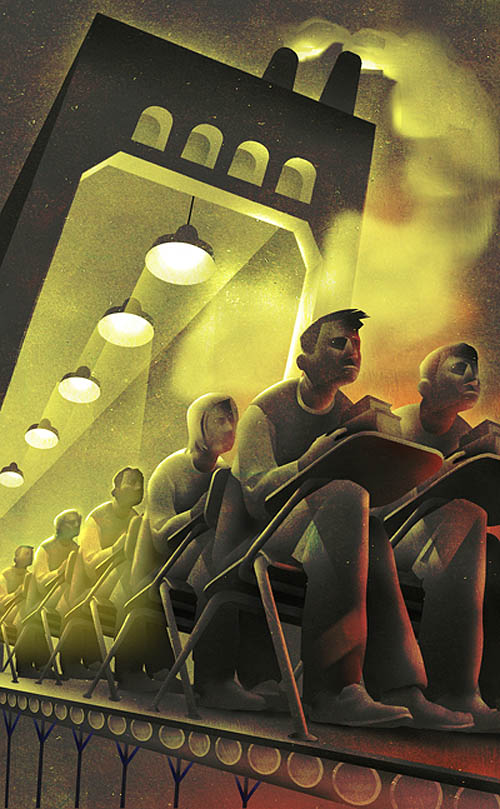
Why have things come to this pass?  It all began in the early part of the twentieth century, with the introduction of the assembly-line, mass-production, and the economies of scale.  Standardization is a good thing in many ways —consider that we can use any compact disc in any stereo— but, again, the weaknesses of generalization rears its ugly head. Using industrial methods to mass-produce educated citizens has negative consequences.

What do we expect out of education? Clearly the expectations vary wildly from person to person. The most common expectation is that education will result in a well-paying job. That may be true, but actually, it is the converse that holds: if you have a well-paid job, you’ve probably had a good education. (Or your dad might own the business.)  A moderately good education certainly increases the chances of a young person being suited to a more responsible position, which in turn might bring a higher salary. Another expectation of education is that it fits a person for a productive role in society. Unfortunately, this doesn’t resonate with (parents who are) rugged individualists. They don’t want their kids fitting into anything; they’re not happy with society, and they don’t want a bunch of commies making their kids just like every other kid in the country. But some of us realize that the world is a complex place, and whether one likes it or not, a person’s interaction with society is complex, and cannot be reduced to a simplistic equation of dollars and cents.  Which means that building a better citizen is likely to require the effort of a team, as Hillary Clinton got laughed at for saying some years ago.

As far as I’m concerned, education is also about values; all parents want their children to learn certain values. And they want those values taught in school: don’t have unprotected sex, learn how to drive safely, learn how to eat sensibly. Be respectful to people that matter, and don’t get tossed around by hoodlums. As you can see, all these expectations are very relative, and in extreme cases, rather crass. These values are better taught at home. There are other more important values that must be taught by both parents and teachers in concert: how to work well with teams and groups; how to lead where needed, and how to graciously take instructions from competent peers.

The job of a school, and of teachers, has evolved greatly over time. As society’s expectations of schools changed, their methods changed, to process a larger number of mediocre students quickly and efficiently. This has not been all bad. From a high-school drop-out rate of around 70% in the decade of the 1950s, we now have a drop-out rate of practically less than 10%, depending on how you count it. But we have given up a great deal to achieve this: for instance the needs of both exceptional students, and particularly difficult students, tend to be neglected in favor of the needs of students of average ability. But, of course, every parent insists that his or her child must be taken care of first, and this demand is backed up by administrators, and so a teacher’s job is very difficult. To top everything, teachers are usually poorly paid.

Let’s turn now to the question of values and bringing up children. We don't anymore consider sex to be a mere means of conceiving children; rather, there are those who regard children as a somewhat regrettable by-product of unplanned sex. No matter what our conscious opinions are, we’re hardwired to take pleasure in children, both our own, and those of others. In recent times, it has become fashionable to consider children a sort of property, and therefore to consider other people’s children absolutely none of our business.  People such as teachers, therefore, find themselves living a sort of contradiction: the children in their classroom are, on the one hand, none of their business, and on the other hand, entirely their business.  As far as I’m concerned, all children are everybody’s business, but obviously I’m not going to waltz into someone else’s home and tell them what to do.  I’m doing it here, instead.

The five day week was a tremendous victory; one would have expected that with the progress of society and more efficient means of production, we would have come to a four day week sometime in the twentieth century. It didn’t happen. In fact, people are working harder than ever, working overtime, and working second jobs. Many of the necessities of life have become so costly that we need to step up our rate of earning more than the increase in the cost of living would explain. (One reason for this is that it is better business sense for a company to hire a few people, and work them hard, than to hire a large number of people to work shorter hours, even if they’re paid less. Another reason is that Business and Industry has decided that there must be a small leisure class —wealthy stockholders— and the working population must work very much harder to support them.)

The consequence of this is that we do not know how to bring up our kids, most of all because we haven’t had the time to figure it out. Bringing up children is not entirely an instinctive skill. It has to be learned. In fact, it has to be taught. But it is too important an enterprise to be left to the tender mercies of school teachers, wonderful though they might be. We must regard our own children as future parents from the word go. Every interaction must be something that that child can draw on in the future, when interacting with his or her own children.

The most important things a parent can convey to a child are: (1) Be willing to take on unpleasant things, for the sake of the good it might bring. (2) Be considerate. (3) Set a good example to the younger people in your circle. (4) Value education, even if the benefits of particular aspects of it are not immediately obvious. (5) Be respectful of your teacher, even if your friends regard her as an idiot. She’s working under almost impossible conditions, because she believes in what she’s teaching. (6) Stay away from anything that will endanger your long-term health.

(Additional values, such as being involved in the betterment of your community, must come from example.)

As you can see, a lot of what has to be conveyed is what anyone knows, but it is also precisely the sort of stuff that we have been conditioned not to talk about, so in this very article I’m violating a whole lot of conventions!

It used to be the province of the local priest or minister to lay this sort of thing on the people. Once religion got seriously discredited, people jettisoned the priests and ministers, but had nowhere to go to be reminded of the commonsense axioms that they had to fall back on in the heat of the daily battle. Parents began to insist that teachers should do this. This means that education experts would have to come up with a new subject, like Sex Education, which might be called something like Not Being an Idiot. It is not the business of teachers to impart family values! A teacher who is a preacher as well loses a lot of credibility with the kids. Teachers do it, even if they get little thanks for it. But it is the responsibility of parents, regardless of how overworked they are. If you are a parent, remember you’re teaching for two: these lessons are needed for your kids. But they’re also needed for your grandchildren. They’re both content, and methods, in Education jargon.

Some extremists believe that Education should start at home, and end there as well.  I don't believe that.  Education is a social endeavor, and that is its glory.  But some things are best taught at home, not least among them being how to bring up children.  A child is never too young to learn the art of conveying values, by example, and with delicacy and imagination.

Afterword: I got so carried away I almost forgot to emphasize one of my main points: one thing that must be taught at home is to value and respect school, and teachers.  A child must not be taught that a teacher must earn his or her respect.  The respect must come first, both from the child and the parent, whether or not the teacher has demonstrated that he or she "deserves respect."  One must start with respect, and only proceed to loss of respect under desperate circumstances.  A teacher simply cannot function if he or she is faced with an array of skeptical faces.

Arch

Final Jeopardy

Final Jeopardy
"Think" by Merv Griffin

The Classical Music Archives

The Classical Music Archives
One of the oldest music file depositories on the Web

Strongbad!

Strongbad!
A weekly cartoon clip, for all superhero wannabes, and the gals who love them.

My Blog List

Followers