.
The cultural developments in the US roughly in the years 1960 - 1969 (The Sixties) consisted of a rich mix of political and ideological, cultural, sociological, psychological, and artistic developments. While we're here concerned chiefly with Sixties music, especially what has come to be known as Folk (in contrast to "folk music", a term whose definition is firmly under the control of ethnomusicologists), it's important to keep an eye on the surrounding climate of ideas.
Briefly,
The Fifties had already seen an interesting change. In the past, young people growing up had resented adult supervision, but accepted the need to merge into adult culture, despite reservations they may have held about its value or reasonability. In the fifties, though, for various historical reasons, the desire to distance themselves from mainstream "adult" culture rose to the level of total rejection. By the time the sixties arrived, Teen Culture was already established as a phenomenon, where the youth considered the approval of their friends more valuable than the approval of "anyone over thirty."
As important as the teen revolution was the steady rise of educated and articulate black Americans throughout the USA. There was a significant African-American presence among US troops in WW2, and the majority of Americans began to notice Black leaders they could admire, and whose ideals and aspirations they could subscribe to.
Capitalist Culture, the pre-eminent ideal in the USA, is hard to identify with [at the best of times], especially for the children of poor professionals and farmers throughout the country who were beginning to be marginalized by the relentless advances of American Business and industry. The large cities became home to vast numbers of unemployed, some unemployed through economic reversals, some simply through choice. This was fertile ground for the rise of Socialist thinking, where the economic advancement of the individual takes second place to the advancement of society. The so-called Cold War, and the Vietnam war were probably the greatest influence on the youth of the sixties. With the prospect of total annihilation apparently hanging over them, the US establishment (namely the employed adults and the government) began to lose any remaining scraps of allegiance on the part of the nation's youth.
Music. The large record companies, decided to capitalize on the popularity of Rock 'n' Roll, and made a lot of money off the Teen culture. Rock stars became wealthy, and gradually became the target of teen discontent. The left edge of the so-called counter-culture needed a new music with which to express itself.
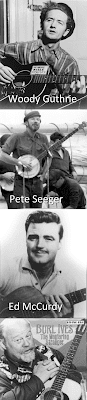
The
Trade Union activists of the forties and fifties were joined by the famous singer
Woody Guthrie. Poorly paid American workers were eager to join the unions, whose members enjoyed better pay negotiated for them by the Union leadership. Woody Guthrie was able to adapt American and British worker songs, with simple melodies, sung to an acoustic guitar. As other musicians were inspired by Guthrie's songs and his music, they also discovered older songs by unknown authors which expressed subtle discontent. Some names of this generation of musicians who sucessfully explored the folk music of the recent past are Ed McCurdy, Pete Seeger, and Burl Ives. The first two seem to have been more sympathetic to the political dissatisfaction that expressed itself as the Folk tradition evolved, while the sympathies of Burl Ives were not expressed in his music, and may have been quite conservative.
Gradually the music of Guthrie and Seeger and their contemporaries who explored songs enjoyed by the workers began to form the nucleus of a musical style that really had little to do with what musicologists call Folk Music. It was played on acoustic instruments: guitars and banjos, which were largely unamplified, except for the needs of recording; there was a careful balance between voices and instruments which enabled the lyrics to emerge (in contrast to the sounds of electric rock music), the harmonies were simpler, at least initially, and occasionally modal. It is this confluence of musical attributes that forms the nucleus of the musical tradition I'm calling
Folk. It is
not folk music, since it has not been transmitted through an oral tradition. It is not music or songs whose authors are unknown; the authors are actually well known most of the time, since much of this music was written in the latter half of the 2oth century. The only purely musical characteristic I can think of that is often found in Folk is the use of what are called "inessential notes", the decorative picking and tinkling that fills out the simple melodies of Folk.
An important member of the Guthrie era is
Pete Seeger. Seeger was a happy combination of someone who was a critical and careful observer of the political and cultural scene, a citizen of the World (or as much of one as the Sixties had any right to expect), a gifted musician and musicologist, and a skilled performer. Best of all, he had a delightful sense of humor, which made his lyrics memorable.
Keith Tonkin, on a page featuring an introduction to the life and achievements of Pete Seeger, quotes lyrics from an unnamed Pete Seeger song: “To Fight perchance to Win, aye there’s the rub. For Victory brings Power and Prestige, And the Children of the Children of the Fighters, Take all for granted and, in turn Opress.” The thought in that short verse goes further than the enlightened self-interest of the Trade Union movement, and it is not surprising that Seeger became something close to Public Enemy Number One in his heyday, because it seemed necessary for the Establishment to demand unquestioning approval in all matter of foreign policy from the general population. In contrast, Pete Seeger chose to put the words of Jose Marti, a Cuban poet, to a popular tune, to create
Guantanamera, which (as I understand) expresses the aspirations of the Cuban working classes before the Cuban revolution.
Between the generation of Woody Guthrie and the folk musicians of the sixties stands
Bob Dylan. Few artists of that time have had such a huge total impact on global culture as he, and it does not seem reasonable to class him with other artists (though there certainly have been some whose influence has been significant). Bob Dylan was able to express the overarching alienation of his generation in words and music, subsuming the anger against everything from bigotry, economic inequity, racial prejudice, political corruption, and the menace of war and weapons of mass destruction. (It is interesting that only the USA has actually used a conventional weapon of mass destruction, considering the deployment of aircraft as impact missiles to still be in the experimental stage). Here he is, singing
The Times they are a-changing. Rather than give a list of topics addressed by Bob Dylan in his songs, I would like to merely point out that Bob Dylan made clear to the older generation --as well as less insightful members of his own-- exactly what his generation was angry about. The vague sense of contradiction, the feeling that the conventional wisdom expresses things that are logically inconsistent, comes out in the lyrics of his songs. The melodies are simple, to underscore the rhetoric of the words, and he often emphasized phrases with speech-like intonation which departed from the nominal melody of the line. His anger, however, was mixed with humor; it is hard to present anger all the time, without the relief of something else, no matter how sardonic. In contrast to those of Pete Seeger, though, Bob Dylan's lyrics -- for the most part-- are more personal and intense, and all references of people or events are indirect and figurative.
Immediately in the wake of Bob Dylan we find a host of musicians who adopted the Folk idiom, some to emphasize the musical aspects, others the protest aspects: Joan Baez, Joni Mitchell, Judy Collins, Arlo Guthrie, and Harry Belafonte to mention a few artists who have had international impact in Folk, and close behind them an amazing cluster of Folk groups, including the Byrds, Buffalo Springfield, Peter Paul and Mary, the Kingston Trio, The Seekers in Australia, and of course, Simon and Garfunkel. (I'm not being selective; any omissions are purely due to ignorance!) While my knowledge of these performers is minor and not uniform, I will give some songs that I know from these artists.
Joan Baez, throughout her career, has been a serious musician first, and a political activist second, and this has been her strength. I express this opinion --and such a statement can only be a opinion, not a scientific fact-- only to contrast her with other artists, such as Bob Dylan, who is a political poet first, and whose music is hard to assess on a musical quality scale! To say that Joan Baez is a consummate musician does not detract from the seriousness with which she takes her responsibility as a world citizen. I recently saw, on YouTube, a video of her singing
Finlandia unaccompanied. The lyrics of that anthem (presumably written long after the tune was composed by Jean Sibelius) are astonishingly Universalist, transcending petty nationalism, and it seemed to me that Ms Baez's choice of that song is symbolic of her philosophy of life, encompassing her activism on every level.
Judy Collins was first and last a musician. Her songs resonated with those who sought the beauty of simplicity, which was a significant sector of those who liked Folk. While on the one hand Folk provided a vehicle for protest and consciousness-awakening and the conveying of serious ideas about society and politics, many were attracted to Folk simply because it provided an alternative to the industrial sound and the technology-driven instruments of both classical music and Rock music. (A similar sentiment was fueling a movement within classical music itself, namely the interest in early music and Renaissance and Baroque instruments.) Judy Collin's early songs were accompanied by the soft sounds of acoustic guitar, and later the sounds of a small string ensemble, a piano, and possibly a couple of winds. Her voice, too, was unaffected, the voice of the girl next door, expressive, but not uncomfortably emotional, and this remained a hallmark of her singing style throughout her career.
Arlo Guthrie, the son of Woody, having grown up in a musical family, was an influential singer, representing the edgier side of Folk that spoke of the concerns of the members of his generation who were disenchanted with their lives to the extent of exploring the drug culture. Where Bob Dylan expressed his anger at the establishment, Arlo Guthrie seemed to me to be expressing his ridicule. At any rate, his voice had great character, which together with his clever lyrics, filled an important niche in world of Sixties Folk.
The City of new Orleans is a song frequently sung by Arlo Guthrie. I give this link despite the fact that the song has a more Country sensibility than a Folk one.
Harry Belafonte, in some ways, could have been expected to have the most difficult time of making a career out of folk song. (Before him, of course,
Paul Robeson had brilliantly advanced the cause of Black Spirituals, an achievement sadly neglected in the latter half of the 20th century.) Harry Belafonte actually began singing in the fifties, and his vehicle was actually folk-songs of the Caribbean, or Calypso, into which it evolved, a mixture of African rhythms, latin music, and influences from all the places in the Earth from which the caribbean folk came. Though he could have been expected to be most occupied with the problems of Black Americans, his sympathies were far wider, encompassing the needs of underdogs of all races. As a result, he presented many songs that flowed from the protest songs of those times, including the songs of the Folk tradition. In one sense, he was always the Entertainer, and as such, somewhat removed from the image of a singer of Folk.
The
Kingston Trio evidently dated from before Bob Dylan, and their music was less political in the beginning. But the Vietnam War made its impact throughout college campuses in the USA, and not surprisingly singing the song Where have all the flowers gone, popularized by Pete Seeger, drew them into the protest movement within the Folk idiom.
The Byrds was a group that recorded some of the best of Pete Seeger's and Bob Dylan's songs, using electrified acoustic instruments, and close harmony. They have been influenced by a number of groups that came before, such as the Beatles, who were most definitely not within the Folk tradition. Very quickly, they attracted a host of fans who liked the edgier sound of electric guitars, especially the 12-string guitar, which became almost the banner of the Folk sound of the late sixties. No matter how electrified the guitars, though, there was a core acoustic sound in the music, and in principle, the music was performable without any amplification at all. This was not quite true for most of Rock and Jazz music. One of the most important songs released by the
Byrds was Pete Seeger's
Turn, Turn, Turn, a song widely recorded at the time, and whose recordings number about a score at the present time; Bob Dylan's Hey Mr Tambourine Man was a major hit for this group, and these two songs signaled a new face for Rock: edgy, electrified, jangly acoustic music, with harmony.
My chronology gets a bit vague at this point, especially because many groups that today are almost synonymous with the sixties did not immediately become well known, and all influenced each other to a great degree.
Two of the most charismatic and talented Folk groups of the Sixties, in my humble opinion, were
Peter Paul and Mary, and
The Seekers. Both these groups recorded many of the songs of Bob Dylan and Pete Seeger most admired by Folk fans generally, and had huge followings of their own. The Australian group, the Seekers, though they recorded and performed much of the time in Britain, were regarded highly in the British Commonwealth. Completely acoustic in their instrumentals, those who admired a switched-off sound were drawn to them. Lead singer Judy Durham's glorious gospel-like mezzo-soprano was also a major attraction. The songs of Tom Springfied was the final clincher to their immense popularity. Unfortunately, this Folk powerhouse was little enjoyed in insular US.
Here they are, singing I'll never find another you.
Peter, Paul and Mary was a trio put together by an impressario, which succeeded beyond anyone's wildest expectations, mostly because of the intelligence, talent, and laid-back musicality of the three principals. To many, it is their renditions of the songs of Pete Seeger and Bob Dylan that are the definitive performances of those songs to this day:
500 miles; If I had a hammer; Don't think twice, it's alright. Both the Seekers and PP&M sang songs from the folk repertoire outside the protest genre; for instance their rendition of Gordon Lightfoot's
That's what you get for loving me is the one that sticks in my own mind. By the end of the Sixties, the messages and the philosophy in the songs of the protest movement were beginning to address more intimate values and wisdom, such as those of interpersonal relationships, the new morality, child-rearing, domestic violence, the environment, and so on. By the end of the seventies, the straightforward political ideals of the sixties no longer resonated with the younger Folk audience, who were more in tune to the implicit individualism of the Folk idiom than its anti-establishment ideals. Gradually, too, Folk was becoming important more for its musical characteristics than for its message.
One of the turning points in Folk, to my mind, was the
Woodstock Folk Festival, which, in its early part, featured a new style of Folk, which had Rock, Country, and Gospel elements, as well as the subtle influence of the subversive drug culture. Young people torn between the intellectual rebel characteristics of the protest movement, as well as the opt-out flavor of the drug culture found a confluence in this synthesis with which they could identify.
Crosby, Stills and Nash (CSN), sometimes joined by Young (CSNY) was an enormously talented group, consisting of alumni of Buffalo Springfield, The Hollies, and The Byrds. This group, significantly influenced by Country sensibilities, had great musical talent, both innate musicianship and vocal ability. They were a distinctively American product.
Perhaps one of the greatest Folk acts ever was
Simon and Garfunkel, carried by their wonderful vocal talents, and Paul Simon's amazing gift for lyrics and music. One has nightmares, trying to imagine the sixties and the seventies if these two had not come together to add their genius to Folk. After having sung several Bob Dylan songs:
The Times, they are a Changing, Blowing in the Wind, they went on to release an amazing panoply of Folk material that began to define one end of the Folk spectrum, the end most closely tied to literary art and poetry. At that time, many artists were concerned with the darker aspects of society, fueled by the never-ending Vietnam War. There were no answers, but there were questions. The only thing that was clear was that This Was Not Good. Since then, we've all come to agree that Not Good-ness was here to stay, even when the Vietnam War ended.
As the sixties grew to a close, the roster of influential Folk singers also included James Taylor, John Denver, and several groups, who explored aspects of Folk that had little to do with social discontent, at least initially.
James Taylor's songs varied in content, and introduced us to the sheer beauty of a voice that would have been considered unremarkable in earlier times. After Bob Dylan, of course, any voice would seem to have had potential. His "
Fire and Rain" is heartbreaking and unforgettable, and has a rhetoric that is almost overwhelming. John Denver's songs had to do with the byways of America, and the great outdoors. With an almost manic insistence on the positive, they were hardly bettered for sheer musicality. Suddenly, Folk was not just about the negative side of life: anger, sorrow, alienation and worry, but about the glory of nature, the ecstasy of flight, the comfort of home, and the delight in children. There was also humor and satire in John Denver's live performances, but of a very gentle Midwestern flavor. The first of his songs that I heard:
Country Roads, which could be considered a Country song, really. A hugely popular singer of Folk was
Jim Croce, so much so that for some, he is synonymous with Folk. This is
Operator. And from Britain, there was the wonderful
Cat Stevens, one whose most loved songs is
Peace Train. Another brilliant song by him, in fact a version of a hymn in the English Hymnal is
Morning Has Broken. This is by no means a Folk piece, but Cat Stevens inexplicably makes it his own. Having taken the name Yusuf Islam,
he performed the same song more recently. Evidently he has found a startling new gravity.
As with all such things, by the end of the seventies, Folk had splintered into many little slivers which bore little resemblance to each other. A number of artists carried on the prophetic tradition, continuing to comment on social injustice, and the new frontier: equality of women. These included Ani Di Franco, and a few Country acts which took on some Folk flavor. Other artists emphasized the Unplugged aspect of Folk, recording with acoustic instruments, attracting formerly mainstream Rock musicians to the strictly non-electric, non-electronic performance style.
A new generation came forward to blend Rock and Folk in new commentary on the excesses of Government and Big Business. It appears that Rock itself, a many-headed monster, has generated heads that are softer, adding aspects of Folk, and apparently now described as Alternate Rock. The opposite extreme is Heavy Metal, which delights in the extremes of guitar amplification and overpowering volume, and percussive uses of electric guitars. Finally, Latin artists emerged as talented Folk performers, notably Jose Feliciano. At the present time, Sixties Folk lives on, even if in disguise as Alternate Rock. Some of the best in Country music has been heavily influenced by Folk. The complex harmonies, the sophisticated picking techniques of Folk are everywhere. And the lyrics of popular music will never again be as simple as "I wanna hold your hand," an amusing title from the Beatles, the majority of whose lyrics left that early attempt far behind. Incidentally, the Beatles' "Yesterday" has a startlingly Folk feeling, though it is not by any means a Folk piece.
Archimedes, with a sigh of relief for having finally finished this one...


