Sunday, January 12, 2014

How are we doing so far?

.
Now that we're into the third week of the new year, it is clear that there's no going back.  That first week, it really feels as though we're still in 2013, but by now, all hope is lost.  We're committed to moving into 2014, a full quarter of the way into President Obama's second term.

While the onslaught of Republican propaganda against the Affordable Care Act (a.k.a. "Obamacare") is beginning to falter, and significant numbers of people are buying health insurance using the government insurance clearinghouses and websites, the fake problems that conservatives manufactured are being replaced by a few real problems that people are discovering.  Most of these are with the programming of the infamous websites that were intended to connect people with insurance plans.

Insurance is a screwy business, as we have learned over the last few centuries.  If an insurance company fails to deliver, the client is forced to go to court, or to eat the denial and be quiet.  For all our supposed litigious tendencies as a society, people in the social stratus which I personally inhabit are more likely to take a denial of coverage of a particular service with resignation than to pursue the possibility of suing the insurance provider.  As the number of clients increase, we might see the number of denials of service increase as well, and then things are going to get interesting (especially with a particularly virulent virus vaiting in the vings.  I mean, wings.)  With almost universal participation, insurance companies are going to have to re-think just how much profit-taking there is going to be.

With underemployment firmly established in most states, it is an employer's market in the world of business.  The usual thought-habits of "College degree =  job" are going to die hard, and when they do, we will have a falling-off of people going to college, further encouraged by unconscionable increases in school fees, but there will be an enormous population of unemployed angry college graduates glaring balefully at world.  The Republican Party will have to do some fancy footwork to direct their hostility away from business and industry towards the government and the Democratic Party.

On a completely unrelated subject, it is becoming an exercise in frustration to try to do the things one used to do fairly easily on computers and the Internet.  Android-based systems seemed to offer so much initially, but every developer seems to become increasingly adept at making the user pay in terms of obligatory advertisement viewing, or surrendering of personal information.  Be careful about giving your e-mail address and passwords to sites.  Only a few big sites have the capability to protect your privacy; most sites can be easily hacked by practically anyone, and are less likely to announce that a security breach has taken place.  Some of the larger sites are also vulnerable, perhaps because they haven't taken customer security seriously enough.  I subscribed to a software service from Adobe Inc, but was told recently that their customer data was recently stolen by an unknown party.  They advised me to use the services of a credit agency to monitor my credit, and offered to pay for it.  It is almost inevitable that Google and Facebook will be hacked, and if anyone has established an account with them, they could be in trouble someday.

Talking about Google and Facebook, their advertising is becoming increasingly intrusive on a standard computer, and almost oppressively so on a tablet or phone.  Neither company ever claimed to exist for the sake of their ordinary users; they exist on behalf of their customers, that is, the companies who hire Google and Facebook to advertise for them, and do marketing analysis for them.  So Google sends user profiles to all those who would like to pay for their analyses.  If you ever click on the website of a Google client (such as Barnes and Noble, say, just to give you an idea of a company that might be clients of Google), for a fee, a list of all sites that you have browsed to will be made available to B & N.  This is disconcerting for anyone who might have Internet destinations that they do not care to have disclosed!

Even more disconcerting is that software can correlate users who browse to one category of website, Category A, say, and who also browse to another category of website, say Category B. Very little can be done with this sort of correlation for most of us, but the potential for abuse of this information is setting off red flags among those who are concerned about civil liberties.

The practical fact is that a business which has access to this sort of information today is probably not in a position to capitalize on it except in the most rudimentary way.  But I can see a class of consultant arising who will offer their services for the right price, to market highly targeted goods to Internet users.

Let's see.  Looking through the ads on the side of my Facebook page, I see
* An ad for Piano Teachers Wanted.  (Someone has noticed that I write about music.)
* An offer to subscribe to the New Yorker.  (I should never have clicked on the link about New Yorker cartoons!)
* A Buddha Bowl Sale.  (One of my Facebook buddies is avidly interested in matters related to Buddhism.  Ironically, the Buddha Bowls have nothing much to do with the religion.)
* Hillary Clinton.  (Perhaps a connection has been made between this Blog and my facebook page.)
*  Get your students more success in mathematics!  (Oh dear.)

So far, it's all pretty innocuous.  But you can easily see how it can get pretty uncomfortable pretty soon.  As long as some mindless computer makes the decision what ads to send my way, I don't really care.  But if a human were to be looking at all this summary data, I would want to get off of facebook in a hurry, and Google, too.

Arch

Saturday, January 4, 2014

Musical Styles: Felix Mendelssohn

—‘’“”
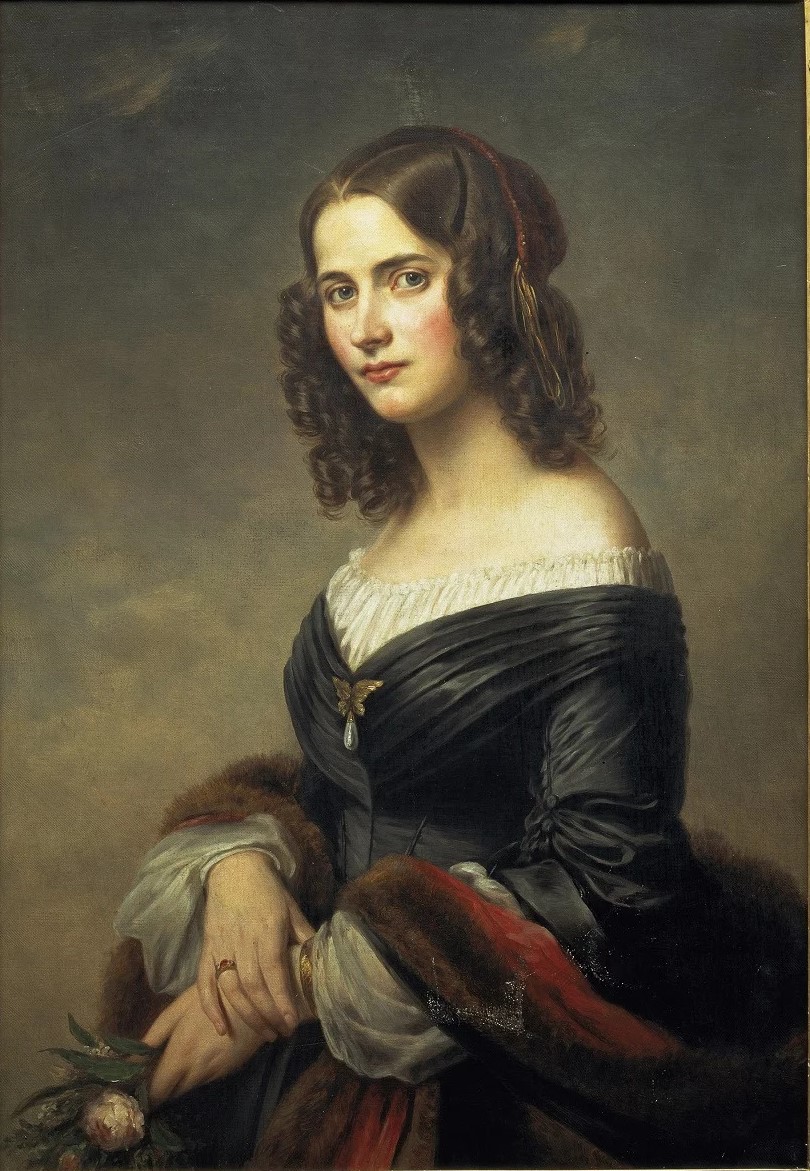
Cecile Mendelssohn-Bartholdy
Felix Mendelssohn (or Felix Mendelssohn-Bartholdy) is the composer I would associate with Christmas the most, simply based on all that I know about him musically.  He seemed to love everything; a truly sunny person.  (Remember, that’s based only on what I know; I bet there’s tons we don’t know.)  He died young, of something like tuberculosis, I believe, though I’m not sure (anyway, from a musical viewpoint it isn’t important), so that we can be forgiven that deep sorrow was not part of his life experience.  (However, one biography states that he fell into terrible fits of temper.  Some of this information is completely new to me; for instance, I had no idea that he had been married.  See a portrait of his wife at right.)

The tune of Hark, the Herald Angels Sing
However, I’m not familiar with any Christmas-related music by him at all, except for the harmonization of the tune of “Hark, the Herald Angels Sing,” which was, in fact, an existing tune.  You can see the tune at right.  (The words are some patriotic verses.)

Well, I cheated; or rather, I attempted to cheat.  I made a desultory attempt to read up on any scholarly opinions there might have been on Mendelssohn’s musical influences, and found none.  You see, he took lessons from a certain well-known pianist and musician (Ignatz Moscheles, I believe), but he was mostly self-taught.  He was well-versed in the hymn-music of the Lutheran Church that was in his environment, and obviously heard all the music that was going around him, and absorbed it all into his own vision of how he wanted his music to sound.  All the composers of the post-Beethoven Era had intensely original visions of how they wanted to sound; ever since Mozart, being original was almost an obsession.  (There are stories of composers of that time who continually protested that they had created something entirely new; you hear a little of this in Amadeus.)

While Mozart was preoccupied with elegance, charm and grace, Mendelssohn was, too; but from all I have seen (and heard), Mendelssohn was influenced by literature, especially Shakespeare, we’re told, and also fairy tales.  Germans were crazy about fair tales, we know, from what we know of the Brothers Grimm, who were collectors of folktales.  For whatever reason, Mendelssohn wanted to develop a light, airy sound, to effectively depict fairy themes.  There are numerous instances of this fairy writing, from the Violin Concerto to the Overture to A Midsummer Night’s Dream.  One technique he used to get this mood was to use rapid repetition of the same notes, or several notes in alternation, pianissimo, in several instruments —usually the upper strings— which of course results in a very lovely feathery sound.  This is the same principle as in the Clementi Bass, which you often hear in Mozart, but Mendelssohn turns it upside down, and puts it in the uppermost register, and creates fairy music.  This is not to say that he didn’t write music of darker moods, and more contemplative music.  He wrote at least a couple of Oratorios and similar works, where the writing was very homophonic and hymn-like, but with somewhat of a Mozartian elegance, but the melodic inspiration was somehow different from Mozart: more naive, more akin to folksong, perhaps.  Perhaps, again, he was influenced by Jewish melody, but I have no idea how much; this is pure speculation on my part.  (One must resist jumping to conclusions in ones haste to deconstruct anything; there’s entirely too much of that going around.)

To come back to the background theme, it would be lovely to hear any Christmas music Mendelssohn may have written; I’m just not familiar with any of it.  It would have been a natural for Mendelssohn to have written music for a sleigh ride, for instance; I will be rather embarrassed if such a piece existed, and I did not know it.

Wait: an easy search did turn up a set of six pieces that Mendelssohn wrote (we’re told) as Christmas presents for a family with which the Mendelssohns stayed in England!  As the notes accompanying the video observe, the music is not particularly Christmassy, that is, jolly and celebratory, and containing references to Christmas carols.  So, honestly, it isn’t really Christmas music.  What a pity.

Now, as to why Mendelssohn doesn’t enjoy as much fame and admiration, outside England, at any rate, as his fellow composers of the period.  I believe he was just as much individual in his style, even if it (his style) wasn’t as arresting or dramatic as the styles of Wagner, Brahms or Schumann and Schubert.  The reason, I believe, is that he was, as almost everyone agrees, very traditional in his musical idiom, very generally speaking, and as a result, the niche he carved out was very small.  This, in turn, meant that there were not a large number of followers in his “school”, so that the Mendelssohn school consisted of just himself.  In contrast, we could say that the Wagner school included Mahler, Bruckner, even Richard Strauss, and even Korngold and John Williams, and Frederick Loewe (the composer half of the team that brought us My Fair Lady).  Brahms was also influential, and I may be forgiven for including Dvorak among his fellow-composers who served to establish a style that made the music of Brahms easy to apprehend.  Mendelssohn’s music isn’t hard to reach; it is just one of a kind, and so easily dismissed.  In addition, numerous minor composers in the United Kingdom found that idiom familiar and comfortable, which instead of bolstering the importance of the style, seems to make it even easier to dismiss as trivial, uninteresting and shallow.  But then, why are Mendelssohn’s string quartets among the most frequently performed?  Is it because they are easy for amateurs to play?  The major quartets that do play them will probably beg to differ.  (Forgive me for sounding annoyed, but I suspect that Mendelssohn's music was fashionable for people to criticize as unoriginal and too fluffy, because there weren't too many people who would come to his defense.  Minor artists indulge in a lot of putting down, hoping that they will look good as a result.  I, myself, am seriously considering putting down a whole lot of other bloggers.)

Well, I apologize for only providing a single link, but trying to describe Mendelssohn’s compositional style in relation to Christmas appears to be an exercise in futility, and did not provide much opportunity to showcase Mendelssohn’s genius!

Arch

Thursday, January 2, 2014

Musical Styles --Continued

—‘’“”
In my previous post, I tried to get started —somewhat clumsily— on addressing the different styles of the better-known classical composers, in the general setting of Christmas music.  If you were to obtain a copy of either the Northern Lights Orchestra, or the Hampton String Quartet’s recording of either“White Christmas,” or “Have yourself a merry little Christmas,” respectively, you will hear a fairly good parody of Mozart’s style; I think the playing of the String Quartet is marginally more convincing.

Casual listeners to music in the various styles can often immediately pounce on various aspects of the music that seem distinctive, and quite honestly, those features are probably what will count most strongly as the distinctive style elements of each composer.  Ironically, what is considered stylistically distinctive in each composer’s music is sometimes the very opposite of what the listener hears.

Let’s start with the transition from Bach to Mozart.

The musical ideal in the time of Bach was counterpoint, which is the combination of multiple strands of melody.  The attention of the casual listener is often grabbed by two strands of melody that are separately recognizable as actual tunes, such as in the elaborate chorales of Bach.  In this sample, the music has been queued to a point where two melodies enter in quick succession, one in the violins right away, and one in the trombones a little later; ten seconds of it should be enough to get the idea across.  The style of Bach’s is called Baroque, initially with a derogatory intent, referring to the highly ornamented building and furniture style of the century leading up to Bach’s day —the 17th— which corresponded with what was perceived as fussiness in the music.  The dense counterpoint strikes some as fussy, others as heavy, others as elaborate, and yet others as clumsy, but of course to lovers of Bach, it sounds inspired and balanced!  Consider the bass lines, just to begin with.  Below is a tiny bit of the same chorale, with the bassline doubled by the Organ, illustrating a typical Bach

Warning: This clip is supposed to sound a little different, because we have a horn instead of the trombone which played the tenor vocal line before, and the bassline has been made louder.  [Another video of this same tune illustrates the bass line so much better: it is Wachet auf played on an ocarina!]

This is by no means one of the most interesting Bach bass lines; for instance listen to the first few seconds of (the bass line of) this one (Turn down the volume first!): Ach, wie fluchtig.

The characteristics of Bach era music were grandeur, intellectual density, complexity, and very generally speaking: seriousness.  Soon, even while Bach was alive, there was a reaction to this oppressively dense contrapuntal sound, and Handel, and Bach’s own son J. Christian Bach, who is incidentally credited with introducing the new style of music, began to write music that was more elegant, lighter, simpler, and (in the view of musicians of that time), economical.  Simplicity and charm was everything.  Music and art (graphic art) took their cue from literature and philosophy, and this period was called the Age of Enlightenment, because the intelligentsia of the time believed that their thinking and their Art was more rational, reasonable, than the Art of earlier times.  Just sufficiently many notes for the purpose, and no more.

And no fewer, either.  While Mozart embraced the principles of logic and reason in his music, he could not resist a certain complexity that was necessary to convey the sophistication of his ideas.  In hindsight, today we see how, as he grew older (though he wasn’t given much of a chance to do too much of that) Mozart’s music gained in complexity, but he was always at pains to obscure that complexity with simplicity.  He always insisted that anything in his music was there for a purpose, but of course, every composer we know always said that.  But to modern ears, Mozart’s music comes across as frilly and fussy, and ironically, it is these frilly, fussy bits that parodists sieze upon, to convey an essentially Mozartian sound!  Isn’t it ironic?  So all the little notes that Mozart used to convey a certain grace and charm, are now parodied to create a certain silliness, which, unfortunately, is not the essential quality of a Mozart work.  Make no mistake, the man was silly.  But not as far as his music was concerned.  So, in a sense, the parodists are creating something (which unfortunately does come across as superficially Mozartian) which would make Mozart cringe.  But what can we say?  If it sounds superficially Mozartian, isn’t that what we really want here?

In the YouTube video consisting of cuts from the Northern Lights Orchestra CD, the first tune is “Have yourself a merry little Christmas,” which to my mind has been arranged to sound something like in the style of Frederick Delius, a wispy, impressionistic style.  (The composer of these pieces will probably be furious to be criticized by mere amateurs, but if one sets out to parody a composer whose music is as widely known as Mozart, one has got to take one’s lumps.)

The second tune (Do you hear what I hear?) sounds very 20th Century, except for a few gestures that sound like perhaps Mozart or Haydn.  In fact it sounds like BBC incidental music!  It is nice, but it is certainly not Mozart.  Perhaps the instrumentation gets in the way; the large orchestra, or the record engineering sounds un-Mozartian.  At times it sounds like Leroy Anderson (0f Sleigh Ride fame).

Next, I want to find some examples that will illustrate the styles of Mendelssohn, Brahms and Wagner.  All of these composers admired Beethoven, and Brahms and Wagner were strongly influenced by them.  (I can’t quite figure out the influences on Mendelssohn by simply listening; I may have to cheat and read some books.)  Anyhow, these composers are going to be a challenge, because at that time, there were so many excellent models in classical music, and musical scores were becoming so widely available, that a young composer could adopt elements from a number of different composers for his or her purposes, sometimes within the same composition.

Until that’s ready, so long!

Arch

Wednesday, January 1, 2014

“If Mozart Wrote Christmas Carols!” --A Look at Musical Styles

“”‘’—
First of all, greetings of the season to all who visit this page!  Some of my friends think it’s silly to go about greeting everyone at this time if one is an atheist, but I think that’s going too far.  Just because we reject the mythology doesn’t mean we reject every single bit of the cultural overflow of the ‘holy’ festivals, too!  Perhaps cynically, the Roman church leaders conflated the birth of Jesus with the several midwinter festivals that were observed throughout most of the northern hemisphere.  Some of these had superstitious overtones, while many of them were simply an opportunity to gather with families, so that the womenfolk could keep company together, while the guys probably got drunk.  I personally don’t feel the need to join in the general inebriation, even if I don’t condemn it entirely!  (Just walk home, don’t drive, fellas.)

Christmastime is when I relegate music to the background, and when I was younger and more energetic, I made tapes of Christmas music, then CDs, and now, just playlists, so that I could have the sort of music I wanted while we played cards, or had dinner, or did the cooking.  But others have had the same idea, and on YouTube you get a number of compilations of this type.  One of these, startlingly, was entitled: “If Mozart Wrote Christmas Carols.”

I get the idea.  Mozart is a stand-in for the generic classical composer.  We classical music buffs know just a little too much to be able to view one classical composer to be typical of all of them.  Even Bach, who died just a couple of years before Mozart was born, wrote music in —what is to me, at least— completely different styles, and Mozart wrote in a completely different style to, say, Brahms (though you can sometimes hear how M. influenced B).

Bach
To the delight of all of us, I’m sure, there is an 19th-century composer who wrote one of the most popular arrangements of a Christmas carol that is performed by good choirs even today: Robert L. Pearsall’s setting of In dulci jubilo.  Though Pearsall was born in 1794 (a couple of years after Mozart’s death), he wrote in a style much closer to Bach’s style than almost anyone else I know.  Here it is:


But even this highly Bach-like setting (a harmonization of a carol or hymn is called a setting, rather than an arrangement) doesn’t sound anything like the setting of J. S. Bach himself of this same carol.  (Incidentally, the Bach organ prelude based on In dulci jubilo is almost the definitive organ postlude for the end of a service of carols.)  Here it is, sung by one of my favorite choirs: The Sixteen Choir, led by Harry Christophers.

If Mozart had taken it into his head to write a setting of this carol (and it seems to me not the sort of thing to inspire him), it would probably have sounded very different indeed.  There are a number of pieces written in the last decade or so that are quite clever parodies of Mozart and the better-known classical composers; This is "What if Mozart wrote I'm Dreaming of a White Christmas" which does not sound very much like Mozart.  (It does sound like Mozart-like present-day writing; composer who turn out the incidental music for TV dramas set in the 19th century like to write this sort of thing; Mozart was highly admired in the UK at that time by the Middle Class, while the more highbrow musical specialists probably liked Wagner and Brahms.)

While most people who know little about classical music (but who probably like it a lot) think that Mozart was the central figure around whom classical music revolved, there really isn’t a single composer who can fill that symbolic spot; we would need someone who is a sort of composite of Wagner, Beethoven and Tchaikovsky, and maybe a little Chopin thrown in.

Bach did write a number of carol settings, or rather, Christmas hymn settings.  We’ve already heard In dulci jubilo; he also wrote wonderful settings of Vom Himmel hoch, a favorite German Christmas carol, Wie schon leuchtet der Morgenstern, or How Brightly Beams the Morning Star, and the two gorgeous settings of hymns for the Christmas Oratorio: Break forth O beauteous Heavenly Light, and Beside thy Cradle here I stand.

Here is a performance of How Brightly Beams the Morning Star, by Maasaki Suzuki and Bach Collegium Japan.  This should knock your socks off.

Incidentally, Tchaikovsky did actually write a lovely carol, called The Legend.  This performance is by the choir of King's College, Cambridge University.

Another major classical composer who wrote a Christmas piece that is performed by choirs today is Hector Berlioz, taken from a larger Christmas work: L'Infance du Christ.  This is called The Shepherd's Farewell.

[To be continued]

Monday, December 16, 2013

The Twelve Days of Christmas!

.
When I was still in high school, my siblings and I decided to sing "The Twelve Days of Christmas" for our parents' wedding anniversary!  I was learning a lot of music in school, and I had become fairly confident with writing 4-part harmony, so once the holidays came round, I frantically ruled my own manuscript paper, and made the arrangement of the popular carol.  Let's face it: there are only nine distinct bars of music that are repeated over and over again, so it was not very difficult to work out, and not difficult for my siblings and me to learn.  It was a screaming success, back then, and it was performed again and again at holiday family gatherings, but I had all but forgotten it, until my Uncle recently played me a cassette recording of it!  Back then, it had been taped on a reel-to-reel tape recorder, and had been re-recorded into the cassette player about fifteen years ago.

I decided to transcribe it into notation in my computer, and here it is!

Notes:

(1) The fabulous glissando in the 11th day was intended to be played by a trombone!  Generally speaking, the group on the left channel was intended to be flute, clarinet, trombone, and bassoon, to fill in the tenor, but for some reason the trombone sound was not smooth enough, so I ended up using a bass clarinet.  Unfortunately, the bass clarinet can't really do a glissando, so it sounds a bit silly.

(2) Initially, as I said, the piece was intended to be sung, and when I put it into the computer last week, I imagined it being sung by a choir, with the verses being alternated between three quartets, with everyone joining in for the opening lines, and "And a partridge in a pear tree!"  But it was too difficult to come up with three contrasting instrumental quartets, so I'm making do with just two.  I must say that the double-reeds on the left channel really sound wonderful.

(3) Notice the use of staccato.  I think I've overdone it, but it does add something to the performance, and makes it a little more familiar when compared with the sung lyrics.

Do enjoy it, and feel free to use this arrangement anytime.  I'll post the sheet music somewhere convenient, if anyone is interested.

Arch

Friday, December 13, 2013

Fox News's Megyn Kelly states that Jesus (and Santa Claus) were White Men

.
The whole concept of race, as exemplified by the question of whether a given person is white (or perhaps I should put that in quotes: "white") is shrouded in vagueness.  Is Megyn Kelly white?  She would probably feel very put upon if we were to conclude that the issue is in doubt, but for people like Ms Kelly, it is desperately important to be classified as white, which is why she is probably such a prominent figure at Fox News.  They need people who see things in black and white, pun intended, and Megyn is cute, and she has a cute name, so, there you go!

It seems to be, without getting too technical, that the label "belonging to the white race" means, today, that someone has a majority of genes inherited from the peoples of Western Europe.  This, unfortunately, excludes the Hebrew peoples, among whom we consider the historical Jesus to have been born.  Israeli people of today, of course, have a significant proportion of European ancestry, courtesy of their protracted exile in Europe.  While Hebrew folks of the Year Dot were probably of at least partly Caucasian ethnicity, they were hardly any more white than Mahmoud Abbas or Benjamin Netanyahu, and it is to Ms Kelly's credit that her concept of whiteness stretches so wide.  Incidentally, Mr Netanyahu probably has more European ancestry than he cares to admit.

I think most rational people, Christian or otherwise, are just as concerned about any attempts to classify Jesus according to American ethnical categories as Megyn Kelly is upset about Jesus being anything but white.  Jesus's color is entirely in the eyes of the beholder, and the Romans of Jesus's time would have seen Jesus as most definitely black, if they were familiar with the concept of color (and they probably were).

From an social-anthropological perspective, the particularly pernicious twist given to the somewhat naive concept of color in the late seventeenth century in England and Western Europe, and elevated to almost maniacal heights in some parts of the US, almost certainly served as a justification of slavery, especially among Christian intellectuals, who may have been secretly troubled by the morals of the practice.  In any case, the convenience of racism was eagerly embraced by people of lesser intellectual capacity, so much so that it became part and parcel of their self-esteem.  Today, a century removed from the economic necessity of the fiction of racial differences, the concept of race is still a major part of the concept-world of many influential people, such as Megyn Kelly, evidently, who appear to use race as one of the ways they use to explain the world to themselves and each other.  Ms Kelly was at pains to emphasize to young people in her audience that, in fact, both Santa Claus and Jesus were white men.  What does that mean?  Perhaps it means that, despite the fact that our President is black, and seems to be accomplishing a lot more than all the white presidents who preceded him, we still have white people to be proud of?  This appears to give us a rather dismal glimpse into what goes on inside Megyn Kelly's confused head!

Let me repeat to anyone who is still confused: White people have nothing to be ashamed of.  Failures of white folks and successes of black folks have less to do with their race than with their individual motivations, their personal histories and circumstances, and their upbringing and education.  Any mental adjusting Megyn Kelly accomplishes is not likely to be very useful to most members of US society.

Tuesday, December 10, 2013

Health Care

.
The amount of hype, both pro and con, concerning Obamacare/ACA is stupefying.  I'm not making fun of it; after all, this is one of the boldest moves in cultural advancement since Franklin Roosevelt was president, in the USA.  Some folks see it as wrong-headed, and a precursor to a Byzantine government bureaucracy that will destroy every cent of discretionary income anyone might hope to earn in the future.  This fear is completely justified, because Americans have, among them, some of the most creative gangsters outside Russia, and they will surely find ways to siphon off some of the money that has to go back and forth in the Health Care industry of the future, just as they did for food stamps, alcohol, firearms and tobacco, and, best of all, drugs.  (Drugs are so much fun that the CIA got into it, and never got out.)

One problem is that health care professionals command such high salaries.  Medical college is far more expensive, ounce for ounce, than other sorts of education, and everything to do with health care is just more expensive, by association.  A friend of mine recently said that the profit margin for certain insurance companies is around 3.5%, which they know from studying the public information on the companies.  But of course!  Most of the money is eaten up by the high salaries, which are all classified as expenses.

Health professionals in other countries are not paid as much, even allowing for the different standards of living.  When one examines the process through which a kid goes to become a doctor, you begin to see why.

First, a would-be doctor has to get a bachelor's degree.  It need not be in science; in theory, a philosophy major could become an MD, provided he or she takes the required coursework.  Many of these kids are driven by a combination of relentless parental pressure, an insatiable greed for money, a need for social advancement, and a modicum of altruism.

Secondly, because of the high admission standards of the leading medical schools, these students apply a great deal of pressure on their instructors to give them high grades, pointing out that all the extra coursework they're taking is not because they're intrinsically interested in it, but because it is needed by the fact that they're Pre-Med, a state that has lost some of its shine in recent decades (but of course, these kids haven't got the memo).  They must "take" college physics, which means they must also "take" Calculus, something about which roughly half of them care less than nothing.  But those of them who can drive their sheer hate of the subject into maniacal memorization actually do better than physics majors, which shows that hate is a more powerful force than love!  Heh-heh.

Thirdly, now that a vast host of students are applying for entrance into Medical School, these schools can demand almost unbelievably high admission standards, in terms of coursework and grade point averages.  They don't care that the applicants despise practically everything they've ever learned; they know that the successful applicants can take an enormous amount of academic punishment and bullying, which makes it easy for their teachers, who need not put a great deal of effort into the process of teaching.  Luckily for us, graduating competent doctors is a major deal, because the reputation of the school enables the students to be more easily employed.

Fourthly, Medical School professors are paid almost as high as football coaches, and have to carry, I don't doubt, a lot of mal-teaching insurance, which probably contributes to the fact that tuition at medical school is very costly.

Fifthly, students who don't make the grade for acceptance into Medical School end up elsewhere in the Health Care Industry, and because of likelihood of litigation in any branch of the industry, all these people carry their own malpractice insurance, and all of them demand high salaries.

Sixthly, possibly because they deal so closely with people in the medical professions, those employed by the Insurance Industry have historically commanded astronomical salaries.  A lot of the money that consumers pay into health insurance actually stays in the insurance companies, so that while shareholders may not net much out of their holdings in these companies, they're a very dependable source of income.

Finally, once a doctor establishes himself in some location, he or she finds, to his or her astonishment, that the health system administrators make a lot more money than the actual doctors.  The administrators, after all, must negotiate with insurance companies exactly how the moolah is divided up, and the remuneration of all concerned parties is most definitely proportional to the moolah concerned.  Not included in this list are the malpractice lawyers and ambulance-chasers of all stripes, who make money on a per-disaster basis!  It is a lovely win-lose situation that can hardly be improved upon.

[More later]

Final Jeopardy

Final Jeopardy
"Think" by Merv Griffin

The Classical Music Archives

The Classical Music Archives
One of the oldest music file depositories on the Web

Strongbad!

Strongbad!
A weekly cartoon clip, for all superhero wannabes, and the gals who love them.

My Blog List

Followers