Sunday, July 17, 2011

Deficit Ceiling Kabuki Theater

.
Mano Singham, in his blog, clarifies some of the strangeness around the whole debt ceiling debate, and what is really going on.  He points out that though the matter is presented sometimes as "Obama vs. Congress", or "Democrats vs. Republicans", etc, etc, it is really Big Business vs. Everybody Else.

Mano quotes several authors.

The first of these is Ralph Nader.  Nader has some hard remarks to make about taxes and corporations.  The most surprising thing he says is that big corporations are sitting on about 2 Trillion in profits that they are not sharing with shareholders.  If they did, the economy would absorb it gratefully, and it would alleviate some of the hardship we see around us.

The next is Matt Taibbi [Rolling Stone], who discusses the style of the Obama presidency, and reports on the opinions of many economic experts who say that the President, wanting not to appear to be an "angry black man," has taken the advice of too many clever white guys (I paraphrase), who do not want to alienate Wall Street.  Obama, Mano Singham has always written, is too concerned with not burning his bridges with Big Business.  One would not think this, given the rhetoric of the Republicans.

Mano then links to Paul Krugman [New York Times], whose brief post I am not smart enough to understand, but suffice it to say that it is critical of Obama.  This is not the time, he says, for Government to tighten its belt, just because the rest of the country is suffering, something I completely agree with.  Tragically for liberals, President Obama seems intent on establishing his credentials as one who stands up to the Democratic Party, in order to gain the support of the so-called independents in the coming election, which is what Glenn Greenwald says, in addition to agreeing with Mr Krugman on most points.

Here is my take on this.

Nobody wants enormous deficits.  But ...

Until the debt is reduced ---in a responsible, considered way--- the country must continue to stand by its debt, especially since the automatic steps that follow on refusal to raise the debt ceiling are very serious and repugnant.  The analogous situation for private individuals is like keeping onto your debt and continuing to make payments, or going into bankruptcy.  For individuals, though bankruptcy practically destroys your credit rating, it can be an opportunity for restructuring your finances under the supervision of the courts.  For a country, there is no higher power to which it can appeal for guidance and supervision.  (In any case, the USA will reject any attempts at benign supervision, and resort to drastic and puerile acts that will make matters worse.)

Everybody, therefore, needs to have Congress raise the debt ceiling.  But it suits the Republicans to pretend that they are doing it for the President, and to levy favors in exchange for cooperation.  One need hardly mention that these favors are all intended to help Big Business and big businessmen: lower taxes, smaller Government spending on the poor.  (Wars are OK, because they help arms manufacturers, who are a stealth component of Big Business.)

It appears that either the President is unable to see through this pretense, or continues to play along with this fairy-tale for his own purposes.

Arch

Monday, July 11, 2011

Gun Control Yet Again: How could we miss?

.
It turns out that I have been a little naive about gun control.

A hostile comment on Comedy Central points out that fully automatic assault weapons have been outlawed since 1934, and Wikipedia corroborates this.  It appears that to follow the progress and the failures of gun control one has to be an expert on guns.

In 1994, a ban on a certain category of assault weapon was enacted and passed under the presidency of Bill Clinton, but the law had a 10-year sunset provision, and thus expired (presumably in 2004).  Evidently weapon manufacturers were able to circumvent the law by making very minor alterations in the features of their weapons, this making them fall technically under the category of allowed weapons.  It was argued that weapons manufacturers could not reasonably be held to a standard higher than the law itself.

So, to be effective, a law has to anticipate all measures that gun manufacturers might take to circumvent its application.  This is like having to spell out what it means to kill somebody.  Reading the gun laws in Wikipedia (look under Federal Assault Weapons Ban, Gun Laws, and Gun Politics) was a painfully difficult undertaking, since the amount of technical detail was oppressive, especially to one who is uninterested in guns except to get rid of the bloody things.

As is typical with Wikipedia articles on contentious subjects, the articles mentioned above have been written by multiple authors with evidently conflicting viewpoints, and, in many cases, limited language skills, resulting in convoluted grammar that is often difficult to follow, and occasionally positively misleading.  One thing is clear: writing skill and interest in firearms do not go together.  A clear, uncluttered article on the present state of gun control from the National perspective, with a clear definition of gun categories, would be very useful.  It is useless to include the interested parties, since pro-gun groups have proliferated over the years (the NRA, the GOA, the Pink Pistols), and some have supported some measures, and opposed others, and become merely an additional layer of confusion on top of everything else.  The delight that gun fanciers have in talking about stocks and spent cartridges and tumbling projectiles would be amusing, if the issues were not so horrific.  It is a dirty business, jealously protected by many dangerous people, but sane people must get into it, or gun violence will continue to escalate.

Arch

Tuesday, July 5, 2011

Once Again: Gun Control

.
The issue of gun control has polarized the nation ---and the world--- so much that each side has largely given up trying to engage the other in any sort of meaningful dialog, which makes it difficult for politicians running for office.

The data and statistics of the issue have been studied at length, and there is little argument that guns are dangerous, etc, etc.  Let's look at the issue from a slightly different angle.  I'm sure that this approach must have been tried before, but ignorance gives me courage.  What is the psychology of the whole business?

The other day I saw (a video of) the fabled Charleton Heston speaking on the subject, and he was calmly deploring the fact that the anti-gun lobby (as the NRA characterizes it) tries to demonize gun ownership, and cast doubts on the morals and the civic-mindedness of gun owners.  I thought hard about the matter, and tried to put myself in the position of a gun-owner, brought up in a gun culture, whose parents and uncles and aunts have all owned guns, the proud descendents of pioneers, who "tamed the West" by the use of guns.

Some of these folks simply consider guns to be tools.  It is something you use to defend yourself, and when necessary, your neighbors, some of which are idiots who refuse to take up arms themselves, and always call on their (more responsible, gun-owning, courageous) neighbors to protect them.  Owning the guns is, in the mind of gun owners, a cherished privilege, but also a duty; sometimes a burdensome one.

Other gun owners think of them as a precious piece of equipment for hunting.  If all else fails, and prices of groceries rise out of control (which will happen, they think, if the price of oil continues to rise!) they can at least feed their families with game.  When the time comes, they feel, they can force the states to give up this foolishness of setting limits on hunting seasons.

Yet other gun owners probably don't think about their guns very clearly at all, but nurse deep suspicions about the constitution of the society in which they find themselves: in contrast to the simple world of Ozzie and Harriet and the TV series of the fifties, society is full of immigrants and riff-raff, people of dubious motives and doubtful values.  Subconsciously ---or quite consciously--- these people probably feel that it is the gun in the gun closet in the hall that keeps the creeps from invading the sanctity of their homes, and making outrageous demands on them (such as a cup of sugar, for instance).

The question is not whether these people would be willing to compromise on their ownership of guns, but how they would feel if gun ownership were to be curtailed in any way.  A whole generation of men has grown up not needing to have very hairy chests simply because owning a gun is sufficient evidence of their testosterone levels.  Unfortunately, I truly can identify with gun owners, and I can easily imagine how threatened they would feel if gun ownership were to be circumscribed.

Another sort of objection comes from a still more reasonable source, namely logic.  To see this, we have to see parallels between the sort of disasters that flow from unrestricted gun ownership, and the sorts of disasters that arise from reckless driving.

We are all familiar with the stories of the drunken revels that take place during hunting season, occasionally resulting in one of the members of the hunting party being ---sometimes fatally--- shot.  I know for a fact that these incidents fill responsible hunters with fury, and rightly so.  Many gun-owning families are scrupulously careful about gun education and training.  When a gun accident occasionally takes place in such a family, they are utterly humiliated, and no doubt shunned by their fellow gun-owners.

The same happens when a member of a responsible family of car-owners happens to be drunk while driving, and accidentally kills somebody.

Meanwhile, of course, all sorts of people are manufacturing slogans to defend one law or another: Guns Don't Kill People; People Do.

It might be a bit unfair to suggest an analogous slogan: Cars don't kill people, People Do.

But one can easily imagine how that slogan would be quickly altered to read: Cars Don't Kill People; Alcohol Does.  It's hard to avoid the observation that the auto manufacturing industry is larger than the alcohol manufacturing industry and the beer brewing industry combined.  Still, the link with alcohol does muddy the water in the case of driving under the influence, and vehicular homicide.  We can't ban the sale of cars just because a small minority of car owners choose to drink and drive.

In that case, the Gun Lobby can argue, is it reasonable to restrict gun sales just because a small ... well, anyway, a large minority of gun owners choose to shoot people dead, for whatever reason?

This is all very well, but no objections by the Gun Lobby can excuse their opposition to a ban on assault weapons.  Clearly a responsible citizen anxious to protect his wife and his neighbors is not about to buy an assault weapon for his gun cabinet.  Clearly a hunter eager to bring home an eight-point buck is not going to hunt him with an assault rifle.  An assault rifle is bought solely for the purpose of violent crime, or possibly, defense against violent crime.

Is the line between an assault weapon and a traditional firearm so vague that gun owners fear some sort of "ban creep" that would gradually ban all guns?  The opinion of this non-expert is that this is most certainly not the case; assault weapons are a clear category whose strict control makes perfect sense to me.  Such guns are only useful to gangsters and militia.

Finally, just from personal observation, I seem to notice that even simply arguing against gun control seems to give some individuals a certain amount of sexual satisfaction!  Even men who do not now, and have never in the past, owned guns become flushed and excited when they defend the right of their more heavily armed buddies to own their guns.  Guns are sexy even at a distance.

So, to sum up, taking these dangerous toys away is too hard, since they are so tightly bound with American concepts of manhood and virility, and even their defense is a matter of pride for a certain sector of the population.  Even female lawyers, politicians and gun-owners get excited over the issue of gun control, which seems to suggest that testosterone is not something that inspires the male sex exclusively.

I hope none of my readers were hoping to find a solution here; I'm merely saying that the problem is complex, and is complicated by motives that are some of them very emotional, some very cynical, and some very mercenary.

Arch

Thursday, May 26, 2011

Star Wars: A Landmark in Popular Cinema

.
Yesterday I was watching Star Wars (subtitled "A New Hope", a subtitle nobody actually uses) with my nephew.  I have to say that the visual effects were almost as fresh today as they were in 1978 --except for a few sad moments, such as when Darth Vader's spaceship goes out of control when hit by a shot from Han Solo who joins the fight unexpectedly.  It was indicated by the hackneyed method of spinning the camera (sad, sad, sad).  The music was just as glorious as the music for any movie; John Williams had succeeded brilliantly in using a simplified version of the Leitmotiv idea introduced by Richard Wagner.  For those who are interested: there are several themes:
Unlike Wagner, whose themes were far more terse, and as such, more conducive to actually weaving into the orchestral texture in subtle ways, John Williams makes sure that when he inserts one of his themes into the action, it is easily heard, and its point easily understood.  (My friend Gary was of the opinion that the themes were more skillfully used in The Empire Strikes Back.)

Unlike the visuals and the music, the dialog of Star Wars (Episode 4) was very simple; simple to the point of banality.  Lucas (and / or whoever wrote the final screenplay) was not aiming for literary excellence at all, but to connect with the vast teenage audience out there, which is never impressed by literary excellence.  Arguably, some of the seventies teen movies had more literary scripts than did Star Wars.  It seems that even dialog dripping with bad grammar, colloquialisms and inarticulate grunts can have different levels of literary merit; something that boggles the mind.  The Harry Potter movies, for instance, in which the adults, for the most part, speak careful English, while the kids (for the most part) do not, have a certain literary quality to them, whereas in Star Wars the dialog is minimal, and the only characters who seem to say anything worth listening to are Darth Vader, Obi Wan Kenobi, and Yoda.

Monday, May 16, 2011

Columbus, Riemann, Bach and Wagner: what do they have in common?

.
I have an indifferent voice, at best, but just this evening I was visiting my brother, and got drawn into singing in the choir for a wedding!  This is a thrill, since we atheists rarely get invited to sing in church choirs.  Luckily for me, this was an amateur choral society, and they were short of male voices.

Everyone has their own way of getting their head in the choir game.  Some folks need to learn the melodies.  Some can simply read off from the notes.  Some have to hear their place in the rest of the choir sound.  Some have to understand the chord for each note they sing.  Me, I have to understand the geography of the piece.

Back in the old days of plainchant, the tune stuck to just a few notes, and once you knew the Home Note (the so-called tonal center, or Tonic), you learned all your notes relative to that one.  They could have called the Home Note 1, and then numbered the remaining notes 2, 3, 4 and so on, and of course note 8 was (essentially) the same as note 1, but an octave higher, so you could call it 1', and the next note 2', and so on.  (You have a problem going downwards.  You could call the note below 1 by 7*, the next lower one 6*, all the way down to 1*, etc, etc.)

As many of us know, the notes were actually called "doh, re, me, fa, soh, la, ti, doh," etc, as charmingly described by Maria in The Sound of Music.  This system is called Tonic Sol-Fa.  Here is an account in Wikipedia.  (Actually, there seems to have been a medieval verse of music of eight lines, the first line starting on the home note, and each successive line starting on the next higher note.  The lines are said to have started with the syllables Ut, re, mi, fa, so, ... , but someone replaced Ut with Do.  Probably got canonized for this innovation.  If anyone can give me a reference to a performance of this verse, I shall be eternally grateful.)

[Added later: Here is a depiction of the original latin hymn to which I referred, and an explanation by Mr Neil Hawes

]
Centuries passed, and by the time Palestrina was composing (Giovanni da Palestrina -- probably not his real name, but I could be wrong) harmony had been discovered, and people were singing many melodies simultaneously, creating a tapestry of sounds at a single instant.  This meant that a given note could be harmonized in many ways.

As a side-effect, it became possible --and desirable!-- to change the home note temporarily, to create tension, and the feeling of travel.  Many tunes depart from their home note by the second sentence, to coin a phrase.  By the time Bach came around, the skill of changing home notes was not just one of many procedural techniques for composers, but almost their most important stock in trade.

How was music notated, once the home note was changed?  The new Doh could be the old Soh, or practically any note!  To be honest, I don't know how this situation was dealt with in the world of Tonic Sol-Fa, as the Do-re-mi system is called.  But Bach, and even many composers before him had begun to use an absolute notation system that simply showed the notes, and new notes that were required because of moving away from the Home Note were indicated with symbols (so-called accidentals: sharps and flats that were inserted right in front of the note).

So when we're singing along, and a whole lot of accidentals suddenly crop up, of course we know that we're traveling, and incidentally, what note to sing, as well.  But for those of us who are hard to please, we need to know where we are relative to the original key; hence my remark about the geography of the music.

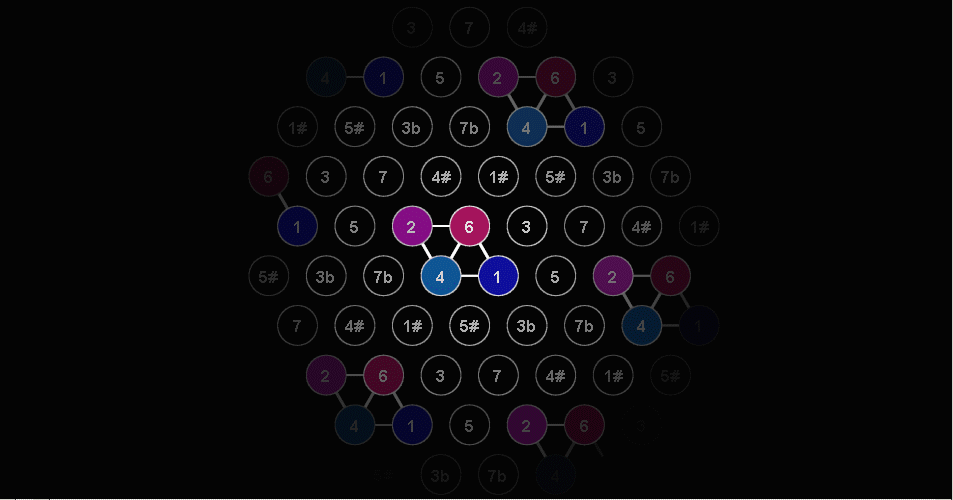
Several months ago, I described a system used by Stephen Malinowski which illustrated relationships between notes.  He actually used several methods, I'm referring to one of them: The Interval Lattice.  Here it is:

Here, the Home Note is represented by 1.  You could think of it as C major, if you like.  Surrounding it are six other notes: counting counter-clockwise from the note immediately to the "east" is 5, or G major; 3, or E major/minor; 6, or A major/minor; 4, or F major; 5#, or 6Flat, G Sharp or A Flat; and finally 3Flat, or E Flat major.

Of course, some folks consider every note to be related to every other note.  This particular scheme gives priority to these 6 notes, but if you take their immediate neighbors, you get all the possible notes included, at (at most) a distance of one (additional) note away.

To help out novices, I should say that some of these 6 notes are closer than others; actually G major, F major, and A minor are the most closely related.  These are most often the first destination when Bach, for instance, leaves home.  Next favorites are D minor and E minor, closely followed by G minor, and C minor.  (By this time, you're seeing that this lattice is not that helpful, really!  Maybe some 3-dimensional lattice might be of help...)  So when I say that I want to know where I am, I don't mean simply which new Home Note; I want to trace the sequence of Home Notes that got me where I am.

Where do Riemann, Columbus and those people come in?

It has to do with maps.  A map, of course, is an abstract representation of a geographic area.  (We've obviously gotten away from thinking of a map as a representation of The World --here be dragons, etc, etc.  Maps of The World are, at best, laughable approximations, because adjacent points are often at opposite ends of the map.)  If we think about it, our system of scales is a map from a set of sounds into the numbers 1, 2, 3, ... , 7.  Mathematicians and geographers soon cottoned onto the fact that any shape other than a plane, such as the Earth, cannot be represented by a single map.

One of the big things-to-do in mathematics is to calculate gradients, such as the pressure gradient, or the temperature gradient, and so on.  A lot of physics is all about gradients, but we math folks own the idea of gradients.  It so happened that everyone knew how to do gradients when using a single map.  Riemann's brilliant contribution to mathematics was to show how to do gradients while using a patchwork of maps!  By and by, Einstein came along, and said that all maps were equally good for physics (though of course some maps were a little more equal than others).

[Added later: As to the mathematics-- A surface such as a cylinder or sphere (or Möbius Strip, for that matter) cannot be represented by a single map.  So you need several maps to represent the whole thing, and these maps must overlap, and there has to be a minimal degree of smoothness in the equations that connect the two maps in the overlap.  These sorts of surfaces, together with all their maps, are called Manifolds, for the simple reason that multiple maps are necessary.  So, all manifolds are locally Cartesian; in other words, a small neighborhood of every point is one at least one of the maps.  Compare this with the remark that Wagner's music is locally diatonic in the following paragraphs.  Later composers have written music that is totally atonal, that is, there is no tonal center at any moment.  In fact, they go out of their way to destroy any feeling of tonality --any feeling that there exists a Home Note, even a temporary one-- in the entire piece.  I must confess that atonal music is not satisfying to me personally, but I might have enjoyed a few seconds of it while my defenses were down.]

Then along came a fellow called Richard Wagner.  I doubt whether he knew anything about Riemann or Einstein, but he was writing music that seemed to completely disregard the home note.  At any given instant in time, one can hear an implied home note.  But unlike Bach, Handel, Mozart and Beethoven, all of whom traveled widely in respect to their home notes, but who always took the time to travel back to the home note, Wagner sometimes set out from the home note, never to go back again in the same piece.  Like Riemann, though, who insisted that every point should be on some regular map that looked more or less like the X-Y grid, Wagner's music is, in a small neighborhood of any moment in the music, like the music of Bach, which is to say, locally diatonic.  This makes Wagner's music easy to apprehend, so long as you did not have a driving urge to "go back home" to the initial Home Note.  [Wagner changed home notes --modulated, which is the technical term for it-- based on the imperatives of the melody he was building.]

Many Wagner tunes are perfectly diatonic.  Some of them, however, are not.  So Wagner is, for music, something like what Riemann (or Einstein) was to mathematics (and Physics).

So, you see, geography is not too far removed from music, conceptually.  To conclude, Merv Griffin's tune used in Final Jeopardy (named by Griffin Think) is an instance of a tune that leaves home in one direction, and arrives home from the opposite direction, having gone completely around the world!

Arch

Sunday, May 8, 2011

AN EXTENDED FAREWELL TO OUR GRADUATES!

.
Every year I feel ever more impatient to give our departing graduates a jolly good word or two of advice, but I never get the chance, what with Finals, and grading, and all the parties, ahem.  This time I’m really going to do it.
Most students –and their parents—see a college education as a gateway to better employment: a nice, easy, well-paying job.  (Actually, jobs for college graduates are not going to be easy, except for the exceptional graduate.  They usually involve less heavy lifting; that much can be said.)
And now you’re expecting me to give you the usual drivel concerning what a college education is all about.  But you will be disappointed; I’m going to give you that drivel at the end.
The Elephant in the Room, of course, is the fact that you’re going to be looking for jobs, so let’s get that out of the way, before your attention starts to wander.
Some of you are thinking: well, I like to … watch TV, hang out with my friends, party on the weekends, play video games, and listen to loud music.  These are personality traits that have to be carefully concealed from your prospective employer, you’re thinking, so the entire job-seeking process becomes very tense and uncomfortable.
Nobody wants to hire a tense and uncomfortable job applicant.  This is no way to go about presenting yourself.
But, imagine what you could be thinking instead.
You’re a person who wants people to get a fair deal.  You want to work reasonable hours for reasonable pay.  You feel you can do as good a job on any task as anyone else they can hire, and dammit, people like you.   But, seriously, you’re more interested in making a good match between what your employer has to offer and what his customers need, than in making a shady buck for your employer at the cost of an unhappy customer.  You want to become a good parent to your kids, and a good spouse, and a good alum of your school.  This means, you have to take on responsibility, and discharge it reliably, and be in a position to hire more alums some day!
If they hire you, good for them.  If they don’t, they will learn their mistake, and begin to realize what an opportunity they let slip through their fingers.  (So leave your e-mail addie with them, in case they need you desperately someday.)
As some of you know —or suspect—I teach mathematics.  When I say this, I can just imagine what goes through people’s minds.  Actually, it could be a number of different things, depending.
“Mathematics!  Fractions!  Eugh!”
“Mathematics!  Pi!  Wow, you must be a god!
“Mathematics!  I guess that would be, like, Accounting …  You must be good at doing your taxes.”
“Mathematics!  Like, Statistics?
(Actually, most people think of mathematics as multiplication.  They wouldn’t come out and actually say this, but that’s what they’re thinking.)
Most of you are not as afraid of math now as you might have been at one time.  There comes a point when you look around, and see how much more afraid of math everybody else is than you are.  This is usually a turning point.
There is a sort of conceptual fence you jump over; one day you’re accustomed to thinking of yourself as a math-phobe, and the next, you’re thinking: well, yeah; it certainly is unpleasant, but not fearful, no.  And your entire attitude towards it changes.  As you go higher up in math, it happens at different levels: Calculus, Trigonometry … all things that people start out hating, and the lucky ones cross the fence, and laugh at themselves for having feared it.
There are these fences you have to cross: from being single to being married; from being a student to being a teacher; from being a youth, to being a parent!
You’re probably thinking: this guy is a total math maniac.  Yes, I’m kind of a math geek; and I wear it proudly!  (I’m other sorts of geek, too; but I’m not quite ready to be outed at this point.)  But all the people who sit on the platform at graduation, certainly at my institution, are absolutely convinced about the value and the fascination of their chosen field, and, very probably, of those of a number of other fields as well.
To be this way, to be so insanely enthusiastic about a discipline, is to be totally persuaded about civilization, about human achievement, about the good parts of human history.  And the fact that we chose to teach tells you that we believe in the future.  We wanted to infect you with this disease, and this is why you should be an asset to any employer who cares about his community.  It is never a good time to hire an employee who looks at civilization with doubt and despair.  We want you to cross the fence from the side of the people who just don’t get civilization, to the side of people who may not understand it, but who are in awe of its amazing achievements.
You can also write.  You can do math.  You can appreciate art, music, and dance.  You can read and understand books.  You can surf the net on your employer’s behalf!  You are an amazing value to your prospective employer. 
We sincerely enjoyed having you with us for this long.  Honestly, we probably enjoyed having you here more than your parents enjoyed having you at home; why else would they send you off to a residential college?  We love to have you come back!  Of course we sometimes tend to hide when you descend on the school en masse, but that’s different!  We have seen you at your best so far, and your worst, and we still like you, but the best is yet to come.
Good luck!

Thursday, May 5, 2011

Sprung ...

.
Spring has, finally!  At least here, in Pennsylvania.

I remember bringing my aunt up here one time.  She had lived in Arizona for years and years, and only visited other places by plane.  We brought her up from Philadelphia by car, and she stared at the scenery.
"Well, what do you think?"
"It's so ... so green.  It's too green!"

That's how it strikes people who live in the Southwest; it's too darn green up here.

This is the time of year when Dogwoods in bloom stand out in delightful contrast to the surrounding greenery, with their distinctive light-colored flowers.  Willows are among the first to get their leaves, an interesting yellow, until a little later in the season.  Now the evergreens are surrounded by leafing deciduous trees.  Here is a photo from my friend's driveway; it's two photos pieced together, to show a variety of trees.

All the way at the left, close to the house is what we believe is a Pennsylvania Hemlock, the official State Tree.  A little to the right, you can see the white flowers of the Dogwoods, at the edge of the lawn.  The tall woody trees near the center are Black Walnuts, that haven't actually started leafing yet.  (I'm told that they're usually the last to get their leaves.)

Right behind my friend and her dog is a Lilac bush, with flowers a deeper shade of purple than the traditional lavender blooms.  Finally, the salmon-colored flowers are on a Japanese Quince bush.  (If I could have got in some Forsythia, we would have the entire spectrum of colors represented in this single view, without the painful contrasts one sees in Conservatories!)

That outdoor grill is making me hungry.  Gotta go.

Arch

Final Jeopardy

Final Jeopardy
"Think" by Merv Griffin

The Classical Music Archives

The Classical Music Archives
One of the oldest music file depositories on the Web

Strongbad!

Strongbad!
A weekly cartoon clip, for all superhero wannabes, and the gals who love them.

My Blog List

Followers