Thursday, September 26, 2013

Under Attack: Obamacare!

The far right extreme of the GOP (or SOP: Silly Old Party) is attacking the Affordable Care Act, commonly known as Obamacare, furiously.  There was a 21-hour address by Ted Cruz of Texas, that brought in such relevant themes as Naziism, and Eggs and Green Ham, and Freedom, all to speak in favor of de-funding the Act.

Jim DeMint who recently abandoned running for the Senate in favor of taking the reins of the Heritage Foundation (a conservative think-tank) has had the Foundation put up an enormous billboard in New York City that decries Obamacare, and urges readers to support de-funding it.  The list of Republican spokesmen (and women) calling for erasing Obamacare is too long to enumerate.

Why is Obamacare such a cause for concern among conservatives?
It is hard to guess.  What they claim is their reason for opposing it need not have a lot to do with why they actually want it destroyed.  I have a few guesses.

(*) Obamacare is a huge Democrat achievement, and if it works as it was planned (and remember, its success was estimated probabilistically, and a lot depends on behavior trends, as most insurance initiatives do; a lot of people acting irrationally can derail it), it will be a huge issue on the credit side for the Dems, and you can see Democrats, both great and small (mostly small, unfortunately) running on the strength of it for a decade.  "We brought you Obamacare!  Vote for me!" 

Obamacare is also a Republican loss.  They fought like dogs to sabotage it, and if they fail, it will be an enormous dent in their reputation.  They brought up everything from Freedom of Choice, motherhood and apple pie, and had to go to the extreme of painting the Insurance Industry as the saviours of the nation, to vilify the Bill (but of course they went right back and said, no, the Insurance Industry is the very devil incarnate, and the Bill was written by them, and is a piece of crap, etc, etc).  So in the puerile world of political point-scoring, Obamacare could be a huge smudge on the GOP scoresheet.

(*) The GOP has been heavily lobbied by the Insurance Industry.  This is senseless, really, because the Industry does not really lose such a lot.  There are controls of runaway profit-taking, I suppose, but it seems to me that the new law strengthens the industry, while reining in its lucrativity.  If the Insurance Industry fights the law, they are really making things harder for themselves.  After a year or two of Obamacare, I believe that the population will look at the Insurance Industry with a very jaundiced eye, but nevertheless I believe it will be in a comfortable position, if not going like gangbusters.

(*)  A few small businesses, and small-business organizations, have been persuaded early that the new law is to their disadvantage.  As far as I understand, while all businesses are given new responsibilities for the health care of their employees, they have also been given new financial help for that purpose.  In all fairness, I have to say that this is inappropriate; I am strongly of the opinion that Health Care is the responsibility of the State (the government, at any rate), but Congress —as it was constituted in 2004-2005— distrusted the Government bureaucracy, and decided that small businesses were more to be trusted with providing health care for the population.  This attitude has been nurtured by Business itself, and Business has only itself to blame for promulgating the myth that Business is more to be trusted than Government.  Yeah, right.  At any rate, now that various sectors of the Small Business whatchamacallit have taken the view that Obamacare is bad for Small Businesses, those who lied to Small Business in the first place have begun to believe it themselves.  Isn't that amazing?

(*)  Healthy young people have been incited to protest against the law, because it requires everyone to carry health insurance.  Some of the young people in my extended family were railing about the new law, and moaning that they could not afford to carry insurance (especially since some of them were unemployed), and, as you can imagine, young people are, generally speaking, not subject to the health problems of older people.  Furthermore, young people are perfectly happy to ignore whatever health problems they have.  And again, young people looking for employment are eager to present themselves as being in almost amazingly good health, even if they suspect that they might have a chronic condition, which of course must be kept from their prospective employers at all cost.

(*)  The people leading the Republican Party at the moment are some of the dimmest bulbs we have had in government for a century.  Let's face it: Health Care is a complex issue, and of all solutions to the problem of National Health Care, the one that was in fact adopted (by a Coalition of idealistic liberals, scaredy-cat Democrats who were nervous about the fallout from the bill —with good reason, in hindsight— cooperative Republicans, who were afraid of the backlash from their more conservative fellow-party members —with good reason— and meddling members of the Insurance Industry Lobby, who were anxious to make sure the law would not debilitate the Industry) is a compromise, and so even harder to figure out than such a law would have been if it was simple in design.  So, not too many people are able to read the law in its entirely and make sense of it.  We liberals —and forgive me for including you in this category— for the most part endorse the law because we have some faith in Obama and his team.  I have not read the law, and I'm afraid to start reading it now.  But such people as Rand Paul, Ted Cruz, and Rick Santorum (who isn't anything connected with any government body, at the moment) and the members of the conservative media have no hope of understanding it.  They do not have the mental equipment for it, and possibly not the vocabulary.  All they can do is to spot an isolated sentence here and there, and cling to them with furious indignation, misinterpret its intention and its consequences, and run to proclaim their hostility to it, and to the Act as a whole.

A big mistake that congressmen make, in poking holes in the law, is that they have of course forgotten what it was like before they had the fabulous health plan they enjoy as member of congress.  They object to the law because it makes it possible that a person may have to change their doctor.  Well, if your health plan is like my health plan, I have been forced to change my doctor any number of times, because my employer changes insurance providers every once in a while, and sometimes a health plan has a list of Preferred Providers, which means a new doctor.  We went to the extent of hanging on to our non-preferred doctor, just for the sake of continuity, despite the very real antipathy between our doctor and our insurance.  So far, so good.

A few Republicans, notably John McCain, have said that de-funding Obamacare is not a possibility.  Who knows; perhaps McCain has been in sympathy with a unified health care system for the USA all along, and simply did not bring it up for fear of being accused of being UnAmerican.  It seems to me that anyone who has served in the Armed Forces can only be in favor of Health Care Reform, both because of the health care they get as members of the Armed Forces, and the miserable health care they get once they're discharged.  Both Kerry and McCain and any real veterans (unlike George W. Bush) are likely to have their heads screwed on well enough to know a good thing when they see it.  There is no going back from Obamacare, unless we want bigger chaos than we have now.

Arch

Thursday, September 5, 2013

The Challenges of a Diet Guru, and their Roots in Education in the USA

.
Suppose you want to educate your fellow-citizens about proper nutrition, weight-loss, and how diet influences the health of a typical modern human.  You want to become a Diet Guru.  In addition, since you’re performing a service, you’d like to make some money while you’re at it.

You look at all those who have tried before you, and failed, or those who have succeeded, but whose successful adherents have gone on to curse their diet guide, because they’ve gone off their diet, and put on more pounds than ever before.

In recent decades, many diets have been centered around gimmicks: Grapefruit, or what have you.  All of us recognize these gimmicks to be exactly what they are, but we have a sneaking suspicion that it just might work.  It’s like the people who go to church, who don’t believe in anything they hear there, but are nervous just in case some of it might be true, and they might get turned into a pillar of salt, or whatever.

Many emerging diet gurus have to deal with two things: gimmicks, and superstition.

Gimmicks
These have to do with marketing.  It doesn’t matter how good your mousetrap is.  It truly doesn’t.  All you have to do is to make a big fuss about it, and put up enormous billboards all over our little town, and (so the theory goes, and make no mistake: the Marketing gurus are total masters of persuading the public that marketing is all that matters, and if you’re selling your mousetrap to people who don’t have the time or the sense to check out their product, marketing is all that does seem to matter) the world will beat a mindless path to your door.  If you charge enough for your glitzy new mousetrap, it doesn’t matter if your product turns out to be totally useless: you’ve already made your money.  Foithermore, if you sold stock in your company, the stockholders are left footing the bill, or eating the losses.  Everybody knows this.  Or they should.

Superstition
This has to do with education, and also a little with marketing.  You see, the USA has achieved almost zero dropout rate in high school, by doing a few questionable things.  Firstly, everybody is taught a vast number of things in high school, all considered basic.  Since nobody is essentially allowed to drop out, these things are all pre-digested and fed to the students in tiny doses which they can easily swallow, but the vast majority of kids in school are not interested in any of this, and don’t have the mental equipment to really assimilate much of it, and therefore cannot remember it.

A basic part of grade school education is human physiology.  Everybody is taught how food is digested: fats, carbohydrates and proteins are digested in different ways, and at different points in the alimentary tract.  Everybody has heard the words Ptyalin, Bile, Lactase, Hydrochloric Acid, catalysis, and so on, but less than one in a hundred outside of the medical profession (or health-related professions) remembers any of that crap.

Everybody learns the circulatory system in school.  You know about the aorta, the pulmonary vein, the arteries, the capillaries, the veins, the lungs, the brain, the heart, the left ventricle, and so on and so forth.  Most people don’t give a damn about any of this.  You were told that the digested food enters the bloodstream, but you weren’t probably told that the food you eat keeps waltzing around your body until it gets either used up, or dumped somewhere.

If someone asks you, of course you exclaim that it is obvious that the food travels around your bloodstream until it is used up, or deposited somewhere.  That’s obvious, you iterate.  But just do not have a mental picture of a cheeseburger being helplessly hauled all over your body until some muscle mercifully puts it out of its misery by either burning it up, or allowing it to take a nap in its cells.  (A very long nap, which could last about 20 years.)

Instead of actually believing what they were taught in school, many folks end up believing various superstitions.  Americans are a superstitious people.  Many of the superstitions are about cholesterol and carbs and calories and steroids and sugars and saturated fats and Olive oil.

Many of these superstitions were actually created by diet gurus, or their marketing consultants.  Marketing consultants have rules of thumbs that help them sell things.  Unfortunately for all of us, many of us have discovered that our lives are made easier by using these same rules of thumb.  Things would be a lot easier if I used these rules of thumb, too, and many of my fellow-teachers use them too.  A major one is to create useful superstitions.  The superstitions, of course, are useful for the diet guru, or the teacher, but ultimately not for the consumer or the student.  It gets the consumer or the student doing the right thing quickly and easily, but once you want the consumer (or the student) thinking about the information in a more sophisticated way, the superstition actually gets in the way.

One of the most recent inventions is the idea that gluten is bad for you.  There are many reasons that gluten might be bad for one: Celiac Disease, if you have it, means that gluten aggravates it painfully.  For various reasons, it has been reasoned, that gluten is bad for everybody.  At present, as far as we know, only fewer than 1% of people have an adverse reaction to gluten.

However, you probably know that a lot of your friends are sort of addicted to pizza, or pasta.  Arguably, it is the elastic, chewy characteristic of pizza dough, and the sweet taste of the tomato sauce that makes pizza taste so good (though most of us are under the illusion that it is just the melted cheese that is the miracle ingredient).  Many of us are also addicted to bread (and butter!), so if a diet guru can turn you off of gluten, which means all sorts of bread products, that immediately removes a whole lot of pizza and bread from your diet, and we all know that all our friends who adore those two foods are well on their way to being Pilsbury Doughboys.

I do not know, not being in the inner circle of those who undertake food research, whether gluten is clinically addictive.  But it seems a far cry from educating people to avoid gluten because it is possibly addicting, (and because it is usually accompanied by a ton of starch!) to telling them that wheat is bad for them.  Gluten itself is a useful protein, and was an important component of the diet of vegetarian Seventh Day Adventists, for instance.  You may not approve of the denomination, but, for any of us not suffering from Celiac Disease, gluten seems to be, from what little I know, a perfectly reasonable food to be eaten in moderation.

Like my spouse, if you find it impossible to eat gluten in moderation, and if you find that eating a little gluten (in any bread or wheat you might eat) at any time of the day makes you hungry all day long, then clearly you could make greater loss in your weight (if you want that) by staying away from gluten, but remember: it is really the extra calories that we’re really trying to avoid.  If you happen to ingest a little gluten, there’s absolutely no need to induce vomiting.

But doesn’t it seem silly to you, to create a whole wheat is bad for you superstition, just to get you to avoid eating gluten, in order to lose weight?  Must we swallow lies, in order to do what is best for us?  This is what religion is, you see.  Don’t bully your sister, or Santa will give you coal for Christmas.  This is what we’ve come down to, because everyone wants to be treated like a kid, because being adult is just a little too difficult for us!  (In fact, one author actually made a point that whole wheat is very bad for us.  Why?  Because people tend to eat a little more whole wheat, believing that a lot of whole wheat is better than a little white bread.  Good calories do not offset bad calories.  Good calories are preferable to bad calories.  Choose between them, and eat just a little of the one you have chosen.  You cannot cancel out calories with calories, generally speaking.  They all add up.  But if you don’t exercise very much, every additional calorie is going to settle in for a long stay.

[How about negative calories?  You may have heard that certain foods, such as cauliflower and broccoli, actually use up more calories from your body than they contribute.  Is this true?  Yes.  These vegetables are mostly fiber, so they provide a feeling of satisfaction, or fullness in your stomach, without contributing calories.  They do have a little carbohydrate in them, but the stomach has to work so hard (and so long) to digest those foods that you use up more calories in digesting them than you get back from them.  Unfortunately they stay in your intestines so long undigested that they survive far, far down your 22 feet of guts, where certain sorts of bacteria get hold of them.  Unfortunately, the digestive process of these bacteria create a little gas, which many people feel uncomfortable about.  Eat broccoli or cauliflower early in the day, so that the methane finds its way out before you go to sleep, or you’ll be rolling about in bed.  Maybe.  Making like a gas well for an hour or two is probably well worth the loss in weight you might experience.]

You might know lots of other superstitions, that might have started out well-intended.  In fact, budding diet gurus, as I said, actually manufacture superstitions, to get their clients to lose weight, and experience seems to show that the superstition works better, at least in the short run, than the actual information.

So if you’re a diet guru wannabe, (1) you have to identify some old superstitions that are getting in your way, and mark them for attack.  (2) make up some new superstitions of your own, and keep hammering them.  The sexier they are, the better name you make for yourself.  Make your money, and leave town before your people go off their diets.

I know what I have to do to lose weight.

(1) I have to eat moderately.  Eating a big breakfast actually helps me eat less the rest of the day, so I eat an egg or two for breakfast, whenever I have the time to do it.  I start work at 7:45 on some days, and it’s hard to get motivated to eat in time to get to work.  I try to eat moderately at lunch, and very moderately at supper.

(2) Remember, your food finds its way into your arteries.  It’s that simple.  There is no special delivery system for food; food and oxygen slosh along together in the blood.  Blood is a mixture of Oxygen, protein, sugar, fat, water, and hormones, which are essentially switches for the body to respond to some condition in a concerted way (all at once).  In the mornings, when you’re walking about, the food can get used up fairly easily.  At night, if you’re asleep, not only does the food not get used up, it doesn’t travel far from your intestines (which is where they got into the blood, obviously), so it gets deposited close to your belly.  Men and women with big bellies (including me) eat late at night, and aren’t active after that last meal.  If you kept working for about an hour after your last meal for the day, doing the laundry, walking the dog, whatever, you’re less likely to develop a big belly, but you might gain weight uniformly all over, if you don’t use up the food efficiently.  If you use up all your dinner, you will not gain weight at all.

(3) I’m guessing here, but if you’re concerned about cholesterol, keeping active after each meal ensures that fat deposits are not made close to the heart, but (if they’re made at all) uniformly throughout the body.  Furthermore, occasional vigorous activity helps flush away fat deposits from the heart itself.  There is a certain amount of blood circulation going on in the walls of the heart itself, just like the engine oil that circulates around the pistons in your car engine.  (You must realize that the engine oil doesn’t normally go inside the pistons: that space is reserved for the gasoline-air mixture, which will be ruined by lubricating oil.)  The blood that the heart itself uses must be kept free-flowing, and fat deposits in the blood vessels of the heart means that it will start to have problems, and it usually signals blood starvation by flashes of pain.  If the blood is completely blocked, you have a heart attack.

Fat in the bloodstream is not good, but a tiny bit is ok.  Generally speaking, thin oils, like olive oil, is better than thick oil, like lard, and less oil is better than more oil.

(4) To get rid of stomach fat, exercise focused on the stomach has to be used.  If you lose weight all over your body, some of the stomach fat will go, too.  But if you want to do body-sculpting, you have to do some exercise that will use up the fat in your stomach.

Again, I’m no expert, but the body prefers to use sugar (specifically glucose, and other sugars must first be reduced to glucose) as fuel for doing work.  If you keep doing steady work for about 20 minutes, from what I have been told, the body begins to use stored-up fat reserves.  (Remember, this happens only after it has used sugar for a while.)  So --and I realize that this might be a superstition too, and I urge you to back this up with your own reading-- if you do 25 minutes of stomach exercises, you use up sugar for the first twenty minutes, and then burn stomach fat for the remaining 5 minutes.  Whichever muscle is being exercised, it grabs fat from the closest fat location.

If you’re suddenly required to lift a heavy weight, or to sprint a short distance, the body “burns up” protein to do it.  The burned protein creates lactic acid in the muscles, which manifests itself as a cramp.  Once the lactic acid is spread away from the muscle that had to bear the brunt of the exertion, the cramp subsides.  But, as you can see, doing sudden, intense exercise does not burn fat, but burns (or, more properly, consumes) a little of your muscle tissue.  Only steady exercise burns sugar and fat, so to help keep your heart healthy by flushing out fat deposits from the walls of your heart, you need (occasional) steady intense exercise.  This is why aerobic instructors make you do jumping jacks; it increases the heart rate dramatically, but doing one enormous jumping jack will probably just use up a little protein. The same goes with bench-pressing an enormous weight.

Very recently, I learned something very depressing.  Apparently all your stomach fat is not stored in the actual muscles of your stomach; a lot of it is stored around your organs: the liver, the heart, the pancreas, the kidneys, etc.  It is not really attached to any muscles you can exercise, so by working on your abdominals (my sources claim), you cannot get rid of all your belly fat.  On the other hand, when I try to feel how thick my abdominal muscles are, they do feel soft and flabby, so I don’t know whom to believe...

(5) It is obviously important to work with your own addictions and eating habits, and if    you’re so feeble-minded that you cannot succeed without swallowing some weird superstition, well, do what it takes.  There is a new diet making the rounds called the Wheat Belly Diet, which will probably work for those whose weakness is pasta, pizza and bread.  Once in a long while, it may be as well to give in to your cravings and eat an occasional pizza slice.  Some folks just do not do well with long periods of deprivation.

So, firstly, eating sensibly will ensure that I don’t gain any more weight.  To actually lose weight, I have to do some sort of exercise, and I walk the dog every once in a while.  This doesn’t really work, because she doesn’t keep up a steady pace, and stops to sniff at every tree and fire hydrant.  But a really long walk does burn up some calories, and some activity after supper helps me deposit my supper all over, rather than all near my guts.

If you’re a Diet Guru to be, do us all a favor, and encourage your clients to incorporate exercise in their regimen.  Diet alone will not work, unless you’re like, 15 years old, in which case you probably should not normally have a weight problem.

Finally, there was something I read that said that extra Insulin in the bloodstream encourages the conversion of carbohydrates and sugars in your bloodstream into fats.  Man, I’ve never heard a better argument for postponing the use of Insulin injections.  But if you need Insulin injections to keep your body functioning, I guess you have to cope with this additional problem.

Arch


Monday, September 2, 2013

Cities of the Future, according to WWW

.
I'm not sure what to think of the big advertisement.  The tubes might be cables or conduits for exhaust gases, or sewers.  You can see a rail transport approaching.  The sky (which is far from blue) seems to contain numerous aircraft proceeding in orderly columns.  The buildings off to the right look uncomfortably like hives.
.

The dominant feature here are the roads.  This is a motorist's nightmare of sorts, except that the traffic is quite thin.  Why the weather is so rainy I'm not sure; perhaps it's Seattle.
.
At last a sunny scene.  Lots of sunshine, and buildings, and an aircraft.  All the glass bowls make me wonder what the deal is, there.  The ring-shaped structure might be an auditorium or an arena.  Notice the elevated line that might be a monorail.
.
Whoa.  This must be somewhere in the Far East, judging from the colors.  There is no feature that is interesting except that there are lots of aircraft in the sky, and a sort of bubble-car on the left in the middle distance.
.
.

Another bleak scene, showing some speeding rocket cars in the foreground, and some smog in the distance.  The industrial sector of the scene is in the background, with smoke pouring out of smokestacks, the foreground is the business and residential sector; the scene must take its inspiration from New York or London.
.

This scene seems to represent a future that is mostly an enormous fun fair.  There can be no serious purpose for the Ferris Wheel, which means that we can't tell what is a roller-coaster, and what is an elevated highway.  All in all, this looks like a fun fair of the future (or of the present; I didn't check the page carefully!)  There seems a representation of Big Ben in the foreground, which really makes me wonder ...
.
This is a very realistic-looking piece of artwork, with a railway system going in a couple of directions, and again the air looking pretty polluted.  Most artists seem pessimistic about our chances of arriving a century or two hence with clean air.  The pollution results in fairly spectacular sunsets, as the scene shows.
.
"Salad Cities"?  The buildings that emphasize horizontal slices must be hotels (or apartment buildings--in the future, the distinction will become blurred, I do not doubt).  There are, surprisingly, birds in the sky.
.
Hmm.  Again a future scene dominated by roads of a sort.  Multi-layer highways enable people to go lots of places, but it seems more realistic to imagine that a lot of travel in the future will be via efficient public transport (which should be able to manage with fewer roads running parallel to each other), or virtual travel.  The tremendous expense of constructing communications (highways and bridges) is not worth the result.  When the mass of concrete in a city climbs, the ability of the city to cool off in the night is eroded, and temperatures will climb.  Air conditioning only aggravates the problem.
.
This is not an artist's impression at all; it is a permanent installation in a bayside location in the City of Singapore, which was created in response to the call by the prime minister in August 2005.  These structures were created in an enormous area of reclaimed land, and is intended to increase the amount of flora (plants) within the city.  Actual trees are a component of the enormous tree-like superstructures.  Imaginative use of plants will be a central part of any bright future we can aspire to.
.
This is essentially the world we have in present-day metropolises.  Idealized in this artist's impression, it can be seen to be truly grim.  Vast numbers of commuters march off either to work or home again, and no greenery is visible anywhere; there is no room for greenery in this sort of urban nightmare.  Many folks will regard this illustration with benevolence, but any visitor to New York City will recognize the aspects of it that are not pleasant.  Dreary magnificence.
.
.
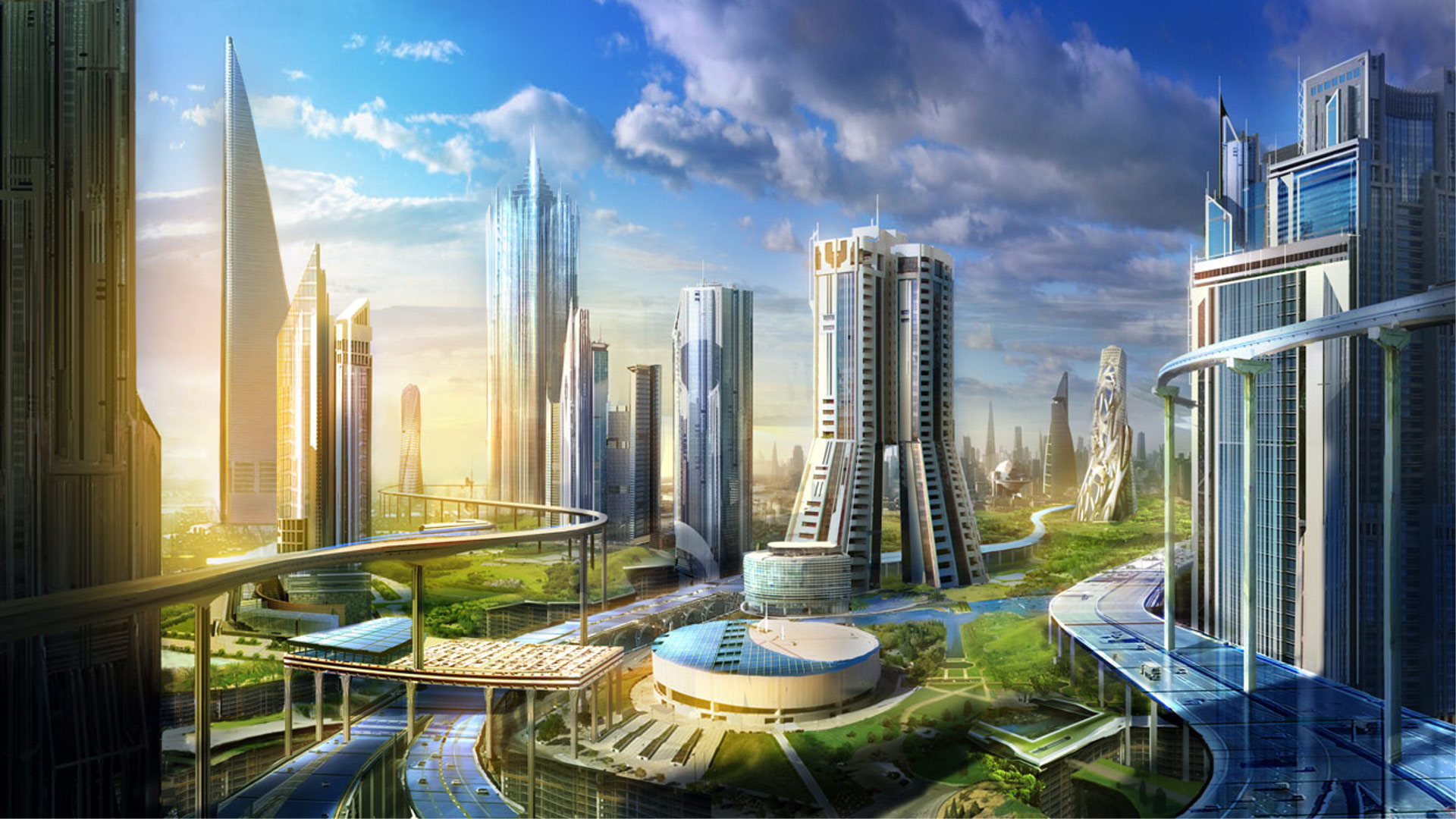
This is evidently a futurescape for a computer game.  Artists depicting the future sometimes think exclusively of architectural aspects, as here, sometimes of city design an planning, some focus on transportation, consciously or unconsciously, as in the previous image, all of which have implications for the style of living in that imagined future.  The image above brings into focus architectural trends in steel and concrete design, especially of the sixties, where there was a move away from rectangular lines, horizontal or vertical.  The vertiginous image shown is a little off kilter; a straightened image is at right.
.
??? What is this all about?  Again, a very dark image--pollution, or just atmosphere?  It seems to be an piece of art some decades old.
.
This is, unbelievably, an artist's view of an enormous "time-travel machine."  The scene suggests that the whole structure (or at least this part of it) is contained inside an enormous doughnut-shaped space (a torus) which is used to enable the time-travel!  But, quite apart from time-travel (a fun "what-if" idea for fiction), we see the possibility of entire human communities existing in space.  The roof is an artificial light source, which plays the role of the Sun, but must be dimmed and brightened in a 24-hour cycle (if this were to be a substitute for planetary living).

[To be continued --maybe]

Arch

Sunday, September 1, 2013

Flyovers: Highways in the Sky

.
This turns out to be a fascinating subject, but one that I don't feel as though I know enough to write about.  My audience (you folks) is probably too diverse to make assumptions about, but I'm guessing that some of you don't think twice about those really complicated highway interchanges that have ramps going in fifty different directions, with overpasses and bridges and underpasses, and the rest of you haven't seen anything more complicated than a cloverleaf!

When I was a kid, growing up far from any big cities with super- highways, I discovered a book one of my uncles had passed on to me.  It was printed around WW2, and had an artist's impression of the City of the Future.  It was conceived at a time when the dream of most people (at that time, that probably meant most young boys) was to have an utopia based on private cars, not private flying machines, as you have in Star Wars, for instance.  So it was a maze of highways, that looked something like the drawing on the right.  What struck me was the elevated highways.

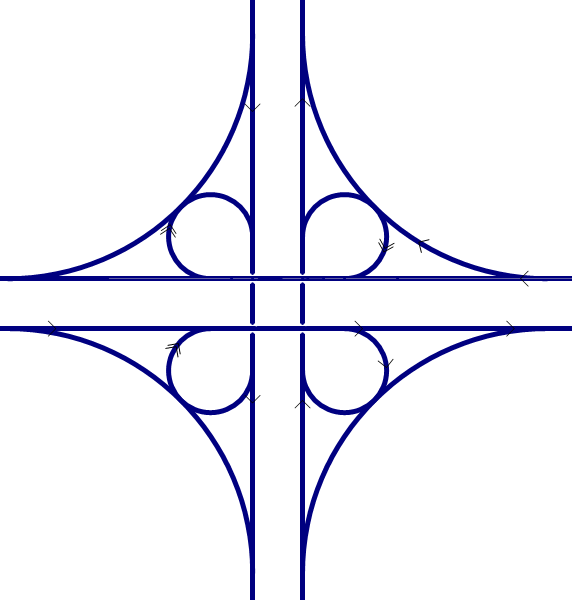
I lived for years in rural parts, and when I went back to drive through Pittsburgh one time, I was amazed at the --seemingly unnecessary-- complicated highway interchanges I saw.  I had, of course been familiar with cloverleafs, the simple design of a pair of highways crossing roughly at right angles.  You had a plan whereby all you had to know to do was merge, and you were set for life.  You took an exit, and if you wanted to turn right onto the other highway, you turned through 90 degrees, and merged back in, at another level, of course, because the other highway had to go either above yours, or below.  So you turned through the 90 degree angle while you either climbed about 20 feet, or dropped about 20 feet.

To turn left, you also took an exit (on the other side of the intersecting highway, onto which you wanted to get), went through 270 degrees --three quarters of a full circle-- and either climbed or dropped the twenty-odd feet of difference in level, and merged into the slow lane of the other highway.

Cloverleaf, with the left-turn circles
outside the right-turn ramps.
Notice that the cloverleaf arrangement is very compact vertically.  You only needed a total of around 40 feet of height, half of it occupied by the lower highway, and the other half occupied by the other highway, so that if no trucks were ever taller than 20 feet (and we must hope that trucks never get taller than that), everything would stay under 40 feet above the ground.  (It strikes me that this is a good design for an interchange near an airport.)  I briefly note that in a cloverleaf, it is actually possible to make a U-turn: you turn left onto the transverse highway, go across a few feet and exit again, go round the circle on the other side, and you end up headed back the way you came, on the opposite lane.

Cloverleaf, with the circles
inside
the right-turn ramps.
In principle all these interchange are intended to enable traffic to flow without stopping, provided it was light enough.  If it was okay for traffic to stop, such as in a major intersection in a city, all you need is a waiting lane for traffic turning left, and you can actually get away without those special left-turn signal lights.  Left turning traffic just waits in a special lane carved out of the median strip on the other side of the intersection, and moves with the traffic going crosswise when the lights change.  Everything takes place on the same level.  A lot of big in-city intersections in the Southwest are set out this way.  (I'll throw in a diagram when I have a few free minutes.)  Only a few vehicles can occupy this special waiting area, so traffic has to be light.  The intersections are widened into a diamond shape to accommodate the special waiting area for left-turning traffic.

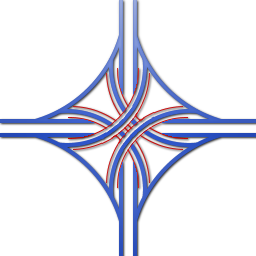
The problem with cloverleafs (cloverleaves?) is that the left-turning traffic has to go round this enormous circle.  Furthermore, the cloverleaf does take up a lot of real estate.  Another design that was invented in the sixties (or the late forties, if our Internet sources are to be trusted), is the stacked interchange.  I just learned about them a few days ago, and I began to realize that they were things I had driven through, but they had looked so complicated I had seriously doubted I could ever understand them.  It turns out that, well, they can be symmetric enough for anyone to understand, but they have lots of alternative configurations for highway engineers to make dozens of variations on the design.

The main idea is this.  (See picture below.)

The two intersecting highways are separated vertically by about 100 feet.  This alone is enough to boggle the mind, but the variations on the design might be a lot less high.  Now, anyone in any of the roads turning right goes off a ramp, and joins the slow lane of the (other) highway in the usual way.  (Since the two roads are at such different horizontal levels, the ramps involve some possibly steep climbs.)  Suppose you're heading North, and now want to turn "left" to take a Westbound highway.  You take the exit ramp with the Eastbound cars.  Now the ramp splits, and you follow a link that drops you onto the on-ramp which the cars that had been on the Southbound highway (originally going in the opposite direction to you) have taken, who are now also going West.  That's it.  A ramp-to-ramp connecting link.

On the plus side, you don't have to go round that enormous circle.  Also on the plus side, any high-rises that might have been situated near the intersection can continue to exist, except that now they have this enormous interchange that rises around 100 feet into the sky, right next to them!

The extra height is needed for the connecting ramp-to-ramp links I wrote about.  There are altogether four connecting links, for all the traffic that wants to turn "left".  Two of them can go side-by-side at the same level: for instance the Northbound-to-Westbound link, and the Southbound-to-Eastbound link.  Two more can be at the same level, but different from the first pair: the Westbound-to-Southbound link, and the Eastbound-to-Northbound link.  So four levels are required, which makes the intersection very high, and gives birth to the description stacked interchange.

Judge Harry Pregerson Interchange
Interstate 105 and Interstate 110

One of the earliest seems to have been the Judge Harry Pregerson interchange in Los Angeles, and I don't know whether it still exists, or whether it has been replaced by a different one.  I honestly don't know whether California interchanges are designed rationally or using some other criteria that defy reason, but anyway, this one was an early example (see the illustration).  This one is also a variation; there are only three of the ramp-to-ramp links I described; the fourth one has been replaced with a cloverleaf.  (Apparently Judge Pregerson presided over a lawsuit concerning this interchange, which no doubt concerned the office buildings in its vicinity.  As we all know, the companies that rent office space in metropolitan areas are enormously rich, enormously avaricious, and enormously influential, especially good at influencing legislature in city governments, and influencing zoning boards.)

This view of the Pregerson Interchange clearly shows the cloverleaf that replaces one of the links, in the bottom right of the photograph.  Notice that, for the most part, the outer boundaries of the interchange are quarter-circles curving inward, so that the none of the buildings in the hollow of three of the curves needed to be removed, nor their parking lots.  (God forbid we should steal a parking lot to make an interchange, right?)
There are several examples in Shanghai and in China generally.  Here is one, near Shanghai.  It is a classic stacked interchange (you can see the links clearly).  Asian engineers have a mania for symmetry, and only depart from the ideal configuration under great pressure.

A couple more examples in the US are one from Baltimore, and one from Texas, the so-called High Five.  (If you're viewing this on a tablet, it looks like one enormous interchange, but it's actually two entirely different photographs I just combined for convenience.)  Looking at what is visible in the photograph, very little can be said about how much of a complete stacked intersection the Dallas example is.  I chose it mainly because of the spectacular photograph, which shows the uppermost decks a dizzying height above the lowest.  Unfortunately not enough of the black high-rise is visible for a comparison of heights.  It is the photograph of the High Five Dallas interchange that inspired this post.  It appears to me to have not just four, but five or even six levels.  (The Shanghai interchange above was claimed to have six levels, but I can't see that.)

The very oldest stacked interchange, reputedly, is the Bill Keene Memorial Arroyo-Seco Interchange in California which was completed in 1949, long before the vast majority of Americans were familiar with intersections between limited-access highways.  It may have looked very different from its present day appearance, but according to at least one article in Wikipedia (which is where I have got every little bit of this information), this one was the first.

Note that though I say that the connecting ramps may lie at the same level in two pairs, the connecting ramps (which I also called links above) may very well slope throughout their lengths, since their ends are at different levels.  (If the Arroyo Seco and the Harry Pregerson interchanges are the same, someone please let me know!!!)

This blogpost is about highway bridges and ramps that are very high above the lowest deck level, generally, as well as walkways that are high about road level.  There are several images available on the Web showing such high-level walkways.


The set of walkways on the left is in the convention center in mid-town Atlanta, the walkway on the right connects buildings in Covent Garden, the well-know music, ballet, and opera center in Britain.  The long passenger walkway in the middle is in Gatwick Airport in the UK, designed to allow planes to pass under it.

Saturday, August 31, 2013

The Little Mermaid

.
The Danish author Hans Christian Andersen wrote several dozen fairy-tales, many of them having little to do with fairies, as such (in contrast to the stories compiled by the Brothers Grimm), the one that appears to be most popular being The Little Mermaid, helped along by the hugely successful animated feature by Disney.

Hans Christian Andersen's stories are frequently poignant and tragic.  There is the story of the Steadfast Tin Soldier, who loves the ballerina doll.  This story was done beautifully in Fantasia 2000, and is probably the loveliest piece of animation there, reminiscent of the artwork in Snow White, and Pinocchio.


The intended audience of Mermaid, little ladies of around 12, simply adored that movie, though I did not like the representation of the Little Mermaid.  The mermaid in the Andersen story was, as I remember, a lot less self-assured and well-adjusted than the spunky redhead in the Disney feature; she was hopelessly romantic, a typical Victorian teenage heroine.  The celebrated statue in the Copenhagen harbor features a rather big-boned young lady built on rangy Scandinavian lines, but viewed from afar, she made a picture that resonated with several generations of sentimental young men (including myself) of a mermaid pining for the boy she had rescued in a storm.  The most common angle of view of the world-famous sculpture is the one on the right, where the sculptor has got just the perfect angle for the body, expressing hopeless longing.  But you can almost imagine the stubbornness hidden there, the plans being considered and rejected, the sheer persistence of teenage infatuation.  If you've never experienced that desperate desire to possess the forbidden object of your love, it is both a blessing and a curse!

It seems very much as though Andersen understood youthful obsession very well.  One of his other fascinating stories was Snow Queen.  This story of epic proportions scaled-down to teenage size, is of a girl who falls in love with a beautiful boy, who is seduced by the visiting Snow Queen, and taken away to her frozen domain in the arctic snows.  The devastated young girl undertakes a search for the boy, and enlists the help of a robber girl, a rough and rude young lady from essentially a gangster family.  The gangster gal's heart is melted by the sad story of our little lovelorn lady, and the unlikely pair renew the hunt for the boy.  I will let you find out how it all ends, but suffice it to say that the story is so rich and fascinating that it is the basis for at least a couple of modern fantasies, notably one by Joan D. Vinge, a two-part science fiction fantasy consisting of The Snow Queen and The Summer Queen.

The Robber Girl provides a whimsical counterpoint that was quite unexpected in the Anderson story, and at least one of the modern versions of the story I've read has the Robber Girl in it as well.

We have come to expect fairy tales to be fantasy creations, but in many of them there are morals as well.  Morals of redemption and loyalty are welcome, though one wonders whether children should not be taught that mindless and unjustified loyalty does not make sense.  Loyalty for its own sake was a feudal value that society has done well to jettison.

There are other interesting Anderson fairy tales that make less sense to me; for instance the Little Match Girl.  (The girls are generally little, for one reason or another.  You sort of expect the Snow Queen to be little, but then she would be a lot more sympathetic than she deserves.)  I have to wonder whether there was some sort of hidden political message in The Little Match girl.

Arch, who thought he had a lot more to say about this subject than it turned out in the end...

Thursday, August 29, 2013

We need a New Organization

.
In a song of the eighties, Huey Lewis sang that he wanted a new drug.  I'm getting very impatient with the institutions and organizations we have today.  Mind you, some of them are awesome: I like Jon Stewart and his Comedy Central, and some of the people in it.  I like Democracy Now, and Amy Goodman.  I admire --I forget her name, but it will come to me-- the anchor on MSNBC.  I liked what the Ubuntu folks were trying to do, and other free software advocates, like Richard Stallman.  I like Toyota (and Honda), the folks who bring us things like the Prius, and the Civic Hybrid, and my wife's hybrid.  But I am getting frustrated by many of the other liberal organizations, because they're getting too comfortable with fighting money with money.  I'm getting impatient with Barack Obama, because he has become very much the compromiser, just a little too easily.

We need to create some new organizations that will apply pressure where it counts.  I do indeed deplore the Democrat organizations that keep wanting to do all the right things, but keep asking for money to do it.  Can you chip in $5 to get Mitch McConnell out of the Senate?  While I do deplore the circumstances that make these folks believe that they need to raise cash to use the same --expensive-- tools that the GOP and its plutocrat sugardaddies use in order to defeat the GOP (and I know that these methods have worked for the Dems for the last several years), but it still frustrates me.  But they're focusing on the politicians, without focusing on the issues.

Let me explain what I mean.

While the well-meaning Democrats keep struggling to elect some poor democrat candidate into some office, tons of used batteries are being tossed daily into the landfills.  But look at this: only disposable pens are available for purchase today.  No matter what you write with, it ends up in the landfill.  Even the extreme Frugalistas on the Internet, who advocate a lifestyle of extreme minimality focus on decluttering their homes by getting rid of everything that they do not need.  But the important thing is to get rid of it responsibly.  "Get rid of all those horrible plastic cutlery," she says, and get metal (or whatever) flatware.  Well, if you've got plastic flatware, you'd better jolly well use it until it can't be used anymore!

I want to see an organization that (1) encourages the manufacture of equipment that uses the maximal amount of recyclable or permanent-material equipment: fountain pens, or ballpoints that use refills, rather than ones that you throw away.  Printers, where the ink comes in a glass bottle.  (Many printers use toner cartridges that are completely recycled.)  Encourage companies that manufacture lightbulbs, who take back their own burnt-out bulbs to recycle.

At present, we have to encourage responsible use of materials at the individual level.  We have to buy wisely, but many of us have limited information about which companies generate more waste, and which companies generate less.  Consumers Union was an organization that advocated all the above, but their liberal staffers often get edged out by some sort of pressure from outside (or, who knows? --inside).  Plastic is the material of choice for manufacturing complicated parts of many products.  But it is possible to be responsible to different degrees about the use of plastic in manufacture, or even downright irresponsible.

I would like to join an organization that (2) encourages the manufacture of garments and shoes and equipment like umbrellas and combs that last longer.  We all know that not all clothing and personal equipment is sufficiently well made to survive one user, and the ones that do are to be found in Goodwill and other used merchandise stores.  So, rather than being a source of cheap products for the indigent, used clothing stores are often repositories of truly well-made clothes for a bargain price.

Planned Obsolescence has been deplored for half a century.  But there is no organization that (3) opposes the principle of planned obsolescence as its principal goal.  This planet CANNOT AFFORD PLANNED OBSOLESCENCE..

It is the habit of most people to laugh at anyone who opposes planned obsolescence and the like.  They say that "people don't like to use old things!  Businesses have to deal with reality!"  Well, here's the reality: either we stop taking planned obsolescence as reality, or businesses will have to face the reality of using garbage as their principal resource material.  The world of Wall-E, it seems to me, is not very far from the future that we could easily get.

(4) We need to organize ourselves into a group that will only buy energy-efficient automobiles.  It is senseless to battle irresponsible automobile manufacturers each of us on his or her own.  We must band together and be a million-strong power block that refuses to buy environmentally bad cars.  A hybrid (A) uses less gas, which is good for everybody, those of us who drive high mpg cars and those of us who drive trucks, and (B) generates less CO and CO2 pollution.  Instead of smiling approvingly at me in my hybrid, guys in big SUV's tend to scowl menacingly.  It could mean that he thinks "Ha.  Another bleeding tree hugger," or he may just be jealous of my shiny new hybrid, which really doesn't cost very much.

A lot of utilities and banks are eager to get their customers to switch over to a paperless agreement, where they send our statements by e-mail exclusively.  But these same companies make their websites impossible to navigate!  I'd like to join an organization that encourages all businesses that conduct their affairs on consumer websites to (5) follow standards of sane website layout, so that customers will have more faith in their ability to find their information on the company website, without having to fall back on paper records.  Recently my electric company claimed that I had called in to cancel my account.  It was with difficulty that we managed to have our re-activation fee waived.  If we conducted our business exclusively on paper, this situation could have never arisen.  How can we have faith in a paperless relationship with this utility if they continue to be flaky about their records?  Nobody wants to go onto a paperless system than I, but in this case, I'd prefer not to do it.  Some US businesses are the least professional in the universe, and still this country deigns to set itself up as the standard of professionalism.  Grow up, people!

[To be continued.]

Sunday, August 25, 2013

Living MORE with LESS!

.
That was the title of a book I bought (probably second-hand) a couple of decades ago, when I was more excited about the whole business of reducing my footprint, and setting an example for my children and my students.

Let me interrupt what I’m saying to briefly place on record just how much I hate both MS Office 2013, and Windows 8.  Thanks for indulging me!  Ok, back to our program.

D. J. Longacre, in her youth.  She died at age 39.
The book, by one Doris Janzen Longacre, was by a Mennonite, for fellow-Mennonites, where the author justified the entire concept of frugality from her Bible.  Now, I was never a Mennonite; I was brought up in a Methodist household, and in our church frugality was not a guiding principle, but simple living (which is not exactly the same) certainly was.  Our lifestyles were tied to that of the early Methodist Church in England, which was born out of rebellion against the excesses of Anglicanism, as it was practiced then which, I suppose, reflected the Baroque sensibilities of the British upper classes of the eighteenth century.  Dancing, alcohol, gambling, smoking, were all either forbidden or strongly discouraged; simplicity was all.
Mennonites, it seems to me —without getting too deeply into the denomination and its philosophy— takes simplicity a lot further.  A quick read of a couple of pages of the book (which, if I were a Christian of any flavor, would be a wonderful read), revealed that it was rather steeped in not only theology, but the sociology of the Mennonite community, which seems to be, at first glance, concerned to the point of being preoccupied, with its distinctness from its surrounding society.  When I was growing up, the Methodist community was a little similar, and there was a lot of emphasizing that we were not to get drawn into the lifestyles we saw around us.  After all, everything around us was sinful, and all our neighbors desperately needed to be guided away from Sin into the Way of the Lord.

Doris J. manages to communicate pretty much the same thing, albeit in far more diplomatic language.  The Mennonite philosophy is steeped even more than Methodism was, in simplicity in every aspect of life.  If I were still interested in matters of religion —and, quite honestly, I was more interested in social matters from a religious perspective— I would have been fascinated by what the Mennonites had to offer.  Heaven knows that Methodism today has no simplicity to offer; it seems to me that to be a Methodist in America today is to be practically nothing.  The only thing that can be said to their credit about the United Methodist Church in the USA is that it has championed the cause of education, and done it wholeheartedly.  Unfortunately, Methodist educational establishments tend to be primarily for the education of future Methodist ministers, and though they may not actually come right out and say this, the rest of the establishment seems only to serve to give the future Methodist pastors experience in living among, well, non-pastors.

My point is that, if people can’t adopt a simple lifestyle for its own sake, maybe they will do it for religious reasons.  Unfortunately, the minute a Mennonite loses his or her religion, there is a small possibility that they might turn into Donald Trump.  This is a risk one takes in using Religion as a basis for any sort of right thinking and right living.  Fortunately for me (and for Society), when I lost my religion (some time before Michael Stipe), I kept my social and moral attitudes, probably because it seemed to me that religious people only paid lip-service to the spirit of the teaching, and honestly, barely observed the letter of the law, either.

There are a number of different things we could choose to adopt as principles for living.  As an educated man, I think I am obliged to use language carefully, so let’s see what these words are, and what I think they mean.  I’m going to list them here first, right out of my skull, and then check out their meanings just to see if I’m right.  Those of you who like to get just the facts, (like the fellow on Dragnet,) might be frustrated at this fanciful approach to precision of expression, but since I write this blog from a combination of motives, which include your edification and my entertainment, you might bear with me.

No it isn't.  Dolts.
Frugality.  Hmmm.  I think this word means to extract the greatest possible use of the resources available, which by implication means that you might need fewer total resources, but of course that doesn’t really follow.  Think of the story of Esther, which my grandmother was fond of telling.  (If you don’t know the story, it is well worth finding out about.  Esther was one cool babe.)

Simplicity.  Again, I think this means to shun complication.  It is taken to mean also to avoid elaboration, ornamentation, ostentation, embellishment and similar things, by extension.  But the original meaning is worth hanging onto, since there are other words one can use to mean those other things.

Austerity.  This one is tough.  I think the word austerity means to be both simple and to shun showy ornamentation or ostentatious conduct in a social context, as an example, or as a social means to a social end, such as forgoing transportation and walking during an energy crisis, or fasting during a drought, not because one cannot afford transportation, but to show solidarity for those who cannot afford transportation.

Self-denial.  This one is like austerity, but is intended to be a private thing: forgoing various things, or certain specific things for personal reasons.  The objective is not usually to achieve some objective to do with the world outside the individual, but rather to achieve something in the individual himself, or herself.  Of course, a poor mother might starve herself to feed her starving child, but that would not be called mere self-denial.

Ok, let’s see.

What do we have for Frugality?
1. Practicing or marked by economy, as in the expenditure of money or the use of material resources. See Synonyms at sparing.
2. Costing little; inexpensive: a frugal lunch.
Well.  I am disappointed.  The word economy gets close, but the idea of making resources stretch is missing.

What do we have for Simplicity?
1. The property, condition, or quality of being simple or uncombined.
2. Absence of luxury or showiness; plainness.
3. Absence of affectation or pretense.
4. (Not relevant: simple-minded)
5.
a. Clarity of expression.
b. Austerity in embellishment.
 I suppose this captures (and goes beyond) what I was trying to say.  Good.

What do we have for austerity?  Oh, this will be good.
1. Severity or sternness in disposition or appearance; somberness and gravity: the austere figure of a Puritan minister.
2. Strictness or severity in discipline; ascetic: a desert nomad's austere life. See Synonyms at severe.
3. Having no adornment or ornamentation; bare: an austere style.
4. (Economics) reduced availability of luxuries and consumer goods, esp when brought about by government policy.
It is the last meaning that is closest to what I was thinking.  The other meanings of the word have nothing to do with the family of meanings I was trying to present here.

Finally: Self-denial.  The online dictionary gives
Sacrifice of one's own desires or interests. See Synonyms at abstinence.
Enough of that.  This post is running away from me.

I want to come up with a plan for non-religious folks like myself to live more with less: Live More With Less for Non Believers, or LMWLNB.  Holy mackerel, that certainly is a mouthful of alphabet soup.

Let’s pretend that we’re going to write a book with this title.  What would we put in it?

A.  Why ordinary people should do with less.  If you were not driven by the ideology of your particular religion or denomination to be austere, simple or frugal, why would you do it?

It seems to me that there are several reasons.
(1) There is not enough stuff in the world for everyone, unless some of us do with less.
(2) It is always a good time to set a good example to the kids, and few examples are more telling than the example of someone who is willing to consume less.
(3) These days, everything you procure for consumption comes with a whole lot of packaging, and even if you’re going to consume every little bit of whatever the actual product is, the packaging will go to the landfill.  Our objective must ultimately be: nothing in the landfill.
(4) Consuming certain kinds of things —particularly foods— have their own liabilities.

B.  Exactly what are we going to do with less of?

(1) Food.
(2) Energy.
(3) Things that go in the landfill, like paper, and packaging.
(4) Real Estate.  This is a biggie.  People are in the habit of eating up land, mostly for unnecessary things: large yards, businesses, roads, parking lots.  And now: well-pads for fracking.  Ostentatious buildings.  Soccer fields.  Enormous fancy supermarkets.  Houses.  When I was young, I thought it would be nice to get an enormous piece of land, and build an enormous house, in which all my family and friends could come and stay for holidays.  Well, I do have a big house, but nobody comes.  It seems that we must make a bigger effort to get people to visit; but if people want to visit, they would come whether we had a big house or not.
(5) Cars.  When you have a big car, you not only need a lot of gasoline, but you end up also needing a lot of clothes to wear while your driving around in it.  Isn’t that curious?  It’s the same with a house.  You’d think that you can get in your house and hang out without any clothes at all.  But apparently the privacy laws in certain parts of the country require you to be modestly clothed even in your own freaking house, which is disappointing.
(6) Packaging.  Thank goodness some things come with little or no packaging, like a truck, for instance.  (Can you imagine how large a carton would have to be to put a truck in?  On the plus side, the kids could probably build a playhouse with it pretty easily, but forget about flattening it for recycling!  Whoa.

C.  Does this mean, we take all the fun out of life?  This was the thrust of the original book that started me off.  No.  You may have to take my word for this, but trying to do something with limited means is a lot of fun.  This is true in so many situations that one is tempted to make a general principle out of it, but we have to be careful.  But in mathematics, or computer programming, or culinary arts, or graphic art (plain ol’ old-time art), or music, creating something with limited means is actually more fun than using an infinite set of resources.  Architecture is another example.  Theater.  It is an interesting challenge to write a play to be performed by, say, five people.  Some of them may have to play multiple roles, but that simply adds to the fun!

D.  Unusual examples of doing more with less.  The original book was centered around cooking; it was initially a cookbook.  But I envisage a book that one could give a young couple, who were getting married in austere times, such as the present.  The idea of frugality is principally to choose resources that serve multiple purposes.  Be it clothing, or planning your home, or planning your time, making one resource do twice the work is healthy.

We have a dog, so we have to walk her.  There is absolutely nothing she likes more than a walk.  (Unfortunately she was never trained as a pup, and she tends to drag us along, rather than walking to heel like a good little doggie.)  But we combine the walk with any number of other activities: exercise, mailing our bill payments, going to breakfast on Saturday, running to the corner store for a carton of milk.

Those who home-school their kids know that their youngsters need to get together with other children on a regular basis, as part of their social development training.  But combining that with exercise, or play, or artistic activity, or music, is a natural thing to do.  And, as a bonus, it is invariably entertaining.

If you were born into a family of limited means, such as I was, you would realize what a blessing it is; it seems to me that to be born to wealth is misery.

A poor child learns to shop for clothes with great imagination.  A poor adult can draw upon those experiences to make the more complicated decisions about what clothes to invest in for all the activities you may need to take part in.

I was recently informed that most women never wear a party dress more than once!  I had heard this often, but I put it down to an urban legend.  But now that I am more aware of what is going on, it seems true: women may as well buy disposable party dresses.  It makes more sense if the dress were to be edible, especially since the morning after the party, you’re normally not in a mood to fix breakfast.  We really need a dress than can be shredded, microwaved, and eaten for breakfast!  Inventors, where are you?  Note: do not jump to the conclusion that my own family follows this pattern.  My wife has been known to wear the same dress for several parties.  But it usually undergoes subtle transformations that extend its useful life.

At a higher level, city planners have to learn to create multi-use spaces.  They have to encourage more creative uses for the facilities they do have.  For instance, our town has a band-shell that seems to get used maybe five times a year.  Why not more often?  Why not a rock concert put up by local kids?  Why not theater?  A magic show?

E.  Creative recycling of materials makes enormous sense for children.  We should encourage kids to make greeting cards out of old calendars, Halloween costumes out of things lying about the house, recycling old clothes to make new ones---that was a good one when I was growing up.  I learned to sew on my grandmother’s ancient Singer machine.  Many of my friends are surprised to learn that I can sew.  (I helped my daughter make her Senior Prom dress.)  But leave alone guys, girls are growing up unable and unwilling to sew.  This is sad, not only because buying all your clothing at the store is a huge expenditure that takes money away from all that extra cholesterol you could be buying instead, but because sewing is actually a lot of fun!  As is cooking.  As is gardening, I’m told, but I just have a brown thumb, and I tend to forget that plants need water.

There are tons of toys that are entertaining, inexpensive, and which can be used for other purposes once they have been used.  Making Christmas tree ornaments, for instance, is quite entertaining.  At the moment, our collection of ornaments is small, but we’re determined to add one ornament a year, and no more.  We must think seriously about actually making the ornament ourselves.  (I’m talking about our own little family.)

[I just Googled "frugality", and got an eyeful.  There are dozens of websites that encourage and coach people who want to get into frugality and minimalism in a maximal way.  Those of my readers who have a stronger constitution and want to jump into the deep end of the frugality and minimalism pool might think of doing that, but it can be very off-putting to be told that a little frugality doesn’t really cut the mustard.  But, fairly soon, we’re going to have to do that.]

Something to think about, eh?  Wishing you all a happy end of the Summer, and a good Fall season!

Arch

[Added later, 2013/8/27:]

I started this blog post with the intention of elaborating far more on these points, but I somehow got sidetracked.

Personally, I believe that frugality is going to be a much greater part of the lives of concerned citizens in the future than it is now.  As I have been at pains to explain above, this most definitely does not mean a lower standard of living, in the most enlightened sense of that phrase.  (I also do not mean citizens who are concerned about their bank accounts exclusively, but rather citizens who are concerned about the future of their world.  This would leave out a large number of those who we normally label conservatives, though ironically, while the rest of us are more preoccupied with the conservation of the parts of our environment that cannot be artificially restored, conservatives are blissfully unconcerned with anything that would get in the way of business.  This naive trust in the efficacy of business, and Capitalism generally, marks most so-called conservatives.)

Perhaps those last few remarks should not have been parenthetical.  The greatest threats to the well-being of the vast majority of citizens of the planet come from business, and I’m going to expand on this idea.

Business, as it is understood now by most conservatives, has been used as a means of dividing the real problems of society.  The so-called business model (about which I know nothing good, really), is to cut up everything into separate packets, each of which tries to make as much profit as possible.  But the cost is measured in terms of cost to the business concerned, which means that it will be revenue to some other business.  So, in its very nature, the business model is one where everything is relative, and the cost is most certainly relative.

So how do they make their profits?  How can the sum of all businesses make a profit?  Someone has to be the loser.  Either businesses make money out of nothing, or there is a hidden source of revenue somewhere.  Marxists have contended that the wealth is created by the labor of workers, whereas Capitalists (i.e., the Business World) maintains that wealth is actually created by the ingenuity of businesses, who create value out of practically worthless raw materials.  But very early in the twentieth century, it became clear that whoever controlled the raw materials would control the wealth, and the political power.  Later in the same century, it began to emerge that it was rather whoever controlled the labor would control the wealth.  By the end of the century, a new factor emerged: who was controlling the information and the technology?  Finally, who was controlling the energy? sd

It is certainly confusing, but confusion is the delight of economists and business.  The less people know about where wealth is coming from (and where it is, at any given moment), the happier business is, except for very young businessmen who are desperate to make a show of affluence.  We can conclude, somewhat hesitantly, that Business uses energy or labor, and natural resources, to influence the flow of purchasing power in various ways.  There is no such thing as wealth, really; it has been replaced by purchasing power.  The Arab States and the US use oil to gain purchasing power (yes, the US has a lot of oil), and the US purchases wars to gain more oil, with which to get more purchasing power.

Conservatives and the Business World view frugality with great alarm.  Why?  Because it is bad for business.  If people stop buying, business will slow down, which slows the flow of purchasing power to business.  Modern Western society has come to depend on escalating consumer demand to be its engine.  In other words, just to maintain the running of Western society, (and now Chinese and Indian society as well), the using up of the environment, the destruction of the wildernesses of all five continents must actually accelerate.

Since I, for one, am vehemently opposed to this, it follows that I am opposed to business, and so I heartily embrace anyone who embraces frugality.

Stop building new homes.  Repair old homes, and make them work for you.  Anyone who clears new ground for a new home deserves our strong condemnation.

Buy only new vehicles when your old ones cannot be repaired.  (Luckily, we are told, automobiles are supposedly the commodities that are recycled most efficiently.  I’m not sure whether to believe this, since I have seen junkyards containing literally a hundred acres of junked cars.)

Wear old clothes.  Shop for clothes at stores such as Goodwill, and American Rescue Workers, and Salvation Army.  Clothes that survive one wearer are practically guaranteed to be of superior construction.  Many women’s clothes bought off the rack today are fit for wearing only once, my wife assures me.  She recently attended a wedding wearing a dress she brought at Goodwill, and I was exceedingly proud of her.

Pick up litter, and dispose of anything in a responsible way.  Picking up after wild teenagers is frustrating, but litter attracts more litter, and litter can ultimately destroy a neighborhood.

Recycle your books promptly.  I myself own several hundred volumes that I will never read, and I am intermittently depressed that the longer I keep them, the less use they’re going to be to anybody.  I’m too lazy, and my wife is too busy to think of an imaginative way to get them out where someone can read them.  (I had better do it before we are faced with a generation that doesn’t have the vocabulary to read the books.)

If you have records, listen to them now before you lose your hearing!!!  What a tragedy that would be.

Support local businesses.  Many local businesses are an entirely different sort of animal than national chains.  If you think about it, a local bookstore is simply a warehouse that has decided to select books that its patrons might find interesting.  They buy the books cheap, and sell them at a profit, but if you did not see the book on a shelf at the store, you would probably not buy it.  If we all did all our shopping online, though, the bookstore would cease to exist, and would be the end of the employment of several people.  Similarly, a grocery store, or even a supermarket, does provide a service.  Many of them recycle food that isn’t selling quickly enough, by preparing it partly, so that you can take it home and complete its preparation into a meal.  These half-prepared (or even completely cooked) meals are usually found at the extensive Deli sections of the supermarket, which are effectively now cafeterias.  When I say businesses, I mean industries, brokerages, energy companies, chain stores, all sorts of businesses that are never satisfied to maintain a steady level of business, but insist of expanding.  We will always need stores.  But we probably do not need WalMart, which seems bent on putting up a new outlet every five minutes.  Business expansion is destroying our world.  Remember, you read it here.  Business expansion, and the politicians who facilitate it, are the enemy. It is just like a cell in your body.  For normal body function, cells multiply, and in that way, replace cells that die.  But some cells stop everything except multiply like crazy.  Similarly, initially businesses concentrated on manufacturing products that people needed, and getting it out to the customer.  Today, businesses go far beyond.  They manufacture products that are already being manufactured by others, which results in more of a product than can be used by anyone.  They put other businesses out of business.  They try to convince people who may not need the product to become customers.  They trick customers into buying their products by changing their descriptions.  They promise one thing, and deliver another.  They pay low wages.  They influence government and subvert the legislation process to frustrate the will of the people.  They transport revenues offshore to avoid having to pay taxes.  But most of all, they use up energy irresponsibly, and pollute the environment.  They consume the planet to make a profit.

Arch.

Final Jeopardy

Final Jeopardy
"Think" by Merv Griffin

The Classical Music Archives

The Classical Music Archives
One of the oldest music file depositories on the Web

Strongbad!

Strongbad!
A weekly cartoon clip, for all superhero wannabes, and the gals who love them.

My Blog List

Followers