Thursday, May 31, 2012

TED (Technology, Education, Design): A Skeptical Look (ASL)

.
If any of my readers has not yet seen a video from the organization called TED, they most certainly should.  The few I have seen appear to be well-designed presentations of ideas that promise good things for the future.  It is upbeat, optimistic, in contrast to the depressing onslaught of news and opinion that we get from most sources.  The most important thing we can do before we can even begin to try to make the world a better place is to believe that it can be a better place.  So TED seems to be a good source of optimism.

But less forgiving eyes than mine have been scrutinizing TED, and this is being reported by my blogging friend Mano Singham.  The first question that was raised (see Alex Pareene) was: exactly who actually attends these talks?  When you watch the videos, you realize that it is an extremely supportive audience.  This is not surprising because it is a hand-picked audience of immensely wealthy people, who pay an enormous fee to attend the gatherings (around $7,500).  So the TED presentations are made in a cocoon of expensive financial and warmly emotional support.  There are no nay-sayers and demonstrators outside the doors of TED, and on the face of it, we can only complain about the enormous wealth of the attendees, and the exclusivity of TED, which must all stick in the throats of committed anti-elitists.

Does the world really need a place in which for super-rich optimists may gather, in what Alex Pareene suggests is an orgy of self-congratulation?

It really is rather obnoxious.  But let me play the devil's advocate.  Firstly, these people (as the article explains in gruesome detail, using concepts and terminology from Aldous Huxley) have no real power; they are not the super rich.  They are a very wealthy second-tier, economically.  Conferences such as those sponsored by TED sustain the hopes of these rich idealists (Alex Pareene says) that they can make a difference.

While I completely appreciate the cynicism of Alex Pareene's views, I wonder whether it is entirely a bad thing that these TED fans, called "Betas" by him, encourage each other to keep a positive attitude about the future, and how it can be saved from disaster by Technology.

Now, it seems fairly certain that if the future is to be saved, the means to do it will come from technology.  I don't see us saving the planet (or the future, whichever you choose to call it) with our bare hands.  Further, since it is equally certain that most initiatives that could have an impact on the future will entail a great deal of resources, we proletariats are certainly not in a position to bankroll it.  The true Ruling Class (or the Alphas, as Huxley would term them) are certainly not about to give their wealth to save the world (except in certain isolated instances).  So if the so-called Betas want to gather in Aspen, and listen to geniuses while they swill champagne, it is fine by me.  Once you get as old as I am, you tend to cast a tolerant eye on the innocent pleasures of people, no matter how misguided.

Unfortunately, as Mano Singham's blog highlights Alex P. as saying,
The model for your standard TED talk is a late-period Malcolm Gladwell book chapter. Common tropes include:
  • Drastically oversimplified explanations of complex problems.
  • Technologically utopian solutions to said complex problems.
  • Unconventional (and unconvincing) explanations of the origins of said complex problems. 
  • Staggeringly obvious observations presented as mind-blowing new insights.
Though I believe this scathing diatribe is a trifle hyperbolic, it is easy to see why a good percentage of TED presentations are mere re-formulations --albeit in an entertaining new form-- of well-known explanations of problems, for the sake of those in the audience who might not be as super-bright as they think they are.  Indeed, TED is all about edutainment.  Still, this is what a teacher in this new age has to do: present well-known information to those who still have not seen the Memo, in arresting new ways.  I'm reminded of a Monty Python episode in which the 'guest' on a children's TV club tells how to Rid the World of All Known Diseases.


Arch

Tuesday, May 29, 2012

“Trickle Down”, jobs, and the GOP

.
Just the other day, a gentleman called Nick Hanauer spoke at TED, the well-known California think-tank, disputing the axiom that it is the richest 1% that created jobs[Note: I have just learned that TED is not, in fact, headquartered in California, though many of its events have been held there.]  I had unwittingly subscribed to this assumption, though I doubted that throwing money at them would encourage them to add jobs to the economy.

Nick Hanauer, a self-confessed member of "The One Percent," spoke persuasively that in hard times we could not depend on the "entrepreneurial class" to spontaneously add jobs.  His main point was that adding a new position at any business was a last resort, and only happened when the business traffic at the place became unbearably great, and new staff was absolutely necessary.

Any business tries to handle their work with existing staff.  They pay overtime, they increase the work-load, they cut out additional services deemed inessential, they use time-saving tricks, until none of it works, and a new slave has to be found!

Why is this?  It is because every new employee means more hands, and less work; but it also means that you have to give him (or her) benefits.  Some of these benefits are required, by law; the other benefits are important for the business to compete for superior workers, who would prefer to work for a business with a better employee-benefits package.  Small businesses are obviously at a disadvantage here, because a large employer can negotiate for health insurance with some company like Blue Cross from a stronger bargaining position.  So the employer has to balance the need for extra hands with the constraint of extra costs.

Should the employer be worried about benefits for workers?  I, and most liberals, feel that they should not; after all, what does the employee's health have to do with his workplace?  (Well, quite a lot, I suppose, but it seems unreasonable to expect an employer to have to deal with matters that are mostly out of his control.  Why should an employer have to deal with an employee's house burning down?  Nobody expects him to.  Likewise, why should an employer have to deal with an outbreak of, say, the flu?  Doesn't it make more sense to say that the community--the town, the state, the federal government, should handle those sorts of disasters?)  The reason some employers prefer to handle health care themselves is that they can arrange for inferior health care for their workers for less money, while if the government does it, it [the government] will be less able to resist the inexorable pressure of the people for better health care for everyone!  Employers, quite justifiably, prefer to control the quality of the benefits they provide, because they can control the costs.  If the government were to do it, their taxes would go up, and (they feel), the government cannot be expected to keep costs low and benefits reasonable; e.g. unlimited cancer treatment.

The conclusion is that the only way to increase employment is to increase business traffic.  The only way to increase business traffic (Henauer concluded), is to give the Middle Class tax breaks.  They will then go out and find things to buy, and businesses will need more workers to cope with the demand.  Giving businesses tax breaks need not necessarily result in new employment.

Honestly, nothing the government can do will necessarily result in new jobs, except increasing the number of government jobs, and it appears only die-hard old school democrats want to do that.  (That's what you do after WW2.  We don't have a war on now.  Er.)

Some businesses (and businessmen), as we have observed through the years, would rather keep pestering their representatives to fool with the laws than go about trying to work with the system.  But often businesses would make decisions based on the state of their business and the economy.  So, it is likely that if sales are up, for instance, they would hire, while if sales are down, they would (possibly) fire.

Some businesses might make the choice to hand over their entire printing operation to an office services specialist such as Staples, or Office Max, or Alpha Graphics, or Kinkos, or many such businesses.  Some businesses might hand over their entire bulk-mailing task to an outside source; this is now standard practice.  Some businesses might close down an entire section, and move the entire operation to a foreign country, where salaries are lower.  (It used to be that businesses would move to the South, where labor was cheaper.  But southern folks eventually learned what folks up north were making, damn them, and kept asking for higher wages.  We could blame everything on the South if we really try!  It all goes to show that the trick of using national borders to perpetuate economic inequity will ultimately fail; this is a basic tenet of Socialism.  If we invoke this principle, of course, we will be labeled socialists, and nobody wants that.)

The entire idea of lowering taxes, and lowering government services to do it, is all about controlling the quality of life of the lower economic classes.  Businesses would like to ration out inferior benefits to any few workers they would care to employ, rather than risk The Government, in its own inefficient, bureaucratic way, providing expensive health care to the undeserving unemployed.

Finally, let's talk about Trickle-Down.

The theory, as I understood it during the Reagan years, was that if the Rich (the "hard-working", GNP-enhancing, GOP-supporting economic elite) were able to retain more of their income, they would spend more, which meant that retailers could sell more, and their employees could spend more, and eventually everyone benefits.

There seems to be no hole in this theory, except for the fact that the weak link in the chain is whether the Rich would choose to spend their money on Main Street, USA.  If course, if they choose to spend it at all, some poor wretch somewhere will probably get a little trickle-down.  It will take someone more economically knowledgeable than I am to analyze this proposition for its weaknesses.  (Perhaps one way the trickle-down is plugged is because the very rich are able to obtain a lot of goods and services by what amounts to barter among themselves, so that none of the money really finds its way into the hands of those who could really use it: we the undeserving poor, who use our savings to stave off starvation, rather than by stocks in the companies of these superhumans.  Actually, I do own stock in these companies, but once I cash them in, the money will probably be gone within 5 years.  Need to practice eating less.)

The numbers would probably not support this idea.  If the top 2% were taxed just a little more on their dividend income, I bet the bottom 30% could be taxed A LOT LESS THAN WE ALREADY ARE.  I wish I knew exactly how much less!  I would probably be willing to be taxed at the same rate I am presently --not too high, considering the services I enjoy, which the top 2% does not appreciate at all, e.g. subsidized public transport-- if the government could increase services.

Let's see how much I am charged by my employer for the --really rather miserable-- Health Insurance I presently enjoy ... just a minute please, while I take a look .. 7.2%.  Hah, if the Government were to raise my tax rate by 7.2 percent, I'm willing to bet that I would get far more reliable, superior health care.  I would have to go to a government hospital, and argue with government doctors for the care, I suppose, and if our cultural prejudices about government services are to be believed, it will be as badly run as public schools.  But I would get my shots, I would be written my prescriptions, I would have gloved fingers slipped up my reluctant orifices essentially just as I have it done now.  This cuts out all the bureaucracy of the Insurance Companies, who have to keep track of what health care I consume, and their highly-paid supervisors, all of whom have been trained to deny services.  It seems to me that anyone who resists this change in the way we do things must have a lot of friends in the Health Insurance Industry who will be out of a job if the Government takes over health care.  I, for one, am more upset about the unemployed and the underemployed, who get little or no health care at present, than about the potentially unemployed Health Insurance employees, who can bloody well get themselves more productively employed.  Of all the parasitic jobs one can take, being a health-care-management employee must be the worst.  I truly pity anyone who cannot find a job except in the health-care-management business.

[To be continued...]

Thursday, May 24, 2012

Education, Intelligence, Experience and Wisdom

.
These words are very useful, especially when talking about how much someone's opinion is worth.  Unfortunately, different people mean different things by them, so it's important to clarify their possible meanings.  (A great deal of disagreement can be traced to different people using terminology in different senses, so that when they disagree on a particular statement's truth, it is a semantic matter.)

An experience is something fairly clear: these are simply things that happen to you, including things that happen when you're around, regardless of whether you were actively involved.  For instance, you might be a witness to an unattended infant wandering into the path of a moving car.  Depending on one's mental equipment, various conclusions can be drawn from the experience, e.g.
  • Don't wander into the path of a moving vehicle; you could get hurt.  [You might conclude this even if the child did not get hurt, if your earlier experiences suggest that the situation could have had a variety of outcomes.]
  • Don't leave an infant unattended.
  • If you see an unattended infant near a roadway, close your eyes, because you might see something distressful.
  • If you see an unattended infant near a roadway, do something quick.
So, clearly, a single experience can be milked in many different ways, depending on all the other experience you have up to that point, to add to your Experience.

The word wisdom seemed somewhat threatening to me in my younger days, because it was always used to mean that I did not have it, whatever it was.  However, in retrospect, it would seem to mean simply assimilated experience.  Experience alone is not worth much if it isn't processed properly.  To someone who does not process experiences well, a given experience can only be useful under exactly the same circumstances.  A person with more developed processing abilities can get more out of the experience, and extrapolate its usefulness in many circumstances that are, on the face of it, widely different from the original experience.  So, two individuals with exactly the same experiences could acquire very different amounts of wisdom from them.

The older one gets, the wiser one is, assuming that the experiences do not contradict themselves.  In these days, as some readers will agree, the way a situation works out is very different from how they worked out when we were younger, so our wisdom doesn't seem to count for much.

For instance, when I was young, if you studied hard, did your own homework, did well in school, you were usually able to get a good position, and be happy in life.  The older I got, however, the more I saw good-for-nothings do brilliantly in life, at least some of the time.  Both sorts of people: those who worked hard for what they achieved, and those who simply sailed their way to success, were eager to boast that America was the Land of Opportunity, but of course, they meant very different things by it.

As I have said before, education is a process of conveying the wisdom of others to someone (the "student"), so that the student can quickly learn a large quantity of wisdom without needing to have the experiences personally.

Of all these words, intelligence is the most problematic.  One possible candidate for a definition is the ability to maximize the wisdom of experience(s).  The intelligent person can extract a lot of information from a little experience.

Another definition is: the ability to comprehend sophisticated ideas.  Do these two definitions mean the same thing?  This question amounts to the following: is it the case that, (i) if someone can maximize the wisdom of experiences, then they can comprehend sophisticated ideas, AND (ii) if they can comprehend sophisticated ideas, then they can maximize the wisdom of their experiences?

I think (ii) is fairly easy to accept, because if a person has assimilated a large number of sophisticated ideas, a given experience can be analyzed at a number of different levels, each of which provides more wisdom.  On the other hand, (i) seems difficult to conclude, at least to me.

Many of us know dogs, for instance, who will be very cautious crossing a street, especially if they were hit by a vehicle early in life (and survived the encounter).  We all know to avoid putting our fingers in a flame, if we tried it once.  We all know to avoid giving certain kinds of advice to certain kinds of people, if we've seen it tried once with poor results.  For example, I have tried to tell my students not to wait until just before the test to study for it.  (They have to study early, so that all the homework they're doing makes sense to them.  But it's no use, because many of their other subjects only require memorizing a certain amount of vocabulary.  Unfortunately, mathematics --which is what I teach-- is far removed from mere vocabulary.  It is skills, pattern recognition, observation.  You certainly have to remember a variety of procedures, and learn which ones to use in a given situation.  But students think that merely remembering the names of the procedures is 90% of what they need.)

Some authors I've read believe that birds are able to assimilate experiences in a certain limited way, so that they avoid routes and choices that did not work out in past years, and choose ones that did.  Mammals, on the other hand, seem to look more for motives and attitudes, and base their choices on the personalities involved.  This may be a very wild generalization.

Tuesday, May 22, 2012

The Dumbing Down of Congress!!

.
First of all, I must make a disclaimer here: the following is based on a certain--fairly automatic-- method of analyzing a piece of language, written or spoken, to assign it a score between about 0 and about 16, which is designed to assess the education level required to understand it.  It is called the Flesch-Kincaid Grade Level.  Wikipedia describes it as follows:
"The result is a number that corresponds with a grade level. For example, a score of 8.2 would indicate that the text is expected to be understandable by an average student in 8th grade (usually around ages 12–14 in the USA). The sentence, "The Australian platypus is seemingly a hybrid of a mammal and reptilian creature" is a 13.1 as it has 26 syllables and 13 words."

The main article that drew my attention is one that analyzes the speech-grade level of members of Congress and Senate.  It asks: "Is Congress getting dumber, or just more plain-spoken?"  (Many users of poor language insist that they speak the way they do in order to be better understood, and to avoid irrelevant verbosity.)

Some of the best-spoken (admittedly in this very limited sense) members of Congress are Republicans: Daniel Lungren (R, CA), Olympia Snowe (R, ME) and Jim Gerlach (R, PA).  Democrats among this high-scoring group are: Lucille Roybal-Allard (D, CA), and Daniel Akaka (D, HI).  [The graphic erroneously identifies the first of these as Lucille Royal-Allard.]

The members of Congress whose speeches of record have scored at the lowest grade-level are all Republicans from the South, the two lowest being John Mulvaney (R, SC), and Rob Woodall (R, GA), which leads us to believe that Southern members of Congress have, on the average, uneducated speech, or that their constituents are intolerant of learned speech (or that the members believe that to be so), or that the audiences to which they are accustomed have attention spans which are lower than those of residents of other parts of the country.  The celebrated Senator Rand Paul (the son of presidential candidate Ron Paul) is reported to speak at a grade level of 8.04.
Some of my former colleagues tended to speak in horrible run-on sentences with a "grade level" very likely in the 20's, but their speeches were deplorably difficult to follow.  (Many members of the older generation are able to keep spewing polysyllabic inanities with their minds in neutral, while they think of substantive things to say.)

To get a handle on this "grade-level" scale, we can look at the scores of a number of well-known documents:
Gettysburg Address: 11.2;   Federalist Papers: 17.1.  Compare with Major Newspapers, which have a reading grade level between 11 and 14, and the Average American, speaking at a level roughly between 8 and 9.

One can easily see how legal documents can be expected to have a higher proportion of legal terms, which are often polysyllabic (e.g. "hereinafter"), and longer sentences, qualified by numerous clauses, both of which push the grade-level higher.  The Federalist papers, therefore, are understandably the highest-scoring items that we have reported on.  Ordinary Americans speak much like Southern Congressmen, which could explain why Southern Congressmen talk like that.  That's how anyone with a strong anti-intellectual bias would talk, regardless of how bright they were.  (Unfortunately, every time someone refers to Southern Congressmen, it nudges their grade-level a bit higher.  Meanwhile, every time some uses the word "Yankee", the grade-level goes down!  Isn't that interesting?)

[
Added later:
The website Standards-Schmandards.com supplies an online Readability Calculator, to which I submitted this blog post.  The results were as follows.
Flesch-Kincaid Grade Level of the post: 12
Flesch-Kincaid Ease of Reading score: 39.

For comparison, they report that "Comics typically score around 90, while legalese can get a score below 10."  For what it's worth, I'm perfectly satisfied to achieve this level of readability.  My audience typically consists of high-school graduates and college graduates, and in my experience the speech and writing of an average person remains at the 12th grade level in ordinary conversation even after a post-graduate education.  A judge writing an opinion, one may suppose, will use more careful language, scoring a higher grade level.
]

Another interesting observation that the single graphic shown above also provides is the way speech-level corresponds with ideology.  The chart has been split between Republicans and Democrats.  Here's what's going on: each dot represents a single individual.  The higher up the dot is, the higher the grade-level of his or her addresses in Congress.  The further to the Right the dot is, the more conservative that person's voting record has been (according to some arbitrary standard of liberalism versus conservatism).

Looking at the Republicans, the dots seem to cluster along a certain curve that slopes from the top left to the bottom right.  The curve has been drawn into the chart, and is obviously a very broad generalization, and does certainly leave out a cluster of individuals in the bottom right.  So it would seem that the more liberal Republicans tend to make speeches at a higher grade level.

The Democrats, in contrast, are all over the place, with clustering around the center of the chart; we can safely disregard the curve that has been so helpfully drawn in.  There seems to be no correlation between the ideology of Democrat representatives and their erudition.  There are statistical measures that can be applied to this question; the test for correlation will range between 1, for very strongly correlated, or 0, for not correlated at all.  I suspect that the Democrat data would yield close to 0, and the Republican data around 0.6.  Statistics are not entirely useless, as you see.

The article's main thrust is that the grade-level of Congress has declined over the last several years.
We observe a steady decline over the years, with the following exceptions:
  • A peak in 1997.  I'm at a loss to explain this; perhaps it isn't important ...
  • A sudden dip in 2001, with both Republicans and Conservatives speaking at a grade level of about 11.2.
  • Sudden peaks in 2002 and 2005, possibly having to do with war.
  • A dip in 2009, possibly having to do with the economic downturn.
 Let's theorize a bit.  The huge dip in 2001 very probably corresponds with the attacks on the World Trade Center.  Soon afterwards, what were the immediate concerns of Congress?  Everyone was anxious to establish their patriotism, and support for the President.  There was interest in retaliatory measures.  The ideas on all sides were simple, even if there was disagreement, and the speeches were intended for the ears of the constituents.  It was not a time for subtlety; it was a time for passion.

What happened in the period 2002 to 2005?  Congress was concerned with the complex issues of the war, and of the needs of national security versus individual rights and freedoms.  These are complex issues, not easy to dispute with simple one-syllable words and short sentences.  I suspect that it was the technical issues that were important during this time that pushed the Flesch-Kincaid scores higher.

What happened in 2006 that reversed the positions of the dotted blue line (Democrats) that had lain below the dotted red line (Republicans) until that year?  It seems that the Congress of 2006 consisted of Democrat representatives whose speech was at a higher level, and Republican representatives of the "plain-speaking" variety.  Evidently, Republicans have heard the message.  After the election of 2010, the rhetoric took a dive to a new low of 10.5, with Republicans averaging around 10.2, and Democrats averaging around 10.6.  Since 2011, the scores have gone up for both parties.  Perhaps the reason is clear to some people, but it certainly not clear to me.  Can we assume that most of the "plain-speaking" Dems got zapped in the 2010 election?  In order to get more information, we have to look at the data much further back in time, against the major concerns of each congress for each year.  But at the moment I'm convinced that (1) when Congress is full of speeches aimed at the people, the scores go down.  (2) When the speeches have to do with legal issues of principal interest to the Representatives themselves: legal and constitutional matters, the scores go up.  I imagine that when the racial discrimination laws were being debated in the 70's, at first the scores would have dipped, because they were such emotional issues.  But later, when the parties found themselves required to compromise on the details of the laws, the scores would have gone up, with the sophistication and complexity of the points being debated.


[To be continued...]

Wednesday, April 25, 2012

Education, Once Again

I have just endured another minor flurry of "statistical analyses" of unemployment; this time (once again) trying to correlate (1) unemployment and (2) average starting salary of a new graduate with (3) his or her undergraduate major (and possibly post graduate degrees). 

Most of us want to shake our heads at the mere idea of encapsulating a person's education with his or her undergraduate major.  Certainly the choice of major (and the grade point average) gives a prospective employer a lot of information about the education of an applicant.  Obviously, also, two applicants with majors in, let's say, psychology, could have very different undergraduate experiences and skills.  Majors with better prospects for employment include chemistry and physics.  Well, two chemistry majors, even from the very same school, could have vastly different skills and coursework, and their worth to an employer should reflect those differences.  (But employers are often lazy, and reporters and bloggers flipping through easily available data on the Internet, are curious about correlations that might catch the attention of casual readers.  So statistics can easily breed monsters.)

But look at the facts.  It is not easy for a youth and his or her parents to decide on educational objectives.
* In a good economy, it is more important to awaken new interests, and sharpen existing interests in the young person.  The field is not important; it is more important to engage the young person with the world and with society, and inspire the developments of his or her talents.  In an ideal world, keeping body and soul together should not be a major concern.
* In a bad economy, it is important to train the young person in whatever skills employers may be looking for.  Employers, much of the time, are not very good at narrowing down the skills they need and want in a new employee.  They often focus too heavily on skills that almost any applicant would have to a sufficient degree, or focus too little on skills they assume applicants would have.  Employers sometimes delegate hiring responsibility to a junior member of the administrative staff, who may succeed in hiring a number of incompetent employees before his or her own incompetence is revealed.  Society (via the fruitful imaginations of new "educational institutions") generates new and wonderful Boutique courses of study (which we shall call "Majors") such as Online Marketing Administration, or Prison Cafeteria Maintenance, which attract students, who are fiercely specialized in these new "fields", in which there has been no time to establish a canonical set of studies and skills.  (In Computer Science, for instance, the discipline struggled for decades, trying to decide exactly what should go into the Computer Science major.  With the enormous success of personal computers in the 1980s, new programming paradigms arrived just in time to throw the entire process off course, and it has remained that way for several years.)

It looks very much as though higher education is in trouble in a very structural sort of way.  If it suits the purposes of American Society to lay the choice of educational objectives (read choice of a major) in the lap of the student --and of course it does, or Society would be responsible for the student's failures, and who wants that?-- then young people essentially have to gamble that a particular choice of study will pay off in employment.

Our society is all about gambling.  Affluent businessmen who have gambled and essentially won, are well known for egging on everyone around them to gamble.  College Professors, who have also gambled and won, are notorious for encouraging their best students to go into Academia.  It's high-stakes gambling that resulted in the Stock Market meltdown of 2007, but high-stakes gambling has not gotten tarred by public disapproval.  It suits society to forgive the excesses of Wall Street, and once again regard it with adoring eyes, as the coming Messiah of the American Economy.  Conservatives who are totally against a planned economy of any kind are obliged to support the gambling tradition in economics.  It's called Entrepreneurship.  Those who know what they're doing can gamble with the money of other people; that's what other people are for.

As for myself, I have seen too many wonderful students living a life of drudgery, pouring their all into teaching bright young kids who are too lazy to back up their ability with work, or into hardworking zeroes who are convinced that more work will make a genius of them, and into helping children of resentful parents who prefer political blackmail to helping their children with their homework.  (And who has the time?  The "successful" parent is probably working a 12-hour day to bring in that $1000 a week that qualifies them to call themselves successful.)  A teacher's job is no sinecure.  I decided to stop encouraging kids to go into Academia about 15 years ago. 

Asking students to gamble on their futures is inhuman.  So the present model of education only makes sense in a good economy.  We can cling to this model only if we can ensure that the economy remains good (and that's a frightening thought; no wonder conservatives want a strong Military ...) or if we believe that it's going to be good (and that's a frightening thought, too; no wonder conservatives tend to be people of blind religion ...), or we must think more sanely about higher education.

Arch

Sunday, April 22, 2012

What is going on in that score fragment?

.
Heh heh!

Any of you who have had a little musical training know that most of the time, music is written in four parts (or fewer).  In the Mendelssohn Octet, of course, there are eight instruments, and what could they all be doing, considering that an ordinary chord only has three notes, and in 4 parts, one of those (at least) is doubled, usually at an octave.  So I thought I'd make things a little more transparent by showing you what's going on in just these first several bars!

Three of the instruments are just alternating notes.  This adds nothing to the harmony, but it does add to the texture.  It's a little like strumming a guitar in a pop song; you get a certain rhythmic excitement out of it.  (In a classical ensemble, without a set of drums, you can imagine that every bit of rhythmic support is well appreciated.)

The lowest part is Cello 2, which simply holds a low E Flat.  The whole tune starts off, and stays in, E Flat for a couple of bars, so that makes sense.  I'm not going to give you that note separately.

The second lowest part is cello 1, which alternates E Flat and B Flat.  (The E Flat chord is -- going from the bottom -- E Flat, G, and B Flat, but of course you can add as many octaves of these as you like.)  Here it is:

This produces a sort of sawing sound that you can hear if you listen carefully!

Meanwhile, violins 2, 3 and 4 are doing the same sort of thing, producing a rather frantic alternating chord.  ("4 Violini" simply means four violins, and "Cresc." is short for crescendo : getting gradually louder.)

The violas, not to be left out, are playing a sort of syncopated 2-note chord:

The First violin plays the melody we hear most prominently.  I really don't need to present the whole thing, which you can hear here.

Arch

Mendelssohn's Legendary Octet for Strings

.
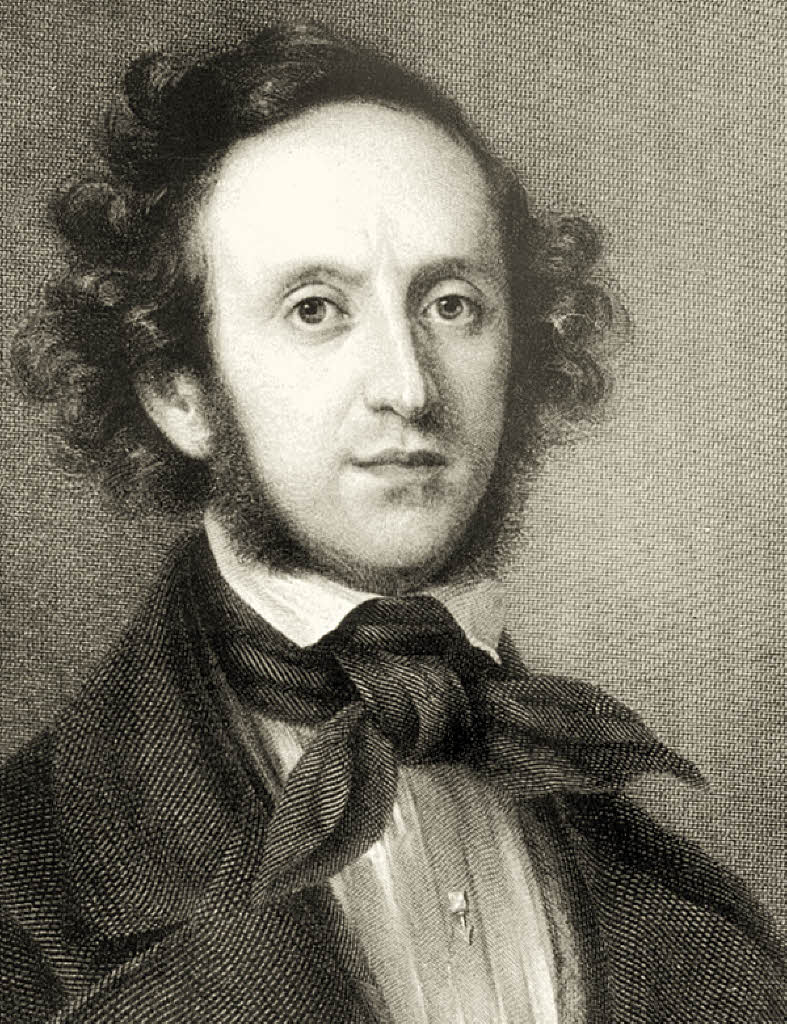
Felix Mendelssohn, the child of a wealthy Jewish merchant family (which was pressured to convert to Lutheranism) was a musical prodigy.  His wealthy parents were patrons of the Arts, and encouraged young Felix (and his older sister Fanny) to pursue their musical talents from a very early age.  The engraving on the right is the representation of him that is most convincing to me.

Felix began composing as a child, and at around the age of sixteen, produced one of the greatest jewels of German music, namely the Octet for Strings, for four violins, two violas, and two violoncellos ('cellos).  This is all I'm going to say about Mendelssohn; suffice it to add that he was instrumental in the revival of interest in Johann Sebastian Bach (who had died in 1750), with a performance of Bach's St Matthew Passion in Leipzig.  [More about Felix Mendelssohn at a later time.]

The Octet is an interesting piece in many ways.  Its performance generally requires two string quartets to cooperate, and given the busy lives of modern music professionals (and their competitiveness), this is a lot to expect.  [Some quartets, for instance the Emerson Quartet, have chosen to double-track themselves, playing all eight parts.  This seems a choice of doubtful wisdom.]  However, the music is so sublime that despite the fact that it has been performed by such great musicians that it is ever harder to contribute something new and different to the many treatments the work has received over the years, performers cannot resist trying.

I recently put a (copy of) my own Octet CD in my car stereo, and my ears complained.  I have been a fan of authentic period performance for many years, and I had bought the best performance I could afford, namely that by Hausmusik.  But now, because of age or the characteristics of my car speakers, I wanted something a little more mellow.  Gut strings are all very well, but it seemed to me that the idiom of Mendelssohn's Oktet would be equally well served by modern, steel-strung violins, violas and 'cellos, as well as it has been with period instruments.  (Often, with music, one sees a composition to do justice to which one needs a new kind of instrument.  At other times, one looks again at a composition, and wonders whether the old instruments might have been better, after all.  You have to keep searching.)

At any rate, I went to the Amazon website, where I could compare different recordings, and here is what I found.

Auer & Kodaly String Quartets (Naxos, paired with Max Bruch Octet)
Good sound; first movement a little slower than most (14:16); mellow sound; excellent playing all round.

Jascha Heifetz & Co. (Sony, paired with the Mozart G minor Quintet)
Good sound with extraordinary stereo separation; brilliant phrasing. Mellow sound, simply because it is an older recording, and the frequency range is smaller.  Still, an exciting performance, and the one I chose to buy.

Academy of St Martin in the Fields Chamber Ensemble, with the late Iona Brown (Philips, paired with one of the Mendelssohn String Quintet, also a wonderful piece)
Good sound, and excellent playing as always.  (The Academy rose to prominence with their recordings with amazing string playing with modern instruments, and later their interest in historically informed performance albeit still with modern instruments.)  Very reasonable speeds; e.g. the first movement is almost as deliberate as the Naxos recording (13:56).  The composer's speed indication is "Moderato, ma con fuoco" which means, as you might guess, "At a moderate speed, but with fire."  Unfortunately, the idea of fieriness is often conflated with the idea of high velocity, and it's interesting how different ensembles deal with the composers apparently conflicting indications.

Hausmusik (EMI, paired with two Mendelssohn Quintets, and Quartet No. 2)
I might not have exactly this recording, but I do own Mendelssohn's Octet by Hausmusik.  The playing there (and in the little Amazon website clip) display an edgy playing to which I was trying to find an alternative; hence this exploration.  On a large stereo system, the edgy playing sounds plausible and interesting, but in the car (where I do a lot of listening) the playing sounds just a little more harsh than I would like.  Given that the sound is a little harsh (as if they were playing close to the bridge, for extra brilliance), the playing is excellent.  After all, Monica Huggett and her troops must have reasoned, Mendelssohn played melodiously is a bit of a cliché.

Melos Ensemble of London--Is there another one? (EMI, Paired with Beethoven Septet and Octet, and the Schubert Octet for wind and strings)
A great recording and performance.  I'm just beginning to notice that these more traditional performances manage to allow the first violin to soar just a bit more than the more modern (authentic) performances such as that or Hausmusik.  In the Hausmusik performance, all eight parts are defiantly equal, while my ear seems to prefer that the first violin should be allowed a little space (in complete contrast to my usual preference in most matters).  The first movement here is the most restrained in pace of all: 14:47.  This double album might be the choice for people with a conventional ear and taste.

Whew.  There are so many recordings that I'm running out of steam.

Some of the recordings on Amazon are of orchestras playing the Octet.  This one is an transcription of the first movement.  The Octet --in particular the third movement Scherzo-- is so popular that it has been transcribed for full string orchestra (which is not hard; you just need to give one of the 'cello lines to the Basses) and even full orchestra, with flutes and clarinets and stuff.  The Academy has recorded it this way, and it sounds fabulous, but of course it's not the same.  Here's a transcription of the third movement:


The Russian string orchestral version is a little wild; I guess they took the "con fuoco" to heart.  (But is it Art?)

I'll possibly add more to this post, but this is an exhausting topic, and probably of interest only to a few readers!  Go to it, kids; you can't go wrong with one more copy of The Octet!

Arch

Final Jeopardy

Final Jeopardy
"Think" by Merv Griffin

The Classical Music Archives

The Classical Music Archives
One of the oldest music file depositories on the Web

Strongbad!

Strongbad!
A weekly cartoon clip, for all superhero wannabes, and the gals who love them.

My Blog List

Followers