Monday, February 20, 2012

Kathleen Ferrier

.
In October 2008 I blogged about the late Kathleen Ferrier, the wonderful British contralto, who died in 1952 of throat cancer.  I posted a few cuts from her albums on YouTube (in violation of their policies, no doubt), and I occasionally get notified about comments to those posts, almost invariably happy to have found the link, and lamenting the death of Ms Ferrier.  She was universally loved in her time, by all accounts.

In addition to the clips I provide in that post (linked above), here are some more video clips of Kathleen Ferrier on YouTube that I like:

  • "Father of Heaven" from Judas Maccabaeus
  • "Erbarme dich" from the Matthew Passion
  • Blow the wind Southerly (unaccompanied)
  • "O Thou that Tellest good tiding to Zion (Handel), possibly one of the most joyful arias ever written:

  • "Nun will die Sonn", from Mahler's Kindertotenlieder; dirges for a dead child.

  • "Silent Night", the arrangement I hear in my dreams! (Francis (Franz) Grueber):

  • "Agnus Dei" from the St John Passion (J. S. Bach):
  • Qui Sedes ad dextram patris, uploaded by me

  • "Du bist die Ruh", Franz Schubert
  • "An die Musik", Franz Schubert

"Deconstructing Academe": Do we need an entire FIELD for this?

.
Well.

I think this will be the last post I make on this topic.

Read the article.  Lots of people have been worried about higher education, evidently starting in the 1990's (though you have to realize that people have been worrying about this as long as there has been higher education, and people to worry about it).  Let me make a list of things that worry me, personally, about this whole business.

  • I too worry about labor conditions in universities.
  • The main question is: does a university education truly work?
  • A related question is: does a freshman know what he is going to get in a university?
  • Academics are famously jealous of academic freedom.  This principle attempts to ensure that a professor is able to express views that differ from those of the home institution, without risking his employment.  But doesn't the institution have a right to control the curriculum?  Doesn't the instructor have a responsibility to coordinate his teaching with his colleagues, in such a way that it makes sense in a holistic point of view?  Is it right that the professor be the sole arbiter of the extent to which this obligation violates academic freedom?
  • In practice, (or so at least many professors will claim,) professors work harmoniously with their colleagues so that students do receive a beautifully coordinated education, from the academic point of view.  However, in hard times, schools compete with each other to offer sexier programs that appeal to students and their gullible parents, such as Web Design, and Video Game Programming, and High Fashion Marketing, in other words, occupations related to the myriad ways in which students have wasted their time in high school.  (One can imagine a college major in Vampire Fiction for Teen Audiences, With A View to Getting A Movie Deal.)  Doesn't the interest of the institution in attracting students with such programs war with the interest of the faculty in providing a well-rounded education, and the interests of the government in supporting higher education that will create an educated and employable workforce and a knowledgeable citizenry?  (Conservatives have an easy answer to this: lower taxes, so that those who can afford it can get any education they damn well want, and just stop worrying about the citizenry, ok?  We're going to take our business overseas, anyway, and we're more worried that kids overseas have the education we need for our labor force.)
  • Universities need young faculty, who can be underpaid and overworked.  Other universities are perfectly happy to provide these, but these people need PhD's.  But it is difficult to provide on-demand PhD's, because they have got to do what is called research.  Yet other universities are perfectly happy to provide graduates who have already done research in college.  This often means Googling a lot of stuff, and then verifying via library books a certain proportion of the information you have Googled.  For a PhD, however, every discipline makes its own rules; Googling is completely out (except for some young fields, where Googling is totally in, and which shall remain nameless).  All your research has to be original.  This means books are not much use, either, but research journals are ok.  But the best idea is to create a whole new field, such as Criticism of Higher Education.  A lot of these modern fields would seem to fulfill the need for providing a topic that someone can earn a PhD in, so that some school has one more young PhD that they can chain to the oars for a few years.
To summarize, I do believe that it is good to study education; there are huge problems with it.  Though it is possible that universities know the problems with higher education, but it is also possible that they are powerless to change matters from within the system.

University accrediting agencies are in somewhat a better position for steering the entire education industry (even though these agencies consist of members of universities).  At the moment they are more concerned with being a sort of Better Business Bureau for colleges and universities, which is certainly one important service they can provide the education consumer.  This document outlines their concerns for the last few years.  It does reveal some preoccupation with the minutiae of college governance, and less concern with some of the bigger questions that they presumably feel inadequate to address, or consider to be outside their mandate.

Kids have to learn some basic things that will enable them to function beyond the kid level: write grammatically, obtain information efficiently, understand people outside their immediate experience: foreigners, historical figures, people of different political views than themselves, people of different religions and philosophies, members of the opposite sex and/or differing sexual orientation, war veterans.  Kids need to practice complex reasoning, so that they can understand sophisticated arguments, and see through a certain amount of bullshit.  (Kids who can see through all bullshit might actually be dangerous.)  Kids need to know a little science, because they have to make up their minds about climate change, environmental pollution, and things that threaten the safety of their families and their community and themselves.  They need to appreciate art and music at a deeper level, because it helps preserve sanity, and binds one to one's fellow man (if you think that is a good thing).  But how to do this efficiently?  How can we organize education in such a way that it doesn't take up all our resources?  But do we need a new field to tell us what is wrong with what we have?

Arch

Tuesday, February 14, 2012

Star Wars: A Weird Feeling of Regression II

.
Now that you know the story (see previous post), a few remarks about the movies.

The first episode that was released (Episode IV: A New Hope) was a ground-breaking piece of cinema.  The concept of the movie cycle, conceived in multiple parts, was somewhat new for science-fiction-fantasy; the special-effects which, though they depended on miniature models and careful photography, were an enormous improvements over the techniques used in earlier movies (e.g. Stanley Kubrick's 2001: A Space Odyssey) and Star Trek.  The ever-present pair of robots were a whole new generation of successors to robots that had appeared in earlier films.  The Storm Troopers, the infantry of the Empire, were an anonymous pack of entities whose only sign of humanity were their voices.  But already, their very uniformity paved the way for things to come, such as the clone warriors of Episode II.

[Added later: How did they show what the Millennium falcon saw through its screens as it whizzed past an enormous Star Destroyer?  A camera was conducted past the suspended model of the star destroyer.  But the camera was suspended in such a way that its motion was controlled by a computer, which jinked and banked as the Millennium Falcon was supposed to be doing.  This was a new innovation; in the past, cameras could only be simply dollied past the stationary miniature model. ]

But, beyond special effects, we must talk about style.  The Empire fleet vessels and personnel were sleek and antiseptic in appearance, subtly signifying robotic entities, entirely under the control of the Emperor and Darth Vader.  In contrast, the Rebel fighters appeared derived from terrestrial models, essentially updated versions of Allied troops from WWII.

In Episodes V and VI, the special-effects gradually improve, still making use of miniatures (and stop-action animation using poseable figures).  One of the biggest tools in their chest, of course, was the ability to blend the special-effects animation with the live action using computer smoothing.  By the time Episode VI rolled round, more and more was being done on the computers.

All of us fans waited impatiently for the prequels, Episodes I, II and III.  By the time Episode I was released, the computer animation game had progressed far beyond the imagination of anyone in 1977.  The improvements all had to do with computer animation.

In traditional animation, e.g. early Mickey Mouse, the lead artist would rough out a sequence of figures that represented the stages in an action sequence.  They would correspond to points of rest, actually; e.g., a running figure would be represented as each foot hit the ground.  These were called the key frames.  All the slides that were required to depict the figure in between the key frames were assigned to a second animator.  The process of creating these "in-between" slides was called "tweening".
Now, if desired, the chief animator could tweak the "tween" transparencies to make the action jerk in a special way, or just leave the tweening as it is.  Next come special artists, who clean up the artwork, and other artists who ink in the outlines and fill in the colors, etc.

Today, it can be done automatically.  We could even do it in PowerPoint, given infinite patience and time.  For instance, we can create a stick figure, and move the control points slightly, to move the figure, or even change its shape: see at right.

The same technology that is available to PowerPoint is used in animation software.  There, in addition to helping us create the individual figures, the software automatically interpolates the tweening.  A mathematical formula is used to move each part of a figure from one position to the next, along a straight line, if desired, or along any curve.  (This can actually be done in PowerPoint as well!  You can have any slide element move along any desired path--within limits.)

All this innovation meant that, by the time Episode I was ready to hit the screen, they had used pure animation to create the scores of robots who appeared in that movie.  (Decrepit remnants of these military robots (Battle Droids) appeared in Episodes IV, V and VI as cantankerous "civilian" robots, venting their spleen on defenseless fellow-robots.  Their synthesized voices are unmistakable! Added later: I must confess I can't find a single reference to vintage battle droids being used in Episodes IV, V and VI, though there are interesting-looking vintage droids in many scenes, e.g. inside the Jawas' mobile warehouse, and inside the bunker of Jabba the Hut.  By the way, robots are called "droids" throughout the cycle.)

More interestingly, the overall effect of the Prequels is smoother, more stylish, more polished.  The old-style robots couldn't talk as fine as C3PO (built by Darth Vader in his earlier existence, don't forget), but they looked far more modern than did either C3PO or R2D2.  The latter two robots, who were present in every episode, look like model T Fords, compared to the battle robots of Episode I, which look like a Prius, although heavily armored.

But more importantly, Lucas (George Lucas, the creator of Star Wars) seemed to deliberately view the Old Republic as a beautiful civilization in its full flowering, a renaissance time, a cultural zenith.  To help in this effort, he actually used some beautiful buildings in Spain as locations for the Prequels.  An example is the use of the Plaza de España in Seville:


Next we see a depiction of the Mos Eisley town on Tatooine, where a lot of the action of Episodes I and IV and VI takes place:

As we consider the series of movies from Episode I to Episode VI, the incidence of scenes of grandeur such as the Palace of the Naboo become less frequent, and desert outposts such as Mos Eisley, and the Moon of Endor become more common.

To summarize, the style of the Prequels reeks of Baroque beauty, while the style of Episodes IV, V and VI is all military might and resistance fighters and desert camps, and ancient spaceships.  (It is a pretty good trick to make a space-ship look ancient, admittedly.) The point is that the Star Wars cycle starts off in beauty and ends in ruins, even though, plot-wise, we have a hopeful new beginning.

Afterword
George Lucas opened up the development of the post Episode VI Star Wars "universe" to fan writers, i.e. writers who wanted to independently continue to develop the story beyond the end of the movie saga.  I regret to report that though, in essence, it involves the new government led by Leia and Luke and Han Solo, at last look the galaxy is as dangerous a place as it used to be, though the central government is now in friendly hands.

Arch

Star Wars: A Weird Feeling of Regression . . .

.
I was recently watching the Star Wars cycle with my wife, starting with the oldest movie (Episode IV), through Episodes V and VI, wrapping round to Episode I, in the order in which the movies were made and released.  First, I will summarize the story, for the benefit of anyone who might have not figured it out.  Bear in mind that the setting is a multi-planet civilization, and we should think of the planets as if they were far-flung countries in the world in which we live.

I
The story opens in the Capital Planet of Coruscant, in a hoary civilization that is so ancient that the planet has evolved into a single enormous city.  (This is amplified in the printed novels that have been released to accompany the movies.)  Coruscant is supposed to be a beautiful city/planet, just beginning to fall into decline.  We see the Senator for Naboo, a minor planet, discussing the fact that his planet is being blockaded by a business conglomerate called The Federation.  It is difficult to notice, but the Senator seems only mildly concerned about the blockade.  Two Jedi Knights eventually set out for Tatooine, to help force an agreement between the Federation and the planetary government.

We see the bridge of the main ship of the blockade, with the Federation bosses talking to the Planetary ruler, young Queen Amidala.  She is angry, because evidently food is in short supply.  Soon afterwards, we see these same Federation bosses talking to someone (long-distance) on the Capital planet, Coruscant.  It is a long while before we learn that the shadowy figure, promising support for the Federation bosses, and issuing orders, is in fact the Senator for the very planet that is being blockaded, Senator Palpatine.

The Jedi arrive, and are captured.  Senator Palpatine (via long-distance hologram) tells the Federation bosses that the Jedi should be no problem.  Eventually, as the Jedi become difficult to control, he asks that they should be killed.  Meanwhile, he is also assuring the Queen that she should make a settlement with the Federation, since Coruscant is too far away to send help from.

To cut a long story short, the Jedi Knights escape, steal a spacecraft, and land on the planet.  They make their way to the planet city of the Naboo, home to the Queen, just as the Federation decides to land and attack the planet.  The Jedi rescue the young Queen and a few members of her entourage, and escape in their small craft.  Among the Queen's ladies-in-waiting is young Padme.

In the uproar surrounding the escape from Naboo, the little spacecraft needs to go to ground, and the Jedi choose the very minor desert planet Tatooine, supposedly in the middle of nowhere.  There they discover that a main component of the engines of the little spacecraft need to be replaced.  They get help from a little slave boy, Anakin, and his mother.  The little boy appears to have a physiological peculiarity that the Jedi look for in youngsters who should be trained as Jedi.  The kid wins a major race, and with the winnings, the Jedi secure the part they need, and the freedom of the little kid.  The mother has to remain behind.  In the course of the action, Padme, a girl of about 15, and the little boy (about 7) become close.

With the repaired ship, our small band goes to Coruscant for help.  There they find that the Senate is in a stalemate.  Palpatine takes them under his wing, oozing charm and assurances, and maneuvers the Queen into calling for a vote of no confidence in the Supreme Chancellor of the Senate.  Amazingly, Palpatine himself is elected Supreme Chancellor a few days later.  He is disappointed when the young Queen decides to depart, in disgust.  Meanwhile, the Jedi organization has met and examined Anakin, and reluctantly decide to train him, even though he is deemed too old.

Responding to desperate pleas from Naboo, the little group leaves for Naboo, and somehow destroy the invaders.  Palpatine arrives afterwards, and congratulates them on overthrowing the invaders.  But the Jedi who led the revolt is killed, and his apprentice, Ben Kenobi, takes Anakin under his wing, to train him.  Surprisingly, "Padme", the young handmaid of the Queen, is revealed to be the Queen, and another young woman has been masquerading as the Queen (at the behest of the Queen).

II, III
In the next two episodes, the friendship between little Anakin Skywalker and Queen Amidala (Padme) ripens into love, as Anakin comes into manhood.  However, as a Jedi, Anakin suffers setbacks and frustrations, since he has an impatient temperament.  All his weaknesses are blamed on Ben Kenobi's ineffective training, supervised by none other than Master Yoda, the diminutive ancient being.  Senator Palpatine has Anakin's mother murdered, deliberately to embitter young Anakin.  Several Jedi defeats at the hand of the Sith, a rival group that gets its strength from the so-called Dark Side, frustrate Anakin further.  Anakin marries the Queen.  But as Anakin's frustrations grow to insurmountable proportions, Palpatine succeeds in persuading him to come over to the winning side: the Sith.  He names himself Darth Vader, and gives up all connections to his former self, including his dead wife.

Palpatine declares himself Emperor, and dissolves the Senate.  With Anakin at his side, he embarks on a rule of repression and terror.  Before Queen Amidala died, she had given birth to twins.  The Emperor sets Anakin to hunt down these infants, but Ben Kenobi has separated them, and hidden them away.

IV
One of Anakin Skywalker and Queen Amidala'sdeath star inside a little robot, R2-D2.  R2-D2, and C3-PO, a robot that Anakin Skywalker had built, and which had come into the possession of Leia, are placed in an escape pod, and fired off to Tatooine.  The Princess is taken on the ship to be interrogated by Darth Vader.  (At this stage, since this is the first of the episodes released, we are unaware that Darth Vader is Leia's father.  Neither of them are aware of it, either.)

The robots land on the planet Tatooine surface.  It is many years after we see the place, and the main city has grown.  It is mainly controlled by the gangsters called Huts, and there is little law and order.  In a remote farm, a young boy called Luke Skywalker lives with his uncle and aunt.  He accidentally comes into possession of the robots, and sees a brief clip from a holographic video the Leia has made, asking for help from one Obi Wan Kenobi.  The only Kenobi Luke knows is Ben Kenobi, who lives some distance away.  Ben manages to get the robot to release the entire message, and Luke is drawn to the holographic image of the Princess.  Returning home, Luke finds his home destroyed.  He decides to go with Ben to rescue the princess.

The Princess is rescued, with the help of a smuggler called Han Solo, who is being sought by the Hutts for being late with a fee.  The plans are delivered to the Rebels, and the death star is destroyed.  But Ben Kenobi is killed in a duel with Darth Vader.

V
Luke narrowly escapes a battle on an icy planet in the Hoth system, and hears Ben Kenobi's voice encouraging him to travel to the swamp planet of Dagobah, where Jedi Master Yoda has retired.  Luke trains with Yoda.  Meanwhile, Leia and Han seek shelter with Lando Kalrissian on a certain gas planet.  When they arrive, they find that Darth Vader has set a trap for them there.  Han is frozen in a block of Carbonite, and shipped off to Tatooine, where his debtors want him.

Luke has a feeling that Leia is in trouble and goes to find them.  He encounters Darth Vader, who has recognized him as his son.  Together, Darth Vader says, we can rule the galaxy.

Lando and Leia evade Darth Vader, rescue Luke, and rejoin the Rebels.

VII
The Empire has built a second death star, near the moon of the planet Endor, home to the Ewoks.  Han, Leia, R2D2 and C3PO end up on the moon, meet the Ewoks, and get ready to attack the power station on the moon which generates the shield that protects the death star, which is in stationary orbit around the moon.  The Rebellion has planned an attack on the death star, and the little advance group has undertaken to disable the shield in time for the attack.

Luke gives himself up, insisting that he can enlist the aid of Darth Vader to neutralize the death star.  But the Emperor, Palpatine, has arrived, and is eager to turn Luke to the Dark Side.  As the Emperor's needling of Luke turns vicious, Darth Vader snaps, and hurls the Emperor into the power shaft of the death star, a sort of well that leads to the central power source of the structure.  The Rebellion, which had emerged from light speed into the space around the death star too early, had been taking a beating.  But the advanced group, belatedly, disable the shield with the aid of the Ewoks, and the death star is destroyed.  Luke escapes just in time, with Darth Vader's body.

There is much rejoicing.

Thursday, February 9, 2012

The Future of Education in America

.
As we have been discussing over the last several years, what I am seeing in American education is troubling in many ways.  As with any observation about the USA, it is almost impossible to generalize broadly (except for the general statement that generalization is impossible).  A number of connected facts are unarguably true:

  • Students are not graduating from either high school or college with as much academic capability as their predecessors from about 20 years ago.
Of course, what makes sense for a young person to know today is a lot different from what made sense 20 years ago.  But today's graduate arguably knows a smaller percentage of what we would expect them to know than the graduate of the nineties knew compared to what we expected back then.

  • Students are far more selective about what they engage with in the classroom than in earlier years.  They are more likely to shrug off the fact that they are clearly bored in class.

    Students have always been complacent about being bored in class.  Read a book or two in the popular literature, and one gets the impression that the best one can say about a classroom is that people are bored.  This is accepted without remark because it is such a common expectation.

    • There is a tendency to blame teachers and professors for the fact that students are uninterested in class work.  There is also a related tendency to glorify websites and videos that feature people teaching material that students would normally expect to see in a classroom.  

      It is the same --putatively boring-- material, but some little factor, perhaps the voice of the presenter, or the pace of presentation, or the colors being used in the diagrams, or the time of day at which the video is being watched makes the video far more effective than a live presentation.

      What does this mean?  Students are less tolerant of factors that were considered minor in the past: what the instructor was wearing, what colors the instructor uses on the chalkboard, what time of the day it is ...  Students are getting very picky.

      I had a friend who was criticized by his students for wearing a green sport coat.  I suppose a green sport coat is not the ideal choice of jacket for an instructor, but to remark on it as a formal criticism of the class goes too far.  I myself have had teachers with annoying adenoidal voices, who dressed like slobs, who taught at that horrible hour right after lunch.  But we compensated in other ways; we studied together, to offset the fact that we couldn't all pay attention every minute during the hour.

      • Many students consider themselves "visual learners".  But this characteristic evidently does not extend to being able to make sense of text.  You can write a sentence on the chalkboard and outline it in red, but there are often a few students who miss a significant syntactical or semantic element in the text.

      Students cannot grab the sense of something they see, either in a book or on the screen, unless perhaps the subject is something entirely un-academic, such as a piece of gossip, or something of personal interest.  The ability to get something subtle from text is gradually being lost.

      It is pointless to blame high-school teachers; they can't fix up a student over a single year.  Reading is truly at least 50% the responsibility of the family.  If the family does not read, it is unlikely that the child will be a wonderful, mature reader.  (What do I mean?  I mean if you take 100 kids whose families do not read, less than 25 of them will end up reading at the inferential level.  There will be a few who transcend the limitations of their backgrounds, to be sure.)  Kids must be convinced of the value of reading (and of books) over the six or seven summers between Kindergarten and 9th grade when they are not totally too busy to read.

      Have you ever got one of those jokes on e-mail?  Have you got one which screams that it is the FUNNIEST THING THE SENDER EVER SAWPASS IT ON TO EVERYONE IN THE UNIVERSE?  I mean, it's a bunch of jokes, so if they're funny, you'd probably pass them on, right?

      But the sender has no confidence in your ability to see the humor in it, so it has to be pointed out in the hugest font the e-mail system will allow.  Does this tell us anything?  Will Mathematics texts have to be printed this way, say, so that kids will actually notice the stuff?

      Arch

      Tuesday, January 31, 2012

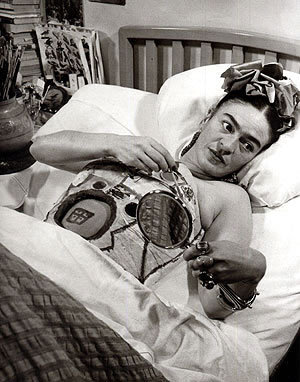
      Frida!

      .
      Left: Frida Kahlo;  Right: Salma Hayek as Frida
      My daughter gifted my wife and me with a big 32" TV, and we have been watching a lot of movies.  We tend to fight about what movies to watch; I tend to watch movies without a lot of violence, whereas she watches movies that are widely considered to be of high quality, even if the movie contains parts that are frightening or disgusting.  What does that tell you?

      Anyway, I happened to pick up a recent DVD of the Frida movie of 2002, starring Salma Hayek and Afred Molina, arguably two of the most talented actors of the times.  (I'm not giving you a link; you can buy the movie, rent it at Netflix or Amazon, or go to a theater to see it if it is shown near you.)

      This (perhaps surprisingly) is the first movie that I have seen with Salma Hayek in it, and I was amazed.  In my estimation, she was Frida; either their personalities matched well, or ... what can I say.  When I see Charlton Heston as Michaelangelo, I am totally persuaded.  Perhaps Salma Hayek was convincing because she is Mexican--indeed Frida Kahlo was half Hungarian Jewish by birth, which could explain some of the wonderful passion and creativity that flowed from her (children of mixed ethnicity are often very creative, for cultural or genetic reasons; who can tell?).

      To know the historical person Magdalena Carmen Frieda Kahlo y Calderón, one has to have met her, or at least, read her writings, and contemporary accounts of her friends and acquaintances.  In the movie, we see her through the eyes of the director, primarily (Julie Taymor), and Salma Hayek herself.  Having only seen the movie, my remarks are about the character portrayed there.

      Frida Kahlo (the name Kahlo is possibly a Mexicanization of a German-Jewish name such as Kähler) in the movie comes across as a person suffering chronic pain, but whose warmth and vitality is largely irrepressible.  Through careful choice of material, Julie Taymor and her writing team (see the credits on the IMDB website) have tried to depict the major forces that shaped the personality and the motivations of this remarkable woman.  But more amazingly wonderfully, the design of the movie steals from the work of both Frida Kahlo and Diego Rivera; the choice of colors, the rich clay-reds, the vibrant blues, the dull browns, greens and greys that work so beautifully in the backgrounds of murals are used skillfully, to immerse one in a sort of Frida-Diego-ness that is satisfying.  One is transported to that time and place (Mexico in the early years of the 2oth century), and this sort of experience always leaves its mark on me.

      Frida was an important figure in Western Culture of the 20th century.  She was, naturally, interested in gender issues, even if gender issues were not her central preoccupation.  The women's movement of the last quarter of the 20th century fastened on figures such as Frida, as an example of (possibly unintentional) victimization.  However, feminism and women's homosexuality were inextricably related in the 90's, and feminists whose concerns did not extend to gay rights were embarrassed by Frida's ambiguous sexual orientation.  At the time the movie was made, most people were far less threatened by bisexuality in general.  We had successfully disconnected pedophilia from homosexuality, and in the light of the 21st century, some of Frida's escapades seem far less weird.  The problem, indeed, is to reconstruct their weirdness in context.

      The person who emerges is warm, ultimately patient, loyal, motherly, affectionate, and surprisingly outward-focused, for one who suffered lifelong pain.  Salma Hayek could not help but portray Frida as an essentially lovable person, even if when the subject was alive, she may have been more palatable at a distance than up close in person.

      [Added later: the movie I saw was in English, and in the present-day idiom.  Not knowing what is come down to us of Frida's style of speech, I cannot comment on how apt the choice of voice for Frida is, in the movie.  But she speaks a fluent "Hey guys," sort of idiom, which seems appropriate for a person who frequented bars and hung out with the boys, and the bohemians of the time.  Is it more important that we should be true to the facts, or that we should be given a representation of a person that we can understand?  Perhaps the memory of an historical person who was difficult to understand is not well served by a biographical film that makes that person accessible--and I can imagine even that observation being far from axiomatic.  But in the case of Frida, I doubt that she was difficult to understand.  Perhaps it was some of the ways in which she was transparent that were difficult to tolerate by her contemporaries, but there is little doubt that she was greatly loved in her lifetime.]

      In addition to the brilliant performances of Salma Hayek and Alfred Molina, we have a host of the best and brightest in the acting world contributing beautifully understated performances to support them: I recognize Geoffrey Rush, Ashley Judd, Antonio Banderas, Valeria Golino, Lila Downs, Mia Maestro, and even Didi Conn.  (Please forgive me if I fail to identify some names with which I'm not personally familiar.)

      In keeping with the art world of Frida Kahlo, the movie has surreal elements that underscore the artistic settings.  The stinging analyses of contemporary socialists and Marxists are nevertheless affectionate and plausible.  (It is startling to realize how modern American intellectualism has most of the Marxism purged from it; how is this possible?  Philosophy has taken on some of the dogmatic aspects of Theology, I'm afraid.)  Again and again one is startled into remarking how various sights and visions Frida sees and has find their way into her paintings.  The movie may fall short for those who knew Frida personally, but to me, it is a work of art.

      Arch

      Thursday, January 26, 2012

      The State of The Union

      .
      I'm writing on Thursday; last Tuesday was the State of the Union address by Barack Obama.

      Anyone elected president of any nation, including this one, could do many things.  (I use the masculine personal pronoun, though obviously the president in question may be either gender.)

      01.  He could set a high moral tone, as an example to his people.
      02.  He could initiate legislation for the good of all.
      03.  He could set in place regulations that favor those in a narrow sector of the population in which he has support.
      04.  He could conduct foreign policy that serves the narrow interests of his own nation, or a sector within his nation.
      05.  He could conduct foreign policy to maximize the chances of peace among nations, and minimize the likelihood of war.
      06.  He could indulge in belligerent and bellicose rhetoric, to inflame the hotheads among his constituents.
      07.  He could indulge in aggressive campaigns to redistribute wealth among his people.
      08.  He could encourage structures and regulations that give the illusion of superior education of the nation's youth, while creating scapegoats of teachers who have incurred the dissatisfaction of their students, deservingly or undeservingly.
      09.  He could ensure that the members of the privileged classes continue to enjoy the privileges they have.
      10.  He could ensure that those in greatest need have the aid they require to offset the disadvantages of their circumstances.
      11.  He could discourage the poor and indigent from bettering their conditions by giving them handouts.
      12.  He could write off the poor and indigent if they make clear that they have no intention of meeting society halfway, and helping to help themselves.
      13.  He can cooperate with his political opponents to the extent that they are willing, to solve problems in which they have a common interest.
      14.  He can depict his political opponents in the worst possible light, as being uninterested in compromise for the greater good.
      These last two are the most difficult:
      15.  Given the fact that many societies do not have the machinery to provide employment to all their citizens as a matter of course (Full Employment), a president can work within the structures he inherits to prevent massive loss of employment due to economic catastrophes.
      16.  He could seek ways of avoiding economic catastrophes in the future, by regulating the mechanisms of business investment.

      I list these here, without any judgment as to whether Barack Obama has or has not done any of these things.  And we must weigh which of these actions we would support, and which of the Republican Candidates are likely to do them; and similarly with actions we would oppose.

      Watching and listening to President Obama addressing the Joint Chambers of Congress in the State of the Union address, (affectionately called the SOTU,) it was hard to avoid noticing that the tone of the speech was infinitely more gracious and “presidential” than any of the Republican candidates could equal.  Reagan, in 1980, was the last great Republican who was concerned with setting a positive tone, and who looked “Presidential”, and more importantly, used a rhetoric that we would not be ashamed of.

      Furthermore, (speaking of the SOTU,) I was struck with the fact that, while the Republican candidates, in their several debates, treated their audience as if they were ignorant hicks, incapable of verifying facts and understanding sophisticated reasoning, President Obama may have been challenging, even aggressive, but did not speak down to his audience.  If I were a Republican, I might have resented the reproachful tone of some of his remarks.  But I would not have felt patronized.

      The Republican rhetoric that has begun to fly about appears to be aimed at ignorant, bigoted high-school dropouts.  It is all jingoism, racism and chauvinism; mere posturing to attract an audience that has been encouraged to feel threatened by society and the economy.  The Republicans are addressing themselves to a constituency that is on the defensive, their backs to the wall.  And why?  Because they have been persuaded that the various forces that have caused them trouble (the economy, the housing bust, the unemployment, the expensive wars being fought, the decline in the quality of goods) were not caused by the very folk who steer the Republican Machine, but by some bogeymen who are Democrats in disguise.  In fact, they have been persuaded to view things that will help them as things that will hurt them.

      The Republican leadership has managed to persuade some of the poorest white Americans that Food Stamps helps mostly African Americans, despite the incontrovertible fact that many white folks enjoy the benefit of food stamps.  I myself, in my poorer days, was glad to avail my family of the few food stamps for which we were eligible, by virtue of qualifying for the WIC program, which is intended to assist young children and pregnant women to head off possible medical problems that could arise later, due to poor nutrition.  The WIC program deserves the highest possible praise for its effectiveness and its fiscal efficiency in terms of bang for buck.

      In the first few years of the life of our little baby, we took her to the Well-Baby Clinic, which ensured that she received inoculations on time, and which monitored her health in various ways.  There was a good balance of racial and ethnic types at the clinic, and one could not accuse any minority of taking a disproportionate amount of services from that clinic.  And the constant chant of fiscal conservatives is that we cannot afford to continue to provide these services.  They insist that it is more important to allow the top-earning 1% of the population to pay less than 15% in Federal Taxes than to provide these sorts of services.  (See the interview of Elizabeth Warren by Jon Stewart for more information about these sorts of issues.)

      Gingrich interviewed by a Cuban TV host.
      In addition, some candidates have been heard pandering to right-wing extremists who wish to escalate aggression towards communist states such as Cuba.

      In short, the Republican candidates speak as though they seek the votes of ultra-conservative, ultra-warlike, independently wealthy people who are indignant about the high taxes that they pay, but are upset about the unemployment situation.  Why would independently wealthy people be upset about unemployment?  Perhaps they deplore unemployment from a purely altruistic point of view.  Quite cynically, is this possible?  Independently wealthy folk are more likely to be employers than employed.  The worse the unemployment, the cheaper is the cost of labor.  Wealthy business owners ought to love that!

      No; the fact of the matter is that somehow the GOP has persuaded folks who are poor and only marginally employed that it is a good thing for millionaires to pay low taxes.  They think this will translate into low taxes for everybody.

      Finally, it is becoming clear that the power of lobbyists is out of control, and the lobbying reform has not changed matters at all.  Banks and Insurance companies can afford powerful lobbyists (some of whom are actually former members of Congress).  And the caliber of people we elect to Congress is such that they cannot resist the force of the lobbyists.  In many cases, it is well known, lobbyists actually write the legislation.

      In an atmosphere of extremism and manic hostility, Barack Obama projected a refreshingly calm, confident, reasonable image.  One is amazed that the chosen ones of the GOP have forgotten how to do this.  What has happened?  Obama has taken ownership of the centrist position that the more enlightened conservatives were accustomed to adopting, leaving them with nothing to distinguish themselves from him.  As a result, they have assumed ultra-conservative postures that are steadily alienating moderate Republicans and Independents.  Liberals (and ultra-Liberals) within the Democratic Party must weigh the relative value of keeping to their Republican hostile rhetoric, versus making the centrist positions of Obama a comfortable home for disenchanted Republicans.  However, we must bear in mind that centrist Republicans are the first to bail out when a Democrat president inches even slightly to the left, or even the perceived left, such as proposing Health Care Reform.  Read Glenn Greenwald's post about this peculiar development for a better explanation.

      It is so difficult to deal with an electorate that absorbs hype more readily than logic!  But this is the brave new world we live in.

      Arch

      Final Jeopardy

      Final Jeopardy
      "Think" by Merv Griffin

      The Classical Music Archives

      The Classical Music Archives
      One of the oldest music file depositories on the Web

      Strongbad!

      Strongbad!
      A weekly cartoon clip, for all superhero wannabes, and the gals who love them.

      My Blog List

      Followers